ADDAC System ADDAC101 (2010–2018)
The first Eurorack module that made digital sampling feel like a natural extension of analog patching—clunky rules and all.
Overview
There’s a moment when the SD card error LED blinks four times and shuts off—just once, cleanly—and you know the machine has accepted your files. It’s a small victory, but one every ADDAC101 owner remembers. Because before that, you’ve wrestled with FAT16 formatting, renamed your samples from “drum_loop_1.wav” to “a.wav”, and deleted hidden system files that macOS loves to sprinkle across storage. But when it works? You’re suddenly playing back a field recording of a Lisbon tram through a low-pass filter, modulating its playback speed with an LFO, and the whole thing feels less like digital intrusion and more like alchemy.
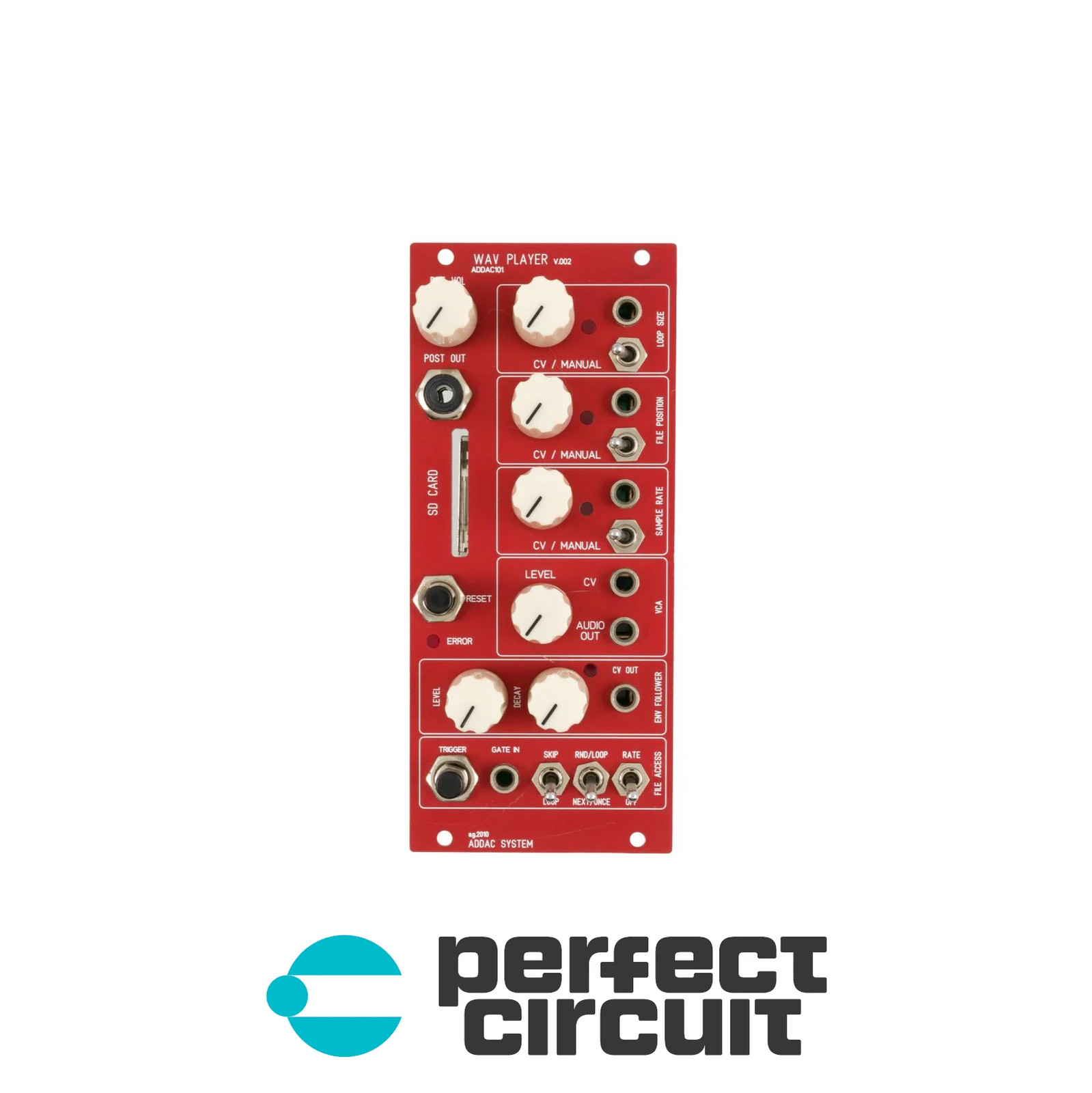
The ADDAC101 .WAV Player wasn’t the first sampler in Eurorack, but it was among the first to make the idea feel accessible. Released around 2010, it arrived when modular synthesis was shedding its purely analog dogma and letting in digital quirks. This module plays 22.05kHz, 16-bit mono samples from an SD card—modest specs by modern standards, but more than enough to inject texture, rhythm, and unpredictability into a patch. You can’t load a full orchestral stem, but you can loop a creaking door, reverse a whisper, or stutter a synth hit until it becomes something new. What it lacks in fidelity, it gains in character: the sample rate manipulation creates gritty pitch bends, and the lack of interpolation gives transients a jagged, almost tactile edge.
It sits in the ADDAC lineup as the entry point to their digital experiments—below the expanded Ultra .WAV Player (ADDAC111), which added stereo, higher sample rates, and more CV control. But the 101 was the trailblazer, the one that proved sampling could be tactile, voltage-controlled, and musically useful without needing a touchscreen or a menu dive. It’s not a ROMpler, not a workstation—it’s a sound mangler with rules, limitations, and a certain stubborn charm. And while newer modules offer seamless SDXC support and micro-USB loading, the 101 demands you slow down, follow its naming convention, and respect its quirks. That friction, oddly, is part of the appeal.
Specifications
| Manufacturer | ADDAC System |
| Production Years | 2010–2018 |
| Original Price | €279 |
| Format | Eurorack |
| Width | 11 HP |
| Depth | 5.5 cm |
| Power Supply | ±12V or ±15V |
| Current Draw | 150mA max |
| Bus Board Connector | 8x2 IDC (Doepfer style) |
| Sample Format | WAV, 22.05kHz, 16-bit, mono |
| Storage | SD card (FAT16 formatted) |
| Max Files per Card | 72 |
| Minimum Files Required | 2 |
| Max File Size (b.wav) | 500 KB |
| File Naming Convention | A.wav, B.wav, ..., Z.wav, 0.wav, ..., 9.wav, AA.wav, BB.wav, etc. |
| CV Inputs | Loop Size, Initial Position, Sample Rate, VCA Amplitude (0–10V) |
| Gate Input | Threshold: 2.5V |
| Outputs | Pre-VCA audio, Post-VCA audio, Envelope Follower CV |
| Playback Modes | Loop / One Shot, Forward / Random |
| Additional Features | Jumper hack for digital glitch effect (sample rate delay loop) |
Key Features
Sample Playback with Analog Control
The ADDAC101 treats samples like modular building blocks. You’re not sequencing a track—you’re manipulating fragments in real time. The four main parameters—loop size, initial position, sample rate, and VCA amplitude—are each controllable via front-panel knobs or CV inputs, making it easy to patch in LFOs, envelopes, or sequencers. Want to sweep through a vocal sample like a resonant filter? Modulate the initial position. Want to drop the pitch into sub-bass territory? Slow the sample rate. The lack of anti-aliasing means pitch shifts come with digital grit, but that’s often the point: it’s not clean, it’s expressive.
Envelope Follower as a Modulation Source
Buried in the back panel specs but front-and-center in utility is the envelope follower CV output. It tracks the amplitude of the post-VCA audio signal and outputs a control voltage that can drive filters, VCAs, or modulation targets elsewhere in your system. Play a percussive sample, and you’ve got a trigger source. Play a swelling pad, and you can modulate a filter cutoff in time with the dynamics. It’s a feedback loop in the best sense—your sample’s behavior directly shapes the behavior of other modules.
The Jumper Hack: Controlled Digital Corruption
Flip a switch, and the ADDAC101 stops playing nice. The jumper hack—accessed via three pins on the rear—introduces a deliberate delay in the sample reading process when the sample rate CV is active. This isn’t granular synthesis in the modern sense, but it creates glitchy, stuttering artifacts that feel more like circuit bending than algorithmic processing. The effect is subtle at first, then chaotic when pushed. It’s a nod to the DIY ethos of early digital experimentation, where bugs became features. And because it requires a physical reset to engage, it feels like unlocking a hidden mode—something you don’t stumble into by accident.
Historical Context
When the ADDAC101 launched, Eurorack was still dominated by analog oscillators, filters, and VCAs. Digital modules existed, but many felt clinical or overly complex. The 101 arrived with a clear mission: bring sampling into the modular world without sacrificing hands-on control. It wasn’t trying to compete with Akai workstations or laptop DAWs—it was offering a new way to think about sound sources. Around the same time, Make Noise’s Morphagene was in development, but that module wouldn’t surface for years and approached granular synthesis with far more abstraction. The ADDAC101 was simpler, more immediate, and more forgiving of mistakes—provided you followed its file rules.
Its closest competitors weren’t other samplers but modules that expanded sonic possibilities through texture: Livewire’s Wave Recorder, Toppobrillo’s Variable Sample Rate Monitor, or the later Qu-Bit Nebulae. But the ADDAC101 stood out for its balance of accessibility and depth. It didn’t require firmware updates, USB cables, or proprietary software. You loaded samples on a computer, dropped the card in, and pressed reset. That simplicity made it a favorite in live setups, where reliability mattered more than infinite features. It also helped that ADDAC, based in Portugal, cultivated a cult following through limited runs, custom panel colors, and a distinct visual identity—gold, green, and matte black front panels that stood out on any rack.
Collectibility & Value
The ADDAC101 is no longer in production, having been succeeded by the ADDAC111 Ultra .WAV Player, which offers stereo playback, higher sample rates, and more flexible file handling. But the 101 remains desirable for its raw character and cult status. Used units typically sell between $250 and $350, depending on condition and whether they include the original box or a custom panel. Gold and green panels command a slight premium, especially if unmarked by rack wear.
Common failures are rare but notable. The SD card slot can degrade with frequent swapping, leading to read errors even with properly formatted cards. Some units exhibit power draw issues when used with daisy-chained power cables, though this is often resolved with a fresh bus board cable. The biggest headache isn’t hardware—it’s the file system. Owners report frustration with macOS and Windows leaving behind hidden files (.DS_Store, System Volume Information) that trigger the error LED. The fix requires cleaning the card with command-line tools or third-party apps like Hidden Cleaner (now deprecated) or ADDAC’s own beta renaming utility. It’s a quirk that feels outdated today, but it also forces users to engage with the machine on its terms, not theirs.
Before buying, test all CV inputs, verify the envelope follower responds to dynamics, and confirm the jumper hack produces audible artifacts. Also check that the reset switch reliably clears the error LED after card swaps. Units with bent pins or oxidized jacks are common in older stock, so inspect the rear carefully. For those who value immediacy over convenience, the 101 is still a compelling choice. But if you hate file naming conventions or need stereo playback, the ADDAC111 or modern alternatives like the Critter & Guitari Organelle (in modular mode) are better bets.
eBay Listings
As an eBay Partner, we earn from qualifying purchases. This helps support our independent vintage technology research.