ADDAC System 701 (2012–2019, Rev2: 2019–2023)
A no-nonsense analog oscillator that nails vintage stability without sacrificing character—like a Moog on a precision diet.
Overview
Plug in the ADDAC System 701 and you’re not greeted with flashy lights or digital wizardry—just a thick, confident sine wave that holds its ground like it’s been rehearsing for decades. This isn’t some boutique oscillator trying to sound “vintage” through DSP trickery; it’s an analog circuit built to track like a metronome while still breathing with that warm, slightly unpredictable soul analog fans crave. Early adopters in 2012 found a module that felt like it had been pulled from a late-'70s ARP or Moog system, but with a level of tuning stability that would’ve made those engineers weep. It’s not trying to be exotic. It’s trying to be right—and it mostly succeeds.
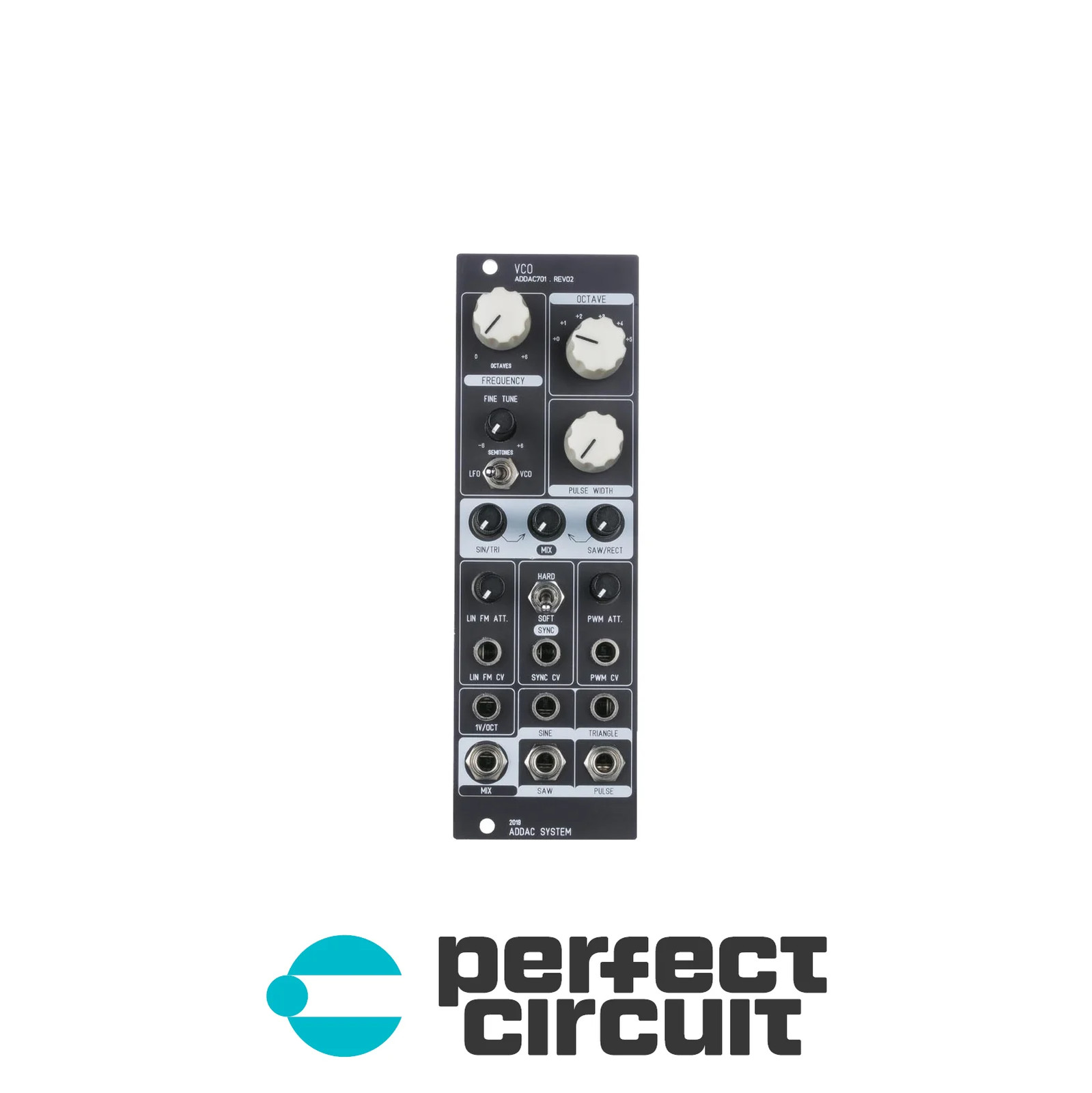
The original 701 was built around the CEM3340 VCO chip, a legendary integrated circuit that powered countless classic synths from the Sequential Circuits Prophet-5 to the Oberheim Xpander. ADDAC didn’t try to reinvent it—they just built it cleanly, with high-quality components and a thoughtful front panel layout that puts control within intuitive reach. You get coarse and fine tuning knobs, a six-position octave switch (rare in Eurorack at the time), and a 1V/Oct input that tracks across a claimed seven octaves with impressive accuracy. The waveform outputs—sine, triangle, sawtooth, and pulse—are all present and accounted for, each with their own dedicated jacks, which means you can route multiple waveforms from a single oscillator without resorting to mults or sacrificing headroom.
By 2019, ADDAC revisited the design with the 701 Rev2, addressing one of the original’s few real weaknesses: long-term tuning drift. The Rev2 swapped in CoolAudio’s modern reissue of the CEM3340, a chip that mimics the original’s behavior but with tighter tolerances and better thermal stability. They also refined the triangle-to-sine conversion circuit, which in the original could sometimes introduce slight artifacts under heavy modulation. The result? A module that not only tracks better but also delivers a cleaner sine wave—critical for FM applications or when you need a pristine sub oscillator source. Owners report that the Rev2 holds pitch through temperature swings that would send lesser oscillators into wobble, making it a solid choice for live use or complex patches that demand reliability.
Specifications
| Manufacturer | ADDAC System |
| Production Years | 2012–2019 (Original), 2019–2023 (Rev2) |
| Original Price | €450 (Original), €158 (Rev2 kit), ~$173 (Rev2 assembled) |
| Format | Eurorack |
| Width | 8 HP |
| Depth | 35 mm |
| Power Consumption | 60 mA (+12 V), 60 mA (-12 V) |
| Oscillator Type | Analog VCO (CEM3340 / CoolAudio CEM3340) |
| Control Voltage Input | 1 V/Oct |
| Frequency Range | 6 octaves (coarse), 12 semitones (fine) |
| Octave Range | 6 positions (switchable) |
| FM Input | Linear FM with attenuator |
| Sync Input | Switchable hard/soft sync |
| PWM Input | Pulse width modulation with attenuator |
| Waveform Outputs | Sine, Triangle, Sawtooth, Pulse, Mixed |
| Mix Section | 3-knob mixer (SIN/TRI, MIX, SAW/RECT) |
| LFO Mode | Switchable VCO/LFO mode |
| Weight | ~200 g (assembled) |
Key Features
Onboard Waveform Mixing – A Rare Practical Touch
Most oscillators give you discrete waveform outputs and leave the blending to your mixer. The 701 doesn’t. It includes a dedicated three-knob mix section that lets you blend sine and triangle, sawtooth and pulse, then crossfade between those two pairs. This isn’t just a convenience—it’s a sound design tool. You can create hybrid waves on the fly, morphing from a soft sine-triangle blend to a gritty saw-pulse stack with a single knob. Some users lament that the mix isn’t CV-controllable, which would have opened up dynamic waveshaping, but the manual control is still powerful. It’s especially useful when you’re layering in a filter or external processor and want to fine-tune the harmonic content before it hits the next stage. It’s a feature more common in digital oscillators, but here it’s implemented in pure analog—no compromises.
Octave Switching with Real Utility
In a world where most Eurorack oscillators rely solely on coarse frequency knobs, the 701’s six-position octave switch is a godsend. It’s not just about convenience—though being able to jump octaves without overshooting your target is huge—it’s about stability. When you’re sequencing or tuning multiple oscillators in unison, the tactile click of a switch gives you confidence. No more guessing whether you’re a semitone high. The switch covers six octaves, and while some users noted that the original had two unmarked positions beyond the labeled range (functionally repeating the top octave), it was still more precise than twisting a knob into oblivion. The Rev2 retained this design, cementing it as one of the few Eurorack VCOs that treats octave selection like the serious tuning tool it should be.
LFO Mode with Caveats
The 701 includes a VCO/LFO toggle switch, letting you drop the oscillator into low-frequency modulation duty. This is handy for freeing up space in your rack, but early Rev2 units had a quirk: the octave switch didn’t behave the same in LFO mode as it did in VCO mode, leading to tuning inconsistencies when used with sequencers. Some owners reported that this caused drift or unexpected frequency jumps when patched into clocked modulation sources. ADDAC acknowledged the issue and corrected it in later production runs by changing a capacitor value. If you’re buying used, this is worth checking—especially if you plan to use the module heavily for modulation. Later Rev2 units and all post-fix modules don’t exhibit this behavior, making them more reliable for rhythmic or sequenced patches.
Historical Context
The ADDAC 701 arrived in 2012, right as Eurorack was shifting from niche curiosity to full-blown synth renaissance. At the time, many modules were either minimalist utility designs or over-engineered digital beasts. The 701 stood out by being neither—it was a focused, no-compromise analog oscillator that prioritized tuning stability and sonic integrity. It wasn’t trying to be the most feature-packed or the most experimental. Instead, it filled a gap: a reliable, Moog-style VCO that could sit comfortably in a modern rack without demanding constant recalibration.
It competed directly with modules like the Doepfer A-110-1 and the Intellijel Dixie, both of which also used the CEM3340 or its variants. But while the A-110-1 was barebones and the Dixie added extras like a sub oscillator, the 701 carved its niche with superior build quality and thoughtful layout. ADDAC, a Portuguese company with roots in hybrid analog-digital systems, positioned the 701 as part of their “Analog Heritage” line—modules that paid homage to classic circuit designs while updating them for modern reliability. The 701 wasn’t a clone, but it shared DNA with the oscillators that defined the golden age of analog synthesis. It was also one of the few Eurorack VCOs at the time to include both octave switching and onboard waveform mixing, features that felt more at home on a vintage ARP or Oberheim than in a 3U case.
By 2019, the market had changed. Behringer’s clones had driven prices down, and many users expected more features for less money. ADDAC responded with the Rev2, slashing the price dramatically—especially in kit form—and streamlining production. The shift from a premium boutique module to an accessible workhorse reflected broader trends in the Eurorack ecosystem, where reliability and value were becoming as important as rarity.
Collectibility & Value
The original ADDAC 701 is now a collector’s item, with used prices hovering between $300 and $450 depending on condition and provenance. These early units are prized for their build quality and historical significance—they represent a time when Eurorack was still boutique, and every module felt like a handcrafted instrument. However, they’re not without flaws. Some original units suffer from tuning instability over long sessions, especially in environments with temperature fluctuations. Owners report that recalibration is occasionally needed, and spare CEM3340 chips are becoming harder to source. If you’re buying one, test it across multiple octaves and with sustained play to ensure it holds pitch.
The Rev2, in contrast, is still relatively common and sells for $150–$200 used. As a kit, it was priced at just €158, making it one of the most affordable high-quality analog VCOs ever made. This accessibility has led to widespread adoption, but also means that condition varies wildly—especially with DIY-assembled units. Poor soldering, incorrect component placement, or missing calibration can turn a great module into a tuning nightmare. If you’re buying a used Rev2, ask whether it was professionally built or tested. Look for signs of overheating, cold joints, or misaligned panels. The good news? Most issues are fixable with basic troubleshooting, and the circuit is well-documented.
One thing to watch for: early Rev2 units with the LFO mode bug. If the seller can’t confirm it’s a post-fix version, assume it needs the capacitor mod. While the fix is simple, it’s an extra step for buyers who just want a plug-and-play module. For those reasons, the safest bet is a post-2020 Rev2 or a well-tested original. Neither will appreciate much in value, but both will deliver excellent performance for years.
eBay Listings
As an eBay Partner, we earn from qualifying purchases. This helps support our independent vintage technology research.