Marantz SR4500 (2004–05)
A budget 7.1 receiver that Marantz's own service department spent three years apologizing for in writing.
Overview
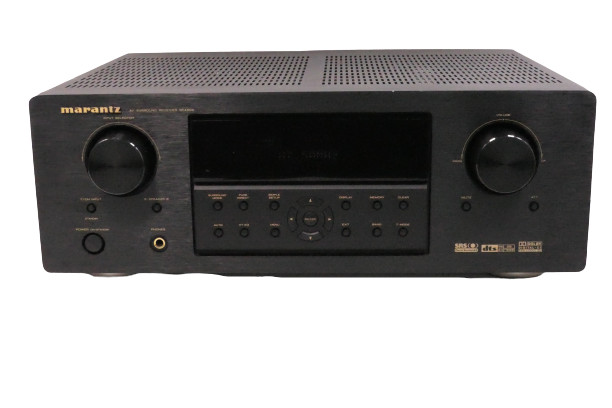
The SR4500 arrived in 2004 and left in 2005 - a two-year run for a 7.1-channel A/V surround receiver that sat near the bottom of Marantz's lineup, below the SR5500 and SR7500 in the company's own full-line brochure. It was not a flagship and Marantz never pretended otherwise. According to the owner's manual, it had a fully discrete seven-channel amplifier section rated at 80 watts per channel of high-current amplification, sold in either black or brushed silver with an all-aluminum front panel. Budget receivers from this period usually wore plastic. This one didn't.
The 80-watt rating is the number on the box. It is not what the amplifier actually delivers. Sound & Vision's HT Labs measured the SR4500's left channel from the CD input to the speaker output with two channels driving 8-ohm loads. They found it reaching 0.1% distortion at 100.4 watts and 1% distortion at 114.6 watts. The gap between the printed spec and the bench is conservative rating on an amp that is over-built for its price class.
Seven channels of discrete amplification at this price point in 2004 was not a given. Most budget receivers of the era used chip amps or shared power supplies that collapsed under multichannel load. The SR4500's manual describes an amplifier section built around a massive EI power transformer paired with oversized filter capacitors. That explains where the measured headroom comes from. Owners report the thing runs warm and heavy for its class, which fits a power supply that isn't cutting corners.
Key Features
Current Feedback Amplifier Topology and HDAM-SA3 Modules
Marantz equipped the SR4500 with its current feedback amplifier technology, a design the company claimed ensures precise and powerful sound reproduction even at high volume levels. The receiver also carries Marantz's HDAM-SA3 amplifier modules, proprietary discrete circuit blocks used for signal handling instead of off-the-shelf op-amps. Whether a listener can hear the difference between HDAM-SA3 and a generic input stage depends on taste and system. The modules are a real Marantz signature, and they don't appear on competitors' budget chassis.
Massive EI Transformer with Oversized Filter Capacitors
The power supply is the least glamorous part of any multichannel receiver. The SR4500's manual makes a point of the EI transformer and the oversized filter caps, and the measured power output backs up the claim. An EI-core transformer is heavier and more expensive than the toroidal or laminated alternatives used in cheaper designs. The oversized capacitors let the amp recover quickly between transients instead of sagging when all seven channels are working. That reserve helps most with inefficient bookshelf speakers in a small room.
HT-EQ Home Theater Equalizer Circuit
Audioholics noted that the SR4500 includes Marantz's HT-EQ home theater equalizer circuit, a processing stage intended to deliver room-filling home theater audio. HT-EQ is a fixed voicing curve rather than a full parametric EQ. It's a switch, not a tool. Listeners either find it helpful for dialogue intelligibility at low volumes or leave it off. It's a period-specific Marantz feature and one of the few processing tricks in the receiver that isn't a licensed Dolby or DTS mode.
Surround Format Support: Dolby Digital EX, Pro Logic IIx, DTS 96/24
The SR4500 decodes Dolby Digital, Dolby Pro Logic, Dolby Pro Logic IIx, and Dolby Digital EX, and supports DTS 96/24 as well. Pro Logic IIx was the important one in 2004. It expanded stereo and 5.1 sources to 6.1 or 7.1 channels, which made a seven-channel receiver useful before 7.1 source material existed. DTS 96/24 support meant the receiver could handle the higher-resolution DTS variant on DVD-Audio and concert discs. It can also be used as a 7.1 processor.
Simple Setup Button and Automatic Surround Mode Selection
Marantz included a SIMPLE SETUP button that, when pressed, causes the receiver to determine the surround mode corresponding to a digital input signal automatically. It's a small convenience, but it means you can hand the receiver to a family member without a manual. The setup menu also walks through speaker size and distance calibration. The manual's speaker setup section notes that frequencies below approximately 100 Hz are routed to the subwoofer when a channel is set to "Small," which is standard bass management for the era.
Digital and Analog Connectivity
The receiver provides three digital RCA inputs, which was adequate but not generous in 2004. That's enough for a DVD player, a cable box, and a game console, with nothing left over for a CD transport. The tuner section covers FM and MW bands. Buyers who needed more digital inputs were looking at the SR5500 and SR7500, and that's presumably how Marantz intended it.
Historical Context
The SR4500 sits in Marantz's 2005 full-line catalog on page 7, below the SR5500 on page 6 and the SR7500 on page 5. That ordering is the entire documented relationship between the three models. The SR4500 was the entry point to Marantz's multichannel receiver range, not a derivative of anything above it. One seller listing describes the model as representing the era when Marantz designed equipment to Hi-Fi standards without making concessions to budget. That's a sales pitch rather than a verdict, though the aluminum faceplate and discrete amplifier section give it more substance than most such claims.
Collectibility & Value
The SR4500 has not become a collector's item, and the market reflects that. A Greek listing on Vendora priced a unit described as like-new at €160 in August 2026. Russian classifieds show the receiver bundled with a DV4500 DVD player as a package deal, and another listing pairs it with a Microlab V3650 speaker set and a PSB SubSonic 5i subwoofer — the kind of whole-system sale that suggests these are being moved by people clearing out a parent's home theater rather than by enthusiasts hunting a specific model. That's not a knock on the receiver; it's just what happens to competent mid-tier gear from 2004.
Repair information is thin but not nonexistent. A Ukrainian YouTube repair video titled "Marantz 4500 ремонт. клацає реле" documents a relay-clicking fault, which is the classic symptom of a protection circuit tripping - often a failing output stage, a shorted speaker connection, or dried capacitors in the power supply. Given the receiver's age, electrolytic capacitor replacement is routine maintenance any buyer should expect. One Russian listing notes the unit was "all working and after maintenance."
Marantz issued at least four service bulletins for the SR4500 between 2004 and 2009. They covered incorrect part numbers in the service manual's mechanical and electrical parts lists, an omitted surround-back speaker connection method in the user guide, and the addition of the main microprocessor software as a spare part. None of these indicate a design flaw. They're documentation corrections. Still, anyone servicing an SR4500 should check for updated part numbers before ordering replacements, particularly for the volume knob assembly and the DSP IC.
eBay Listings



As an eBay Partner, we earn from qualifying purchases. This helps support our independent vintage technology research.
Related Models
- Marantz 1090
- Marantz 10B
- Marantz 1120 (1971–1977)
- Marantz 1180
- Marantz 1200B