Marantz 1120 (1971–1977)
Sixty watts per channel doesn't sound like much on paper. The 1120 was known to put out 15 to 20 percent more than that, which is why owners call it underrated in the literal sense as well as the figurative one.
Overview
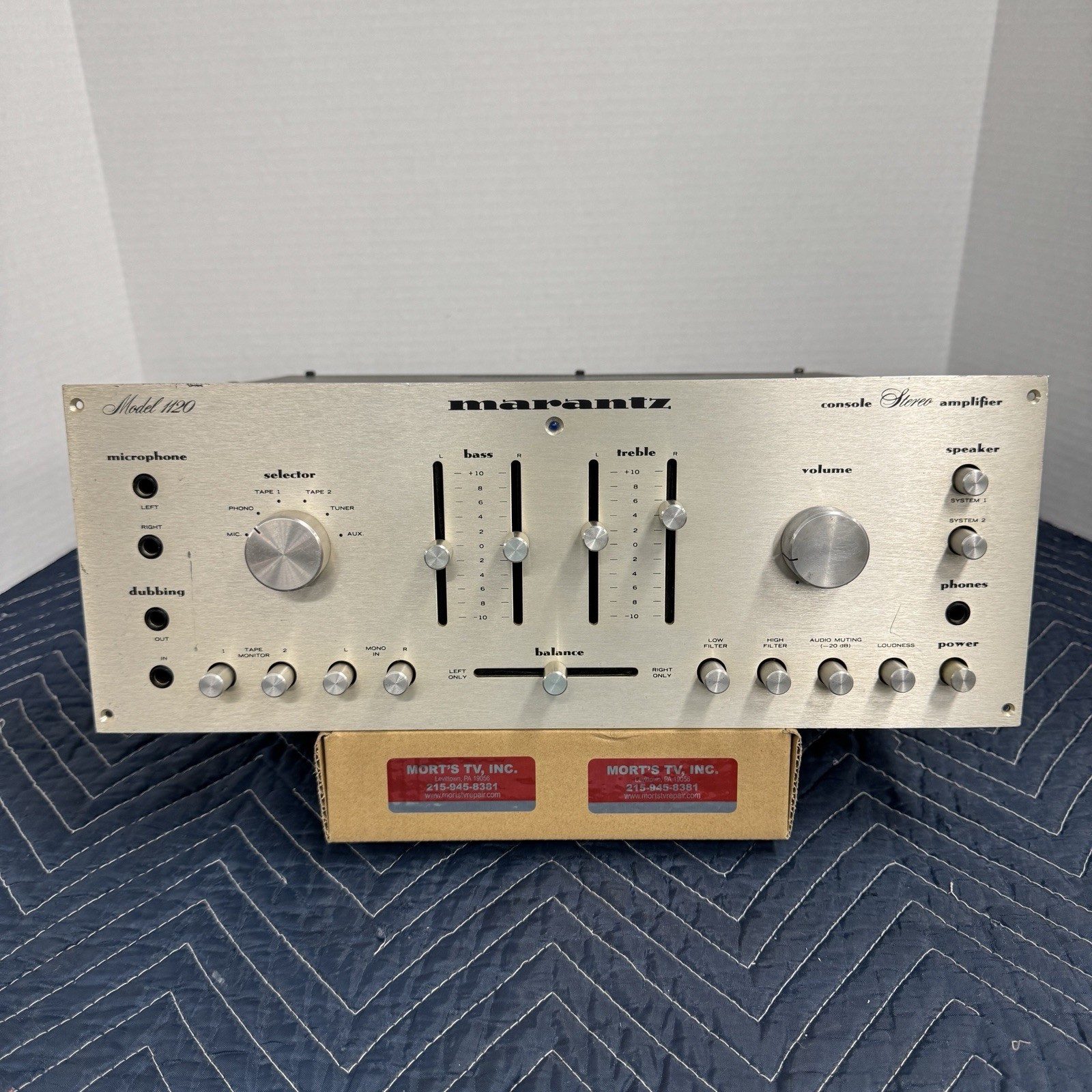
The Marantz 1120 is an integrated amplifier. Marantz's own materials and period listings variously call it a stereo integrated amplifier or a console stereo amplifier, and it arrived as one of the company's first full-size chassis integrated designs. It was introduced in 1971 at $349.00 and was the top model in the line at the time. Marantz built it to compete with the best Japanese separates of the day, particularly the Sansui AU-9900, and positioned it in what period coverage called the medium-high power class, with some rather interesting features.
The features start at the front panel, where a built-in oscilloscope display shows the incoming signal waveform in real time. Owners treat it as a conversation piece. One notes that seeing the scope in action while playing records is maybe the biggest thing about the amp. It isn't a gimmick bolted onto a mediocre circuit, though. The 1120 is a fully discrete, all-silicon transistor design with a dual-mono output stage running from power supply through output, a toroidal transformer, and two 10,000 µF filter capacitors. Rated output is 60W RMS per channel into 8 ohms across 20 Hz to 20 kHz, though one Russian source lists 40 watts per channel, and the record doesn't resolve that conflict. The same 20 Hz to 20 kHz window holds frequency response to ±0.5 dB. Total harmonic distortion is listed under 0.2%. Some sources cite under 0.1% at 65W, but that claim circulates without a named source behind it, so treat it as folklore rather than lab data. Signal-to-noise is 80 dB, and phono input sensitivity is 2.2 mV. A separate set of figures puts input sensitivity at 1.1 mV for moving magnet and 110 mV for line inputs, with a damping factor of 30 - or, as one spec sheet phrases it, greater than 30.
The 1120's strength, as collectors describe it, is low and very well controlled bass, the kind of grip that keeps a woofer from wandering on demanding passages. The phono stage is widely praised as outstanding for its time. Owners consistently report a warm, detailed midrange sometimes compared to tube gear, plus a phono section that makes an emotionally compelling connection to the music. One long-term owner, who rebuilt a unit after admiring the 1120 since first hearing one in 1974, calls it fast and clean, with excellent imaging.
Inputs cover mic, phono, tuner, aux, and two tape monitors. Outputs include two pairs of speaker terminals and a headphone jack. The preamp and power amp sections can be separated, so the 1120 can serve as either half of a component chain with an external preamplifier or power amplifier. Gain is 40 dB for the phono stage alone, 20 dB for the tone amplifier alone, and 86 dB from phono input all the way to the speaker terminals. The whole thing measures 17.5 inches wide, 5.5 inches tall, and 12.5 inches deep, and weighs 32 pounds.
Key Features
Built-In Oscilloscope Display
The front-panel scope is the 1120's signature. It's a real-time window on the incoming signal waveform, not a decorative meter. It's the detail that turns heads decades later. Whether the scope is a known failure point isn't documented; the fact sheet is silent on that, and so is this page.
Dual-Mono Output Stage
Channel separation starts at the power supply. The 1120 runs a dual-mono topology from supply through output, backed by a toroidal transformer and a pair of 10,000 µF filter capacitors. That's a lot of iron and capacitance for a 60-watt integrated, and it's a big part of why the bass stays controlled under load.
Separable Preamp and Power Amp Sections
The pre and power stages can be split, so the 1120 works as a standalone preamplifier into an external power amp, or as a power amp fed by an external preamp. Most integrateds of the era didn't offer that.
Phono Stage
Phono input sensitivity is 2.2 mV, and the stage is widely praised as outstanding for its time. It's the most consistent compliment the 1120 gets from collectors. Owners describe it as making an emotionally compelling connection to the music. The circuit is now over fifty years old.
Tone Controls and Filters
The preamp section has per-channel bass, midrange, and treble controls plus switchable high and low filters, along with a mono/stereo switch and input selector. Period coverage of the model calls out the filters, the mono/stereo switch, and the input selector.
Cabinet and Chassis
A brushed aluminum front panel sits in a broadcast-style walnut cabinet, the look of early-70s Marantz. The 32-pound, 17.5 × 5.5 × 12.5-inch chassis is full-size, not a compact compromise.
Historical Context
The 1120 entered the market in 1971 at $349.00 as the top model in the Marantz line. Production is generally placed at 1972 to 1975 in Sunnyvale, California, the USA-built era. The research record also carries a 1971-1977 span, and owners have dated individual units to 1973 and 1974. Marantz billed the top-line U.S. amplifier with a three-year guarantee, and one owner calls it the well-built last American-made Marantz model.
It belongs to the Marantz 1000 series, a family of eleven integrated amplifiers produced at the turn of the 70s and 80s that includes the 1030, 1040, and 1060. Unlike the famous 22xx receivers, there's no tuner here, just amplification in a more compact chassis. The 1120 is effectively a preamp-equipped version of the Model 16 power amp, and it was built to take on the Sansui AU-9900 and the better Japanese separates of the day.
Documentation is thin. Marantz apparently issued no separate brochure that survives in the record, and what remains is mostly the service manual plus owner recollections. Period coverage in Audio (May 1973, p.40) profiled the 1120 alongside the SAE Mk XII and Sherwood S-7200. It noted that owners could also use the amp's tone-control and filter facilities to record a program source, a method described in the owner's manual. The manual also documents the loudness circuit's behavior, a 7 dB ±2 dB boost with the switch engaged at both 100 Hz and 10 kHz. The loudness button itself can be difficult to activate on some units.
Collectibility & Value
Marantz 1120s appear on auction sites quite rarely. When they do, the consensus is that it's a very good amplifier - good-looking, good-sounding, strong in low and well-controlled bass. Like most Marantz amps of the period it isn't cheap, but it holds its value. A clean example with original box and manual runs around $1,000. Recent asking prices span a wide range: $375 and $695 for units described as integrated amplifiers, $1,000 for a serviced and cleaned console stereo amplifier, and $50 for an upgrade kit, which suggests spare and upgrade parts are available. Individual speaker terminals and screws also turn up as spare parts.
Known issues cluster around age rather than design. Documented complaints include a power supply problem and a loud squealing sound through the speakers. One owner found low audio level on one channel at first power-up, though the same unit ran on both channels afterward with no noisy transistors. Rebuild threads circulate about caps and transformers, and units are commonly sold fully recapped. One owner's warning stands out: a 1120 bought in working condition turned out to have its insides messed up.
eBay Listings


As an eBay Partner, we earn from qualifying purchases. This helps support our independent vintage technology research.