Altec 1567A
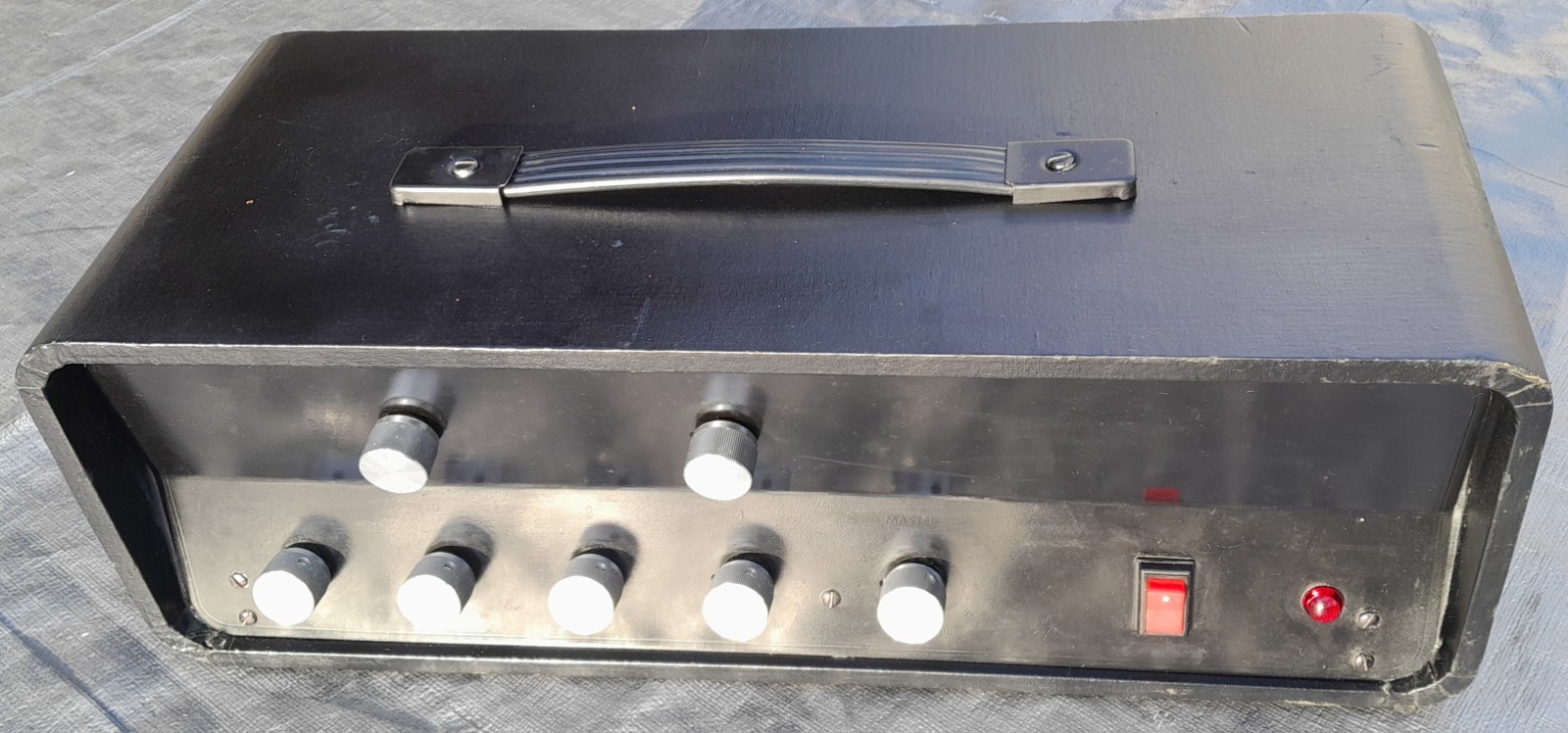
A five-channel tube mixer-amplifier with four microphone inputs, a high-level channel, and a +18 dBm output, in a rugged 5¼-inch rack chassis. It was built for permanent installations and remote broadcast alike.
Overview
The Altec 1567A was designed to be serviced while still passing program. The hinged front plate swings down without interrupting signal flow. That tells you the intended environment: broadcast consoles, recording studio monitor feeds, paging systems, and anywhere else downtime was not an option. Altec built it as a five-channel mixer amplifier with four low-level inputs and one high-level input, all tube-driven, all on a standard rack chassis that takes up just 5¼ inches of vertical space.
The control panel is plain industrial design. Raised, abrasion-resistant characters identify each channel, and bleached "write-in" blocks let an engineer label inputs with a grease pencil for a given session. The background surfaces are etched and colored in a non-glare green that is easy on the eyes under dim control-room lighting. Every control falls readily to hand with the front panel open: five mixer pots, a master gain, bass and treble tone controls, VU range switching, illumination, and power. Altec left room inside for an owner to replace the stock molded-composition potentiometers with miniature step-type attenuators. Serious users frequently made that mod to tighten channel matching.
Electrically, the 1567A is a straightforward, high-headroom design. The four low-gain channels deliver a maximum of 97 dB of gain. The high-level channel (channel 5) tops out at 55 dB and needs just 17 mV of input to hit 0 dBm at the output. Rated power output is +18 dBm, or 50 volts open circuit. Frequency response holds to ±1 dB from 30 to 15,000 cycles per second. Input impedance on channels 1 through 4 is 1 megohm. Channel 5 presents 25 megohms, which suits a wide variety of high-impedance sources. A pair of plug-in transformers adds flexibility: the 4722 for microphone inputs and the 15095 for line output. The 4722 offers source impedance options of 30/50 and 120/200 ohms, and the 15095 delivers line outputs at 150 or 600 ohms.
Noise performance on the 1567A is respectable for a tube design of its era. The equivalent input noise is rated at −123 dBm, and output noise with the master gain control fully closed measures −68 dBm. The recorder output is designed to see at least 270,000 ohms of load impedance with a maximum capacitance of 100 mmf, ensuring compatibility with the tape machines of the day. Altec's manual is explicit about grounding discipline: the circuit ground connects to the chassis at the input to prevent RF pickup on microphone cable shields from being amplified, and the company warns that any additional chassis-to-ground connection — such as a second unit sharing a rack — will introduce hum. When driving a power amplifier without an isolating transformer, the power amplifier's own circuit-to-chassis connection must be lifted while keeping the two chassis electrically bonded through rack hardware or a three-wire power cord.
The 1567A was designed to work with Altec's own power amplifier lineup. Its direct output, approximately 1,100 ohms impedance, can drive high-impedance amplifiers such as the 1568A, 1569A, 1570B, and 128B directly through up to 25 feet of low-capacitance coaxial cable without a line transformer. For longer runs or balanced connections, the 15095 plug-in transformer delivers 150- or 600-ohm outputs. Altec's normal operating procedure recommended setting both mixer and master gain controls for 14 dB of loss each, with average microphone levels then producing 0 VU at the line output. When followed by high-gain power amplifiers, the manual insists that attenuation be taken at the power amplifier's input rather than at the 1567A's master control, to preserve signal-to-noise ratio.
Altec offered a fitted carrying case, the 12866 Assembly, for portable use. The case includes two covers, two mounting brackets, and eight screws. Four of the screws attach the amplifier chassis to the brackets, and four are the chassis' own panel screws. The manual cautions not to mix the two sets, because the panel screws are only ¼ inch long while the case screws are ¾ inch. The rear cover has a small slot for routing input, output, and power cables, and it can be installed with the slot at the top or bottom depending on the wiring scheme. That suits an amplifier that might be shipped between studios or used in remote-broadcast vans.
The service literature documents maintenance on the 1567A well. The parts list shows a complement of electrolytic and Mylar capacitors, including a 50-50-50-50 mfd, 5-volt Mallory SPO 97068 unit and a 60-125 mfd, 200-25 volt Mallory FP for the power supply, along with ceramic disc capacitors and carbon-composition resistors. The manual doesn't summarize the tube complement in a single line, but the parts breakdown and circuit topology point to a design that an experienced technician can recap and restore without extraordinary difficulty. The chassis layout is spacious and the components are through-hole, so the 1567A is considerably easier to service than most solid-state successors from the 1970s.
Collectors today encounter the 1567A most often in former broadcast or institutional settings, often rack-pulled and showing the green patina of decades of control-room use. While no period magazine reviews of the 1567A were located in the available sources, the unit occupies a respected niche among tube mixer enthusiasts who value its combination of five-channel flexibility, +18 dBm headroom, and the unmistakable sonic character of Altec's mid-century engineering. Prices on the secondary market vary widely depending on condition and whether the plug-in transformers — the 4722 and 15095 — are present; units missing those transformers require hunting down replacements, which are scarce. Restoration typically involves recapping the power supply and replacing any drifted carbon-composition resistors in the signal path, but the basic design is robust and the rewards, for those who do the work, are considerable: a genuinely useful tube mixer that can drive a modern power amplifier or feed a recording interface directly.
The 1567A never appeared on album covers or in hi-fi showrooms. It was a tool, built by Altec for engineers who needed to get a signal from a microphone to a loudspeaker or a tape machine with minimal fuss and maximal reliability.
eBay Listings
As an eBay Partner, we earn from qualifying purchases. This helps support our independent vintage technology research.
Related Models
- McIntosh C104 (1950–1954)
- McIntosh C20
- McIntosh C200 (2000–2006)
- McIntosh C22 (1963–1968)
- McIntosh C35
- McIntosh C40 (1993-1999)
- McIntosh C47 (2020-present)
- McIntosh C500 (2003-2007)
- McIntosh C70 (2020-present)
- McIntosh C712 (1998-2002)