McIntosh C200 (2000–2006)
Two boxes, 34.3 kilograms of transformer and attenuator, and a volume control that moves in 0.5 dB steps. This was McIntosh's statement preamp for the turn of the millennium.
Overview
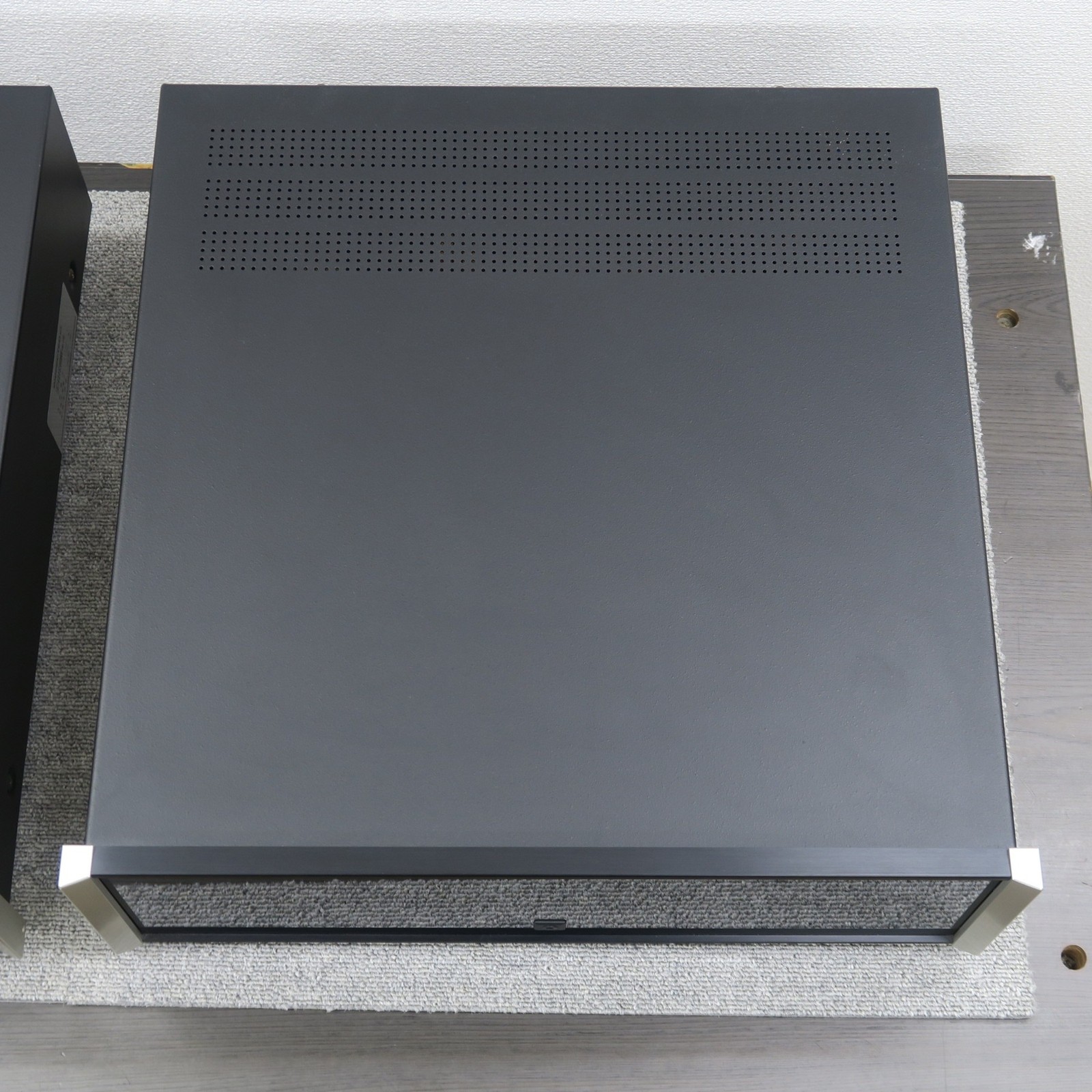
Lift the C200's control chassis and you see where the money went. At 18.4 kg, the C200C Controller weighs more than plenty of complete integrated amplifiers. The C200P Preamplifier adds another 15.9 kg. Each box measures 444 mm wide, 137 mm tall, and 508 mm deep. That's a two-chassis preamplifier taking up as much rack space as a power amp and a half, and McIntosh made no apology for it. This was the flagship, announced in 2000 and built through 2006, and it inherited its two-box architecture directly from the earlier C100.
The split isn't cosmetic. The C200C Controller holds the power and control systems. The C200P Preamplifier holds the analog signal circuits. Separating them keeps transformer hum and digital switching noise physically away from the audio path. McIntosh went further than most by putting each amplifier section on its own power supply, with dual wiring back to the signal circuit. Even the power transformer is double-shielded, wrapped in both copper and iron.
The headline numbers are strong. Frequency response runs 10 Hz to 40 kHz at +0, -0.5 dB, which is flat well past the range of human hearing. Total harmonic distortion is rated at 0.002% maximum from 20 Hz to 20 kHz at rated output. Signal-to-noise is 98 dB on high-level inputs and 86 dB on phono, A-weighted. Maximum output voltage is 25.0 V balanced, 12.0 V unbalanced. Those figures come from a single documentation source rather than an independent lab, so treat them as manufacturer ratings and not third-party verified measurements.
The connectivity is generous: three balanced and eight unbalanced input pairs, three balanced and three unbalanced output pairs, plus four switched and one unswitched AC outlet. An owner running a turntable, a CD transport, a tuner, a tape deck, and a home theater processor all at once will not run out of holes. The remote is compatible with other McIntosh CD players and tuners.
Key Features
Dual-Chassis Architecture: C200C and C200P
The two boxes are designated C200C and C200P, and the division of labor is strict. Control, power, and switching live in the Controller. The analog signal path lives in the Preamplifier. Interconnect cabling between the two is part of the package. Listings for the C200 note that the interconnecting cable is included, and a complete set should always have it, because a C200 without its cable is a paperweight until you find a replacement.
The split gives you a signal path that never shares a chassis with the transformer. Add the double-shielded transformer, copper and iron in layers, and isolated supplies for each amplifier section, and the C200 is built around one assumption: noise is the enemy, and you fight it with distance and shielding rather than with filtering after the fact.
Four Logarithmic Attenuators Per Channel, 213 Steps
Here's the detail that sets the C200 apart from nearly everything else in its class. Volume is handled not by a single pot or a single chip, but by four microprocessor-controlled logarithmic attenuators per channel. Input switching and volume control are implemented separately on the positive and negative sides of each channel. That gives 213 steps in 0.5 dB increments, with accuracy of ±0.05 dB. Three speed patterns are available: Slow, Fast, and VRV, so the knob responds the way you want it to.
In practice, 0.5 dB steps mean you can find the exact right level for a given recording. A discrete balance amplifier follows the volume stage, and a muting circuit kills the power-on and power-off thump.
Separate MM and MC Phono Stages with a Mu-Metal-Shielded Transformer
The C200 carries dedicated moving-magnet and moving-coil phono inputs with their own equalization. Input sensitivity is rated at 4.4 mV for phono and 450 mV for high-level sources, with maximum input of 50 mV on MM phono and 5 V balanced on the line stage. Input impedance is 47 kΩ for MM, 5 Ω for MC, 44 kΩ balanced and 22 kΩ unbalanced on the high-level inputs. Voltage gain runs 70 dB from MC input to tape output, 40 dB from MM, and unity on high level.
The MC stage is where the real engineering lives: a dedicated step-up transformer with silver wire windings, housed inside a mu-metal shield. Mu-metal is expensive and fussy to work with, and it's the right material for keeping a very low-level magnetic signal from picking up stray fields. Phono signal-to-noise is rated at 86 dB A-weighted. That's not the quietest number ever printed, but it's respectable for a stage handling 0.5 mV IHF sensitivity.
Gold-Plated, Gas-Filled Relay Switching
Signal switching goes through relays with gold-plated contacts, further plated in rhodium and ruthenium, and the relay bodies are filled with inert gas. Contact oxidation is a real long-term failure mode in preamps that switch low-level signals, and inert gas fill plus noble-metal plating pushes that failure out by decades. All connectors are gold-plated as well.
Power Supply: Ceramic and Electrolytic in Parallel
In the power supply, monolithic ceramic capacitors run in parallel with electrolytic capacitors. This is a classic technique. The electrolytics handle bulk energy storage, and the ceramics handle the high-frequency decoupling that electrolytics are too slow and too inductive to manage. Combined with the isolated per-section supplies and the double-shielded transformer, the supply is designed to stay quiet under load.
Setup Menu, Home Theater Pass-Through, and Non-Volatile Memory
The C200 includes a setup menu, a home theater pass-through for front left and right signals, and an extra audio output for multi-amplifier systems. A control jack can power connected McIntosh amplifiers. Holding the red power button for over two seconds triggers a microprocessor reset. Non-volatile memory retains calibration, engaged via a rocker switch, during extended disuse.
Historical Context
McIntosh announced the C200 as its flagship preamplifier, and it inherited the dual-chassis concept from the earlier C100. It arrived in 2000, three years before the MC501 monoblock amplifier. Contemporary reviewers described it as a "deadly serious, no-holds-barred control center," praising its transparency, rhythm, and tonal purity, and noting its ability to preserve musical character across the full dynamic range. It drew favorable comparison to the C220 and to other preamplifiers in its price bracket.
The historical record is thin. The C200 is new enough that it never generated the folklore of a C22 or a C20, and old enough that factory documentation has scattered. Enthusiast discussion of the model has circulated on Audiogon, Audio Asylum, and AudioKarma, and one long-running owner assessment calls it simply "a world class preamp." No independent second source in the available record corroborates any of its published specifications. Every number on this page traces back to a single documentation set. Contemporary classified listings from the period, such as those in Audio (November 1978, p.155), show McIntosh separates trading actively on the secondary market.
Collectibility & Value
Prices for the C200 land in serious territory. Recent eBay listings have shown the two-frame preamp at $6,820 and a Japanese-market 100 V example at $5,158. Neither listing includes a sale date in the available record, and no sold or completed prices were found, so treat those as asking prices rather than established market values. A wanted-to-buy listing has circulated seeking an operational C200 with the original manual, and a Reverb listing for an Italian "2 TELAI" example exists without a stated price.
Two practical notes for anyone shopping. Confirm the voltage configuration before plugging anything in. Second, original packaging, the interconnect cable between the two chassis, and the owner's manual all matter here. Complete examples surface with original boxes and documentation, and a C200 missing its cable is a problem to solve before it's a preamp to enjoy.
The record contains no information on common failures, capacitor replacement, servicing procedures, or spare parts availability. There is no technician complaint file to report, and no known weak point to warn about. That's a gap, not a clean bill of health. Nobody has documented the failure modes yet.
eBay Listings

As an eBay Partner, we earn from qualifying purchases. This helps support our independent vintage technology research.
Related Models
- McIntosh C104 (1950–1954)
- McIntosh C20
- McIntosh C22 (1963–1968)
- McIntosh C35
- McIntosh C40 (1993-1999)
- McIntosh C47 (2020-present)
- McIntosh C500 (2003-2007)
- McIntosh C70 (2020-present)
- McIntosh C712 (1998-2002)
- McIntosh C29 (1980-1983)