McIntosh C20
Eight tubes, eight inputs, and a rear-panel trim control for fighting your own listening room. The C20 was McIntosh's bid to make stereo behave.
Overview
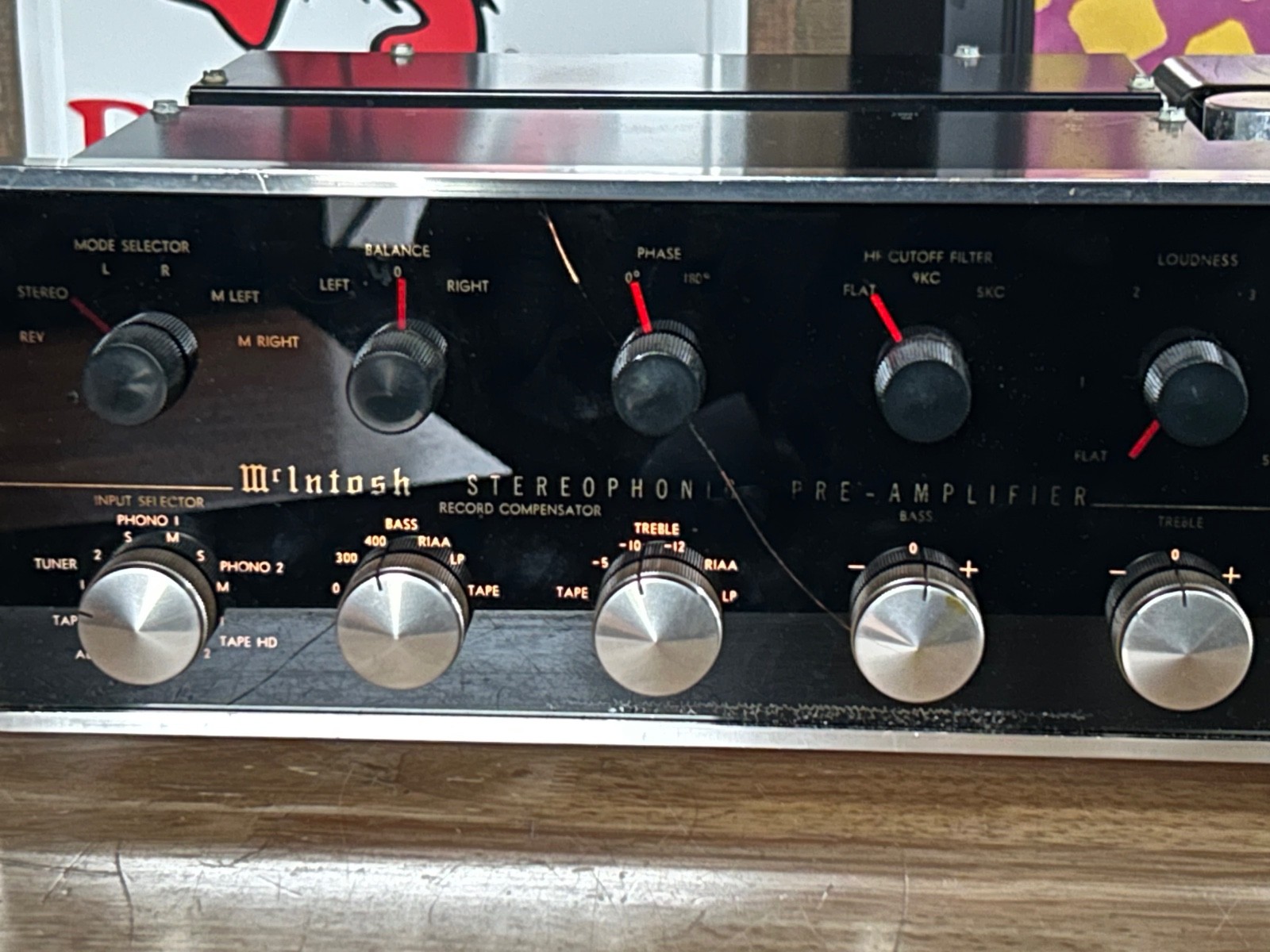
Reach around the back of a C20 and you find something most preamps of its generation never offered: a pair of LOW FREQUENCY TRIM controls, independent of the front-panel tone knobs. They bring two channels into balance against the unequal behavior of speakers and rooms. The C20 is a stereo control unit built on the assumption that the room is the problem, and the owner has to fix it.
McIntosh's own advertising in the period pushed the same theme. It billed the C20 as offering "flexibility with simplicity" and framed control flexibility as the prerequisite for getting the most out of stereo reproduction, while insisting that operation stay simple. That's marketing copy, not a verdict, but it lines up with what the manual describes. High Fidelity (October 1960, p.57) was more sober. It called the C20 an exceptionally flexible stereo control unit with complete switching and equalizing for tape, phono, and high-level inputs, and noted that under normal operating conditions distortion stayed extremely low at any output level usable with existing power amplifiers. The same review singled out the phono equalization as exceptionally accurate and praised the rumble and scratch filters, the high gain, and the low hum level.
The input count is the headline. Eight separate inputs are provided: Auxiliary, Tape, Tuner 1, Tuner 2, Phono 1, Phono 2, Tape Head 1, and Tape Head 2. There's also a Tape Compare (Monitor) input that accepts signal from a tape playback preamplifier. The Auxiliary, Tape, Tuner, and Tape Monitor inputs have a sensitivity of .25 volts and an input impedance of 100K ohms. The two phono inputs are each split into three groups. The XTAL-CERAMIC group is for constant-amplitude cartridges such as ceramic or frequency-modulated devices, with 0.1 volt sensitivity and a capacitor termination creating an extremely high impedance. The LOW group suits magnetic cartridges with output under 10 mV, at 2 MV sensitivity and 47K ohms impedance. The HIGH group is for high-output magnetic cartridges, with 10 MV sensitivity and a 70 MV maximum input voltage. If a cartridge wants something other than 47K, the manual expects you to solder a resistor across the cartridge terminals. It supplies a chart: 180K for 37K, 62K for 27K, 22K for 15K, 8.2K for 6.8K.
The tube complement, per the voltage and resistance chart, is a mix of 12AX7s and 12AU7s with a 6X4 rectifier. V1 and V2 are 12AX7, V3 and V4 are 12AU7, V5, V6, and V7 are 12AX7, and V8 is the 6X4. That's the lineup the service documentation expects you to measure against, and any technician should check it before touching a soldering iron.
Outputs come in two sets: MAIN OUTPUT to feed power amplifiers, and TAPE OUTPUT to feed a recorder. Both are fed from cathode followers, and the manual is specific about what you may hang off them. Input impedance of connected devices should be 50,000 ohms or greater, and the capacitive reactance of the audio cables should not fall below 8,000 ohms at 20,000 cycles, which is the reactance of 1,000 mmf. In practical terms, 25 mmf-per-foot cable can run 40 feet, and 13.5 mmf-per-foot cable can run 75 feet. The TAPE OUTPUT is deliberately unaffected by the Mode Selector, Balance, Phase, Aural Comp, Bass, Treble, Rumble Filter, and Volume. It is affected by the Input Selector, Record Compensator, and HF Cutoff Filter. That's a considered choice, not an oversight. A recording can be made while the room-side controls are used freely for listening.
Four A.C. receptacles sit on the rear panel. Three are switched by the volume control's on-off switch, and the fourth is red and uncontrolled, meant for a turntable or record changer. They're rated for a maximum of 600 watts total.
The Tape Compare circuit is the other piece worth understanding. With the brass push button out, the source signal passes through to the amplifiers and speakers. Depress it and the recorded tape becomes the source, an instantaneous A/B against what's being laid down. The manual carries an important warning: when Tape Compare is engaged, signal from any other source will not be heard from the loudspeakers. The Rumble Filter on the brass insert is a sharp roll-off below 60 cycles, and the button being in means the filter is on.
Balancing procedure, per McIntosh, is a fixed sequence: Input Selector to PHONO 1 M, both Record Compensators to RIAA, Bass and Treble to 0, Mode Selector to STEREO, Balance and Phase to 0, HF Cutoff Filter to FLAT, Aural Comp to FLAT. With those set, a monophonic signal feeds both sides of the preamplifier, and the rear LOW FREQUENCY TRIM controls bring the systems into balance. The C20 was designed so that once balanced, the system stays in balance through all modes of operation.
The manual has a second balancing trick. With the Treble control fully counterclockwise and the Bass control fully clockwise, rotate the RECORD COMPENSATOR control marked BASS to the TAPE position to add further boost. Then switch the Mode Selector between L and R and listen to the low end while adjusting the rear trim. That procedure is aimed at monophonic records played with a stereo cartridge, and the C20 handles that case directly. In the monophonic position of the input selector, the sides of a stereo cartridge are paralleled to cancel vertical output, which is what generates the objectionable noise when a mono record meets a stereo stylus.
Service documentation for the C20 is unusually complete for a unit of this age. A maintenance manual covers serial numbers 6L700 and above. It lists the special components built specifically for the C20: the input selector, bass and treble compensator switches, HF cutoff filter, mode selector, tape compare, tape jacks, phase switch, a 50 PIV silicon rectifier, and the power transformer, alongside the filter capacitors and the bass, loudness, balance, and rear-panel bass trim controls. McIntosh's own service note in the instruction manual is blunt. All McIntosh equipment is designed for long trouble-free operation, and components are of the highest quality and conservatively operated. If trouble develops, the unit may be serviced by a franchised dealer, a competent serviceman, or returned to the factory, but equipment will not be accepted at the factory unless return authorization is received first. Get that authorization before shipping anything to Binghamton.
Installation is shelf-mount. The preamplifier was designed to sit on a shelf, with two panel cutout templates and two shelf mounting templates supplied in the manual envelope. The front panel carries a 1/4 inch overlap to cover the edges of the cabinet cutout. Fold lines on the shelf template accommodate standard panel thicknesses up to one inch.
Market Value
┌──────────────────────────────────────────────────────────────────────────┐
│ MCINTOSH C20                                                    Nov 2026 │
├──────────────────────────────────────────────────────────────────────────┤
│ High      $3,620                                  Latest            $170 │
│ Median    $1,978                                  Trend                — │
│ Low       $59                                     Volume           ~3/mo │
├──────────────────────────────────────────────────────────────────────────┤
│ $4,000 ┤                                                                 │
│        │                                                       .         │
│        │                                .                  .             │
│ $2,307 ┤.                                .                               │
│        │                .                    .                           │
│        │                                                                 │
│        │                                             .                   │
│    $50 ┤                     ..                        .    .           .│
│        ├─────────────────────────────────────────────────────────────────│
│    vol │▄               ▄    █▄         █▄   ▄       █ ▄   ▄▄  ▄        ▄│
│        └─────────────────────────────────────────────────────────────────│
│         2026-03                      2026-05                      2026-07│
└──────────────────────────────────────────────────────────────────────────┘
eBay completed sales. Excludes accessories, parts, and non-working units. Hover points for details.
eBay Listings
Recently sold on eBay: $406–$3,300 (median $1,978, based on 13 completed sales, past 12 months)


As an eBay Partner, we earn from qualifying purchases. This helps support our independent vintage technology research.
Related Models
- McIntosh C104 (1950–1954)
- McIntosh C200 (2000–2006)
- McIntosh C22 (1963–1968)
- McIntosh C35
- McIntosh C40 (1993-1999)
- McIntosh C47 (2020-present)
- McIntosh C500 (2003-2007)
- McIntosh C70 (2020-present)
- McIntosh C712 (1998-2002)
- McIntosh C29 (1980-1983)