Adcom GFP-750 (1997–?)
A preamplifier that left out the frills, with circuit design borrowed from the Pass Labs Aleph P.
Overview
Adcom introduced the GFP-750 in the fall of 1997. An early Audio ad carried the tagline "Your ears will forgive you for bypassing all the unnecessary features and all their sonic penalties" (Audio, October 1997, p.58). That tells you what the company was aiming for. This was a purist's preamp dressed in black, for a buyer who already knew which features mattered and which just got in the way of the music. The GFP-750 was a fully balanced design, a rarity at its price point. The circuit was no secret. Frank Alles, writing in Audiophile (p.62), traced it directly to the Pass Labs Aleph P and a DIY project called "The Son of the Bride of..." that had circulated among the hard-core build-your-own crowd. There are six devices per channel, two of them used as the differential pair.
The reviews backed up the marketing. Anthony H. Cordesman, writing in Audio's "AURICLE" column (December 1997, p.92), measured a signal-to-noise ratio of 102 dB A-weighted, an unusually good figure for a preamp of any era. He also noted the "vanishingly low rated distortion" of the circuit. The rated output was 1.0 V, a standard line-level spec that meant it played nice with any power amplifier in Adcom's stable or beyond.
Design & Circuitry
The power supply was a dual affair: two separate supplies, each connected to its own secondary winding on a single transformer, T1. That kind of isolation between channels, or between control logic and audio circuits, was usually reserved for five-figure preamps. A microcontroller (U53, running at 12 MHz, with a 74LS04 hex inverter and a 74HC573 tri-state octal D-type latch for address latching) handled all the state switching. Turn the source-select rotary encoder on the front panel and U53 puts out an 8-bit control word. That word gets latched through U68 to fire one of eight relay drive transistors, which clicks the appropriate relay for CD, TUNER, AUX 1, AUX 2, TAPE, POWER, MUTE, or PROCESSOR. There are no mechanical switches in the audio path and no scratchy pots after ten years, just relay contacts making and breaking the signal.
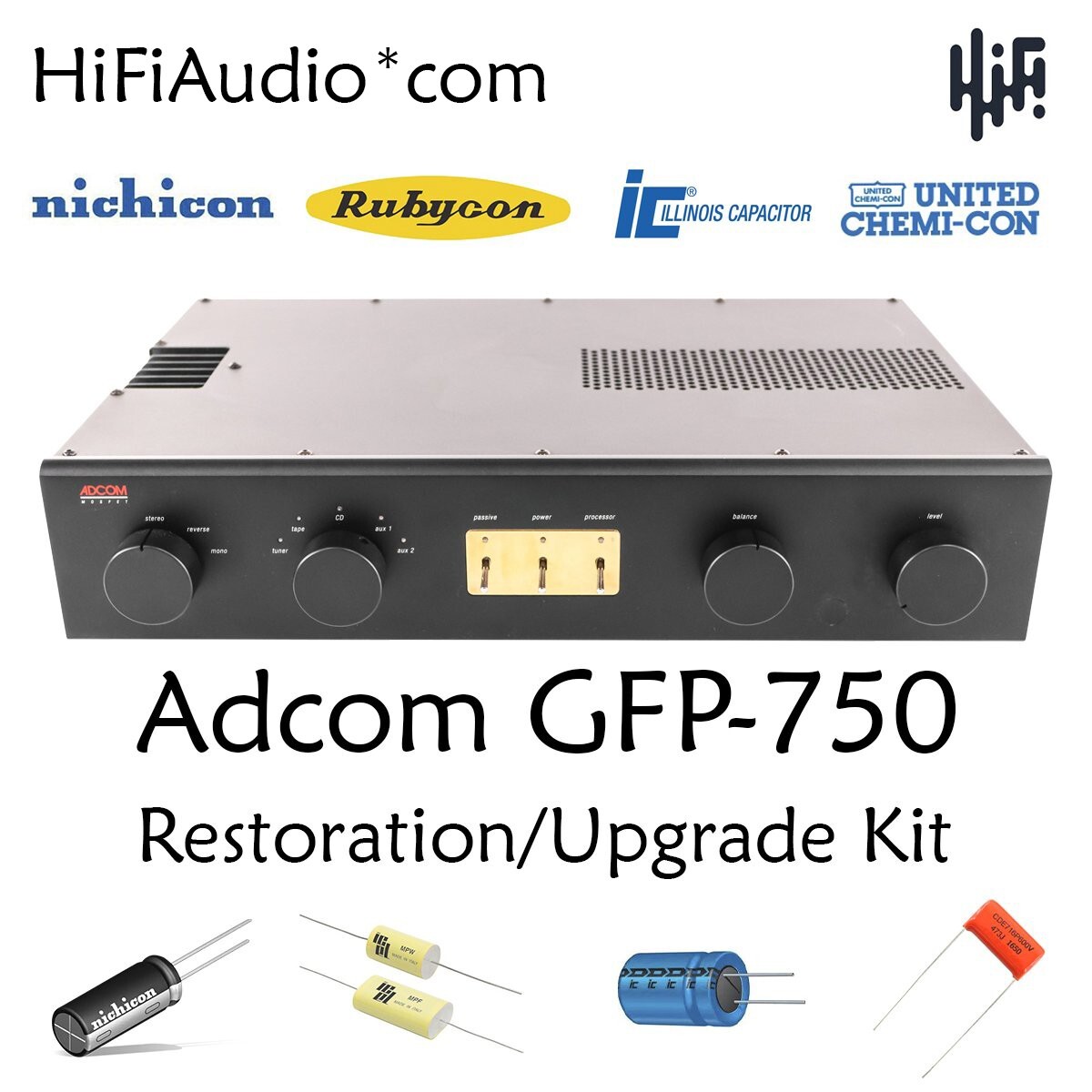
The balance control was motorized, which suggests Adcom expected this preamp to live in a system controlled by remote. There was a remote, though the documentation is sketchy on its full capabilities. The front panel itself kept things sparse: a rotary source selector, volume, balance, and a modest array of buttons for power, processor loop, and tape monitoring. Red LEDs (D403, D405, D407, D409, D411, D415, D418, D421) indicated source selection, sat in LED holders, and were driven through 499-ohm metal-film current-limiting resistors. The main PCB carried 2SC4793 transistors in the output stage, an LM7805 regulator for the low-voltage logic, and plenty of 1% metal-film resistors and 470-µF electrolytics where it counted.
The GFP-750 was designed from the factory to be convertible between 240 V and 120 V operation. A 240 V unit shipped without the rear-panel "switched AC outlet" - that position was blocked with a rubber plate - but Adcom provided part numbers (25000750 for the jack, 48000075 for the wire set) so owners could add it themselves. The conversion involved moving a couple of secondary wires on the transformer and swapping three fuses: F2 went to 2 A/250 V SLB, F11 to 500 mA/250 V SLB, F12 to 1 A/250 V SLB.
Performance & Reception
Cordesman's Audio review (December 1997, p.92) made a point of the GFP-750's transparency. That "vanishingly low" distortion figure and the 102 dB S/N ratio meant the preamp got out of the way. Owners report that it paired especially well with Adcom's own GFA-5802 power amplifier, a 300 W/channel brute that shared the same balanced-input philosophy. The relay-switched source selection meant no signal degradation over time. The motorized balance pot is one more thing that could theoretically fail, but it held up well in practice.
Adcom's own advertising (Audio, January 1998, p.3; HiFI-Stereo, March 1998, p.7) positioned the GFP-750 as "a cost-effective and flexible control center" that also served as a bridge to "the rapidly expanding world of multi-channel surround sound." That multichannel promise dated the unit somewhat. The processor loop was clearly intended for an outboard surround decoder, a workaround from the era before HDMI and pre-pros took over. A two-channel purist could simply bypass it and forget about it.
The Frank Alles review in Audiophile (p.62) dug into the circuit details and confirmed what the early adopters suspected: the GFP-750 shared DNA with the Pass Labs Aleph P, a preamp that cost several times more. It has six JFET devices per channel, two as the differential pair and the rest in the gain stage. The topology prioritized linearity and low noise over parts-count bragging rights. The preamp sounded airy and detailed without tipping into glare.
Collectibility & Market
The GFP-750 never reached the cult status of Adcom's power amplifiers - the GFA-545 and GFA-555II are far more common on the used market - but it has a dedicated following among those who know. The relay-switched source selection and motorized balance are both areas where age can introduce trouble: relays can stick if not exercised, and the balance pot motor can develop dead spots. These are fixable by any competent tech, and the parts are standard. The real issue is scarcity, and finding a clean one takes patience. When they do appear, they command a premium over the earlier GFP-565, but they are still a bargain for fully balanced, relay-switched, dual-mono-style preamplification.
An owner willing to do a little maintenance - exercise those relays, check the electrolytics, maybe upgrade the 470-µF caps in the signal path - gets a preamp that will hang with components costing ten times its original price. Don't expect to find one at every garage sale. The sellers know what they have.
eBay Listings



As an eBay Partner, we earn from qualifying purchases. This helps support our independent vintage technology research.
Related Models
- Adcom GFP-1
- Adcom GFP-565 (1989–?)
- McIntosh C104 (1950–1954)
- McIntosh C20
- McIntosh C200 (2000–2006)
- McIntosh C22 (1963–1968)
- McIntosh C35
- McIntosh C40 (1993-1999)
- McIntosh C47 (2020-present)
- McIntosh C500 (2003-2007)