Roland MC-202 MicroComposer (1983)
A £365 slab of grey plastic that turned a monosynth and two digital sequencers into a briefcase studio — and then became the accidental heart of a whole genre.
Overview
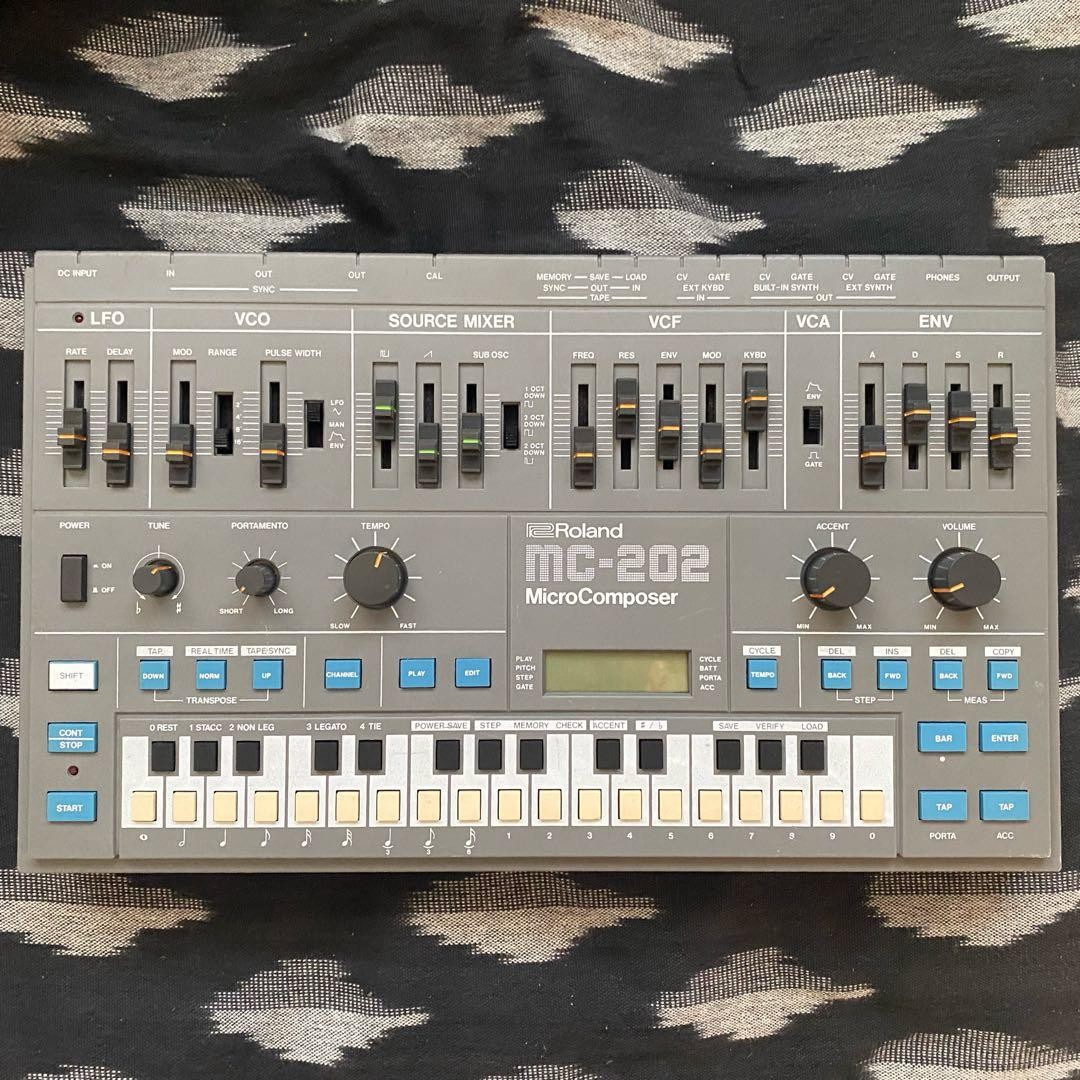
The MC-202 is one of those machines that Roland built to solve a very specific 1983 problem and which then went on to do something entirely different for the next forty years. Its price was £365 including VAT, and for that money you got a full monophonic synthesiser with a built-in 2½-octave moving-rubber-pad keyboard, two independent digital sequencers, and a cassette interface — all in a package you could carry under one arm. Electronics & Music Maker (1983) framed the machine as half of a "compose-record-anywhere" concept, pairing it in its editorial with the Fostex X-15 Multitracker and staging a dedicated three-day London event on microcomposing machines around the two products. That's the pitch Roland was making: not a toy, not a sketchpad, but a serious composer's tool that fit in a bag.
The sequencing architecture is where the 202 earns its keep. Two channels — Channel 1 and Channel 2 — share a pool of 2729 notes, counted as complete events, and can be entered either in real time or step by step, with the step data later edited for length, rests, and the like. According to Electronics & Music Maker (1983), a second sequence can be recorded while the first plays back, provided an external synth is connected, and a second synth can also be patched in to duplicate the built-in voice. That's a genuinely useful arrangement for the era: you could build a two-part piece on the 202's own engine, or use the sequencer as a brain driving outboard gear through 1V/oct CV and 5–15V trigger outputs. The magazine noted that any external 1V/oct, 5–15V trig synth can be hooked up to record or play back alongside the internal synth, or to play the other channel on its own.
The editing functions are more extensive than the price suggests. There are three edit modes, with dedicated Cycle, Delete, Insert, Copy, sharp/flat, and Accent operations — the Accent function opens either the VCA alone or both the VCA and VCF, giving you a volume accent with or without a brighter tone on the current note. Copy will duplicate bars onto the end of the current sequence including Accent and Portamento data for each note. A Tap mode lets you correct a real-time rhythm without altering pitch, and a time signature can be redefined by entering a new number from 1 to 9 before pressing Start. Stopping either real-time or Tap recording always occurs at the end of the current bar, with an extra beep on the first pulse of the next available bar — a small courtesy that tells you a great deal about how carefully this thing was thought through for actual use.
Then there's the LCD. Unlike the portable keyboards of the period that offered melody recording and playback, the 202's editing happens through a liquid crystal display, and Electronics & Music Maker (1983) argued that the combination of LCD editing and direct communication with analogue and synth-controlled machines put the MC-202 "into a special category of its own for the more serious musician." That's the crux of the machine. It's not a preset box. You look at a small screen, you enter codes, you edit steps. The learning curve is real, and owners have always been divided on whether the interface is clever or maddening — but the capability is there for anyone willing to learn it.
Tape sync is the other half of the story. The 202 saves sequences to a standard mono cassette recorder, and it also writes a sync "click track" for tape control on playback. Because the external tape sync sets the correct tempo throughout a played-back sequence, the built-in synth can be used to build a multitrack recording with nothing more than a cassette four-track alongside it. Electronics & Music Maker's own reader correspondence from the period shows the flip side of that promise: one owner wrote in frustrated that his MC-202 wouldn't read its own sync pulse back off tape no matter what level he recorded at, and that loading pattern data from cassette was giving him trouble too. That's the honest caveat on the tape workflow — it works, but it's fussy, and it depends heavily on the cassette deck and the levels. A Power Save function turns off all operation while retaining internal memory intact, which is a welcome hedge against losing a session, but it is not a substitute for a reliable save.
The synthesis side is a single monophonic voice, and the period press was blunt about its character. Sound on Sound (August 1995, p.174) described the MC-202 as an "instant bass machine," producing sub-sonic power that can send your bins shaking with its throbbing, warm low end — and noted that the Accent behaviour, which can hit the VCF cutoff and VCA together or just the VCA, is what lets the 202 approximate the TB-303's sound. That same review observed that it is possible to have CV and Gate sockets fitted to an MC-202 which bypass the processor completely and trigger the synth section directly. That modification is worth flagging for anyone shopping today: the stock machine's CV/Gate behaviour runs through its processor, and a modified unit behaves differently. Collectors should ask.
The 202's place in the MicroComposer line is well documented in the period press. Roland's first MicroComposer, the MC-8, arrived in 1977 at around £4,000 in the UK and emphasised calculator-keyboard programming of up to eight separate sequences feeding external analogue synths. The MC-4 followed roughly three years later at around £2,000 for the basic unit, adding real-time as well as step input via an external synth and four separate voice lines. Then came the Amdek CMU-800 at around £400 for musicians who already owned a home micro, and finally the MC-202 — the compact, self-contained, affordable end of that lineage. The trajectory is clear: each step traded some programming depth for portability and price, and the 202 is the point where the MicroComposer concept became something a working musician could actually afford and carry.
What the 202 became, of course, is a different story from what Roland sold. The combination of a monosynth with a distinctive filter, an accent behaviour that pushes it toward 303 territory, and a sequencer that can be driven independently of the synth is precisely the recipe that later producers went looking for. The Sound on Sound comparison to the TB-303 wasn't a marketing line — it was a practical observation about how the two machines' accent and filter behaviour overlap. That's why the 202 sits in the odd position of being both a period curiosity and a genuinely sought-after instrument decades later. It's not a clean, friendly machine. The display is small, the editing is code-based, the cassette workflow is temperamental, and the stock CV/Gate path has quirks that a modification can address. But it does something specific very well, and it does it in a form factor that fits in a bag.
eBay Listings



As an eBay Partner, we earn from qualifying purchases. This helps support our independent vintage technology research.
Related Models
- Roland MC-505 (1998)
- Roland MC-8 MicroComposer
- Alesis MMT8
- ARP 1601 (1976)
- ARP Sequencer 1601
- Korg Electribe (1999-)
- Korg SQ-64
- Korg SQD-1
- Oberheim DSX
- Sequential Circuits Model 800 (1975)