Korg Electribe (1999–)
A compact, code-driven groove machine that arrived with a CD in the mail and rewired how bedroom producers thought about live sequencing
Overview
The Korg Electribe line didn’t debut with a press release—it arrived via a playable CD tucked into Entertainment Weekly, a stunt that matched the machine’s ethos: cheeky, forward-thinking, and built for immediacy. Launched in 1999, the Electribe series landed as a family of compact music production stations designed to bridge sketchpad spontaneity and stage-ready performance. These weren’t just drum machines or synths—they were groove-centric workstations wrapped in utilitarian enclosures, each model tailored to a different flavor of electronic music. The naming convention alone hints at the lineup’s diversity: EA-1 (analog modeling), ER-1 (rhythm synthesis), EMX-1 (drum and synth fusion), ESX-1 (sampling), and the later Electribe 2 variants, all unified by Korg’s vision of accessible, hands-on sequencing.
Despite their shared DNA, the Electribes are best understood as a toolkit rather than a single product. Some, like the ER-1, offer 6-voice polyphony with analog-modeled oscillators split across two parts, while others lean into sampling or expanded pattern sequencing. The interface—typically a grid of rubberized pads and a small LCD—invites tactile programming, and the 16-part structure (standard across several models) allows layered, evolving arrangements. Owners report that the sequencer feels intuitive, almost game-like, making it easy to build complex rhythms and basslines without deep technical diving. But that accessibility comes with constraints: users of the Electribe 2 note the limited polyphony as a bottleneck, especially when stacking synth and drum parts. The effects, while functional, are often described as underpowered—many producers route the output externally to flesh out reverb or modulation.
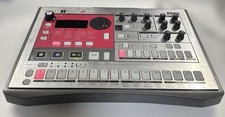
Physically, these units are built for portability. The EA-1 and ER-1 measure approximately 11.5 by 8.5 inches and sit just 1.75 inches tall, making them easy to tuck into a case or stack on a desk. Later models like the ESX-1 upgraded to a sturdier metal chassis and a larger back-lit display, a nod to stage durability. And while the Electribe 2 is confirmed to use analog modeling—no internal samples, just code—earlier models vary in sound generation, from VA synthesis to sample playback. The line’s strength lies in its specialization: acid machine, rhythm machine, sampler, each model a focused instrument rather than an all-in-one DAW replacement.
Specifications
| Manufacturer | Korg |
| Product type | Music Production Machine |
| Number of Steps | 16 steps x 4 |
| Number of Parts | 16 parts |
| Number of Patterns | 250 patterns |
| Memory | 256 Patterns, 16 songs |
| Patterns | 64 steps maximum per part, motion sequence, 1 parameter per part, 64 events |
| Songs | 256 patterns maximum per song |
| Polyphony | 6 voices |
| Dimensions | approximately 11.5 x 8.5 inches in area |
| Depth | only 1.75 inches in depth |
Key Features
16-Part Sequencing with Motion Sequences
At the core of several Electribe models is a 16-part sequencer that treats each sound—drum, synth, or sample—as a full-fledged track with independent step sequencing, effects, and modulation. The motion sequence function, which captures parameter changes in real time (like filter sweeps or pitch bends), adds dynamic movement without requiring deep editing. With up to 64 steps per part and 64 automation events, the system encourages evolving patterns rather than static loops. Users appreciate how quickly complex arrangements can be built, though the 250-pattern limit (100 user) on some models can feel restrictive for larger projects.
Analog Modeling Synthesis (Electribe 2)
Unlike sample-based groove boxes, the Electribe 2 relies entirely on analog modeling—software-generated waveforms that emulate the behavior of vintage oscillators and filters. This means no internal samples, just code shaping the sound in real time. The result is a punchy, responsive tone that cuts through a mix, particularly in bass and lead roles. However, the 6-voice polyphony, shared across all parts, demands careful voice management. Stack too many synth lines, and notes start dropping—owners report this is the most common frustration during live sets.
Compact, Stage-Ready Chassis
Measuring just 1.75 inches deep and under 12 inches wide, the EA-1 and ER-1 were clearly designed for portability. The low profile makes them easy to integrate into tight setups, and the rubberized pads provide reliable triggering without excessive travel. Later models like the ESX-1 upgraded to a metal case and larger back-lit display, improving durability and visibility on dark stages. This evolution suggests Korg was listening to performers who needed more robust hardware for touring, even as the core workflow stayed consistent.
Historical Context
The Electribe line launched in 1999 with a memorable CD-based invitation featured in Entertainment Weekly, a rare marketing stunt that underscored Korg’s intent to reach beyond traditional music stores. Positioned as groove machines for dance, techno, and acid producers, the series offered a middle ground between the complexity of workstations and the limitations of drum machines. The product family spans specialized roles—acid machine, rhythm machine, sampler—indicating a strategy of modular creativity rather than one-size-fits-all design. Each model targets a specific workflow, allowing users to pick the tool that matches their sound.
Collectibility & Value
Current market prices vary significantly by model and condition. The Korg Electribe EMX-1 lists at best prices from $779.00, though one Facebook user reported finding a unit from a Korg outlet on Reverb for $1150, suggesting wide price dispersion. The ESX-1 is available from $505.00, making it a more budget-friendly entry point. No original launch prices were found for the 1999 models, though a 2010 version (EMX-1 SD) carried a £516 RRP. Common failures or maintenance issues are not documented in available sources, but given the age, potential buyers should verify LCD function and pad responsiveness. Enthusiasts still praise the Electribe 2 as a powerful sketchpad and performance tool, though its limitations in polyphony and effects processing are well noted.
eBay Listings
As an eBay Partner, we earn from qualifying purchases. This helps support our independent vintage technology research.