Korg SQD-1
A Z80-driven MIDI sequencer that stores your music on Quick Disk. It also treats a MIDI keyboard like a master controller.
Overview
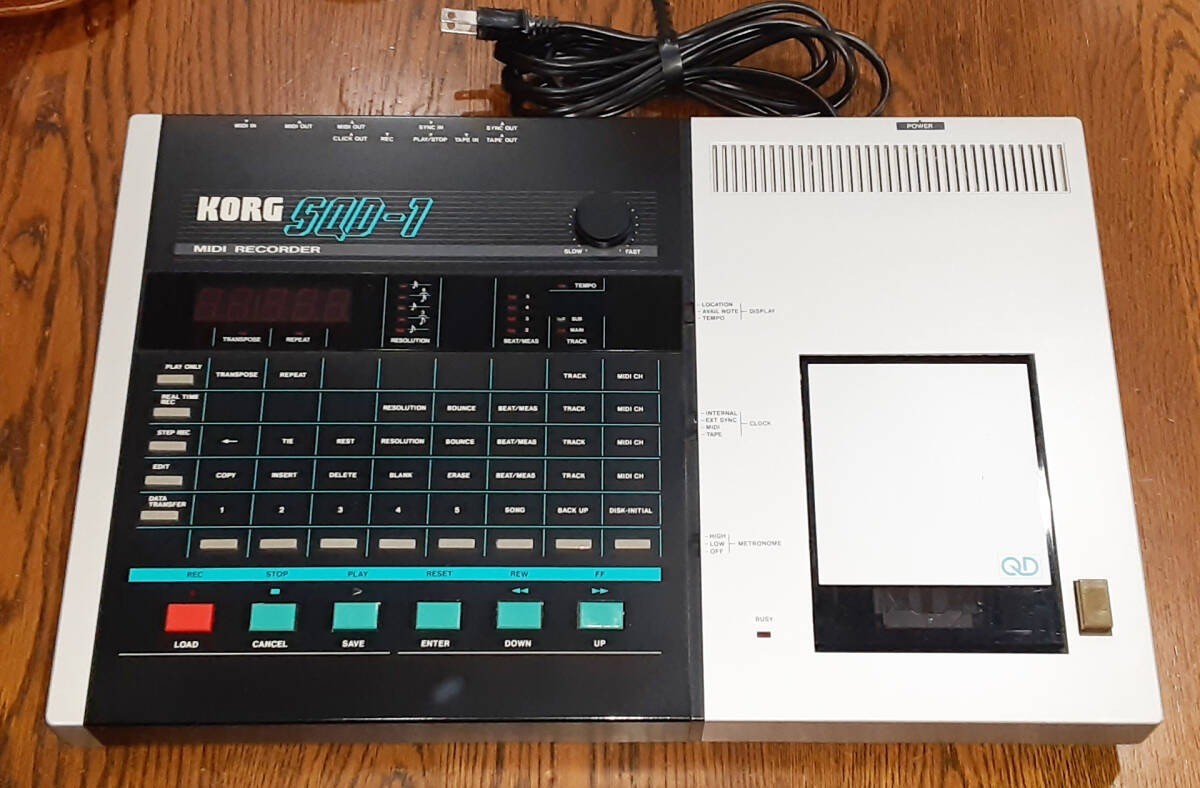
The SQD-1 is a MIDI sequencer built around a Quick Disk drive. A Z80 CPU runs it, reading system programs from a 256K EPROM. User data lives in 64K of RAM made from eight 64K-bit dynamic RAM chips. That RAM is volatile, which is why the Quick Disk is there. It's the permanent home for your sequences, and the CPU handles all reading and writing between RAM and disk. Two circuit boards do the work. The KLM-727 carries the microcomputer, MIDI interface, and Quick Disk interface. The KLM-728 runs the switch input matrix, the 7-segment display, and the LED drive circuitry.
The front panel is terse: 19 function switches, 3 slide switches, and DIP switches on the rear, all reporting through a 5-digit 7-segment LED display. PLAY ONLY sends RAM data out over MIDI and enables transpose and repeat. REAL TIME REC lets you specify beat and measure, track, and MIDI channel, recording against INT CLOCK, EXT CLOCK, SYNC CLOCK, MIDI CLOCK, or TAPE CLOCK. STEP REC adds tie and rest recording on top of the real-time capabilities. EDIT handles copy, insert, delete, blank, and erase. DATA TRANSFER covers the Quick Disk operations: disk initialization, backup, song list, load, and save.
Memory capacity is approximately 15,000 notes, dropping to roughly 7,500 when velocity is recorded. The Quick Disk side stores 30,000 notes or more using both sides of the media. Recording is a 2-track system, with the main track carrying multi-channel recording capability. The control panel reports track status as MAIN/SUB, beat/measure from 2/4 through 8/4, and resolution through a row of LED indicators. On the back, DIP switches set four MIDI functions: MIDI out set to mix or internal, key velocity on or off, pitch bend control change on or off, and aftertouch on or off. A data transfer switch chooses between Disk and MIDI. Connectors include MIDI IN, two MIDI OUT/MIX jacks, DIN SYNC IN and OUT, and TAPE SYNC IN.
The rear panel is where the SQD-1 gets ambitious. The tape sync interface records a clock signal onto tape, then runs the sequencer from the clock read back off it, using an op amp integrator and comparator to shape the waveform. A foot switch interface synchronizes start/stop and recording through a comparator. The metronome drive taps a programmable peripheral interface for strong and weak beat pulses. Those drive a ceramic buzzer and a separate click generator gate built from an op amp and transistor, so you get an audible metronome and a synchronized click output.
Quick Disk performance is worth understanding if you're shopping for one, because it's the part that ages. The drive's control signals run through the Z80 SIO, with a write-protect input, a write gate output, a media-set input, a data output, and a data input. The last two are clocked against a 101.5625 kHz transmission clock and sampled on the trailing edge. The clock check calls for a reading of 6.37-6.67 MHz at pin 1 of IC27 on the KLM-727 board. The system clock at pin 6 of IC3 should sit between 3.96 and 4.04 MHz, with an 8 MHz oscillator divided down by an LS393. Tempo is adjustable and checkable. At the maximum FAST position the sync output should read 190-192 Hz, and at the minimum SLOW position, 25-26 Hz, each trimmed by its own potentiometer.
Mix (October 1985, p.236) flagged the SQD-1's "really nifty features, including sync-to-tape," while placing it in a conversation about using a MIDI keyboard as a master controller — the same issue's advice being to pair a cheaper sequencer like the QX7 with a master unit and load parts between them. The framing is telling: the SQD-1 was reviewed as a working tool for people assembling a MIDI rig, not as a standalone curiosity.
The system exclusive implementation is thorough for its era. The SQD-1 uses Korg's ID 42H with format ID 30H. The manual documents sequence data transfer in both directions. The unit transmits sequence data when it receives a data dump request during a save operation set to MIDI in the data transfer mode, and it acknowledges incoming sequence data during a load operation the same way. There's a data end block, a data dump error response, and a device ID exchange. Sequence data moves in blocks of up to 56 bytes, with the first block running 57.
The fact sheet behind this page is thin on market data, and no production years, original price, or current resale figures could be confirmed. What's documented is the machine itself: a Z80 sequencer with a real disk drive, tape sync, DIN sync, and a MIDI implementation detailed enough to move data in and out. Owners report the Quick Disk is the piece to check before buying, since it's a mechanical media format with its own clock and drive circuitry. That's general reasoning about the design, not a documented failure pattern. Ask about disk function first.
eBay Listings
As an eBay Partner, we earn from qualifying purchases. This helps support our independent vintage technology research.
Related Models
- Korg Electribe (1999-)
- Korg SQ-64
- Alesis MMT8
- ARP 1601 (1976)
- ARP Sequencer 1601
- Oberheim DSX
- Sequential Circuits Model 800 (1975)
- Roland MC-202 MicroComposer (1983)
- Roland MC-505 (1998)
- Roland MC-8 MicroComposer