Roland Juno
A family name that covers some of the most-played, most-repaired, and most-loved analog polysynths Roland ever built. "Juno" means several different instruments, and the differences matter.
Overview
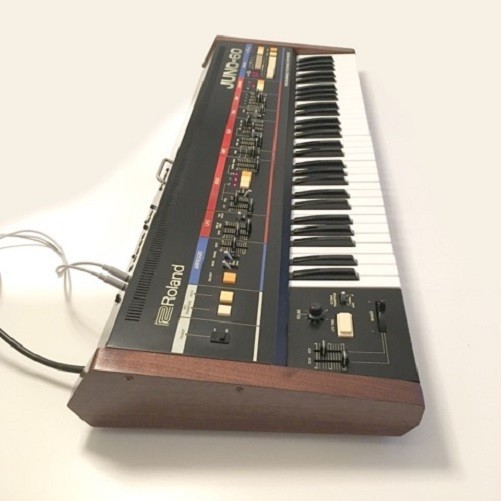
"Roland Juno" is not one synthesizer. The name covers a line of instruments. The archive treats the individual models - Juno-6, Juno-60, Juno-106, and the later Alpha Juno machines - as separate entries. This page is the family hub: what the name means, how the models relate, and what a buyer or repairer needs to know before committing to one. Anyone shopping for "a Juno" needs to decide which one first, because the spec sheets do not overlap neatly.
The period press is the best surviving record of how the line was positioned. Polyphony (December 1983, p.6) called the Roland Juno-6 the first of the under-$2000 polyphonic synthesizers, and noted its five-octave keyboard with a good, fast action. That price point is the whole story of the early Junos. They were the affordable way into polyphony, and Roland got there with deliberate engineering compromises, not by cutting corners on the keyboard or the filter. The same review describes a high-pass and low-pass filter that, combined, produce a bandpass response. The filter can also be pushed into oscillation, which gives you a second tone source hiding inside the VCF. The bender is center-sprung, bending pitch up or down and opening or closing the VCF, and the reviewer found it easier to use than some alternatives.
Then came MIDI. Sound on Sound (October 1998, p.266) notes that the Juno-106, the immediate predecessor to the Alpha Junos, was the model that introduced MIDI into the range, and that it was a significant departure from its older brethren. The same piece calls the 106's redesign sleek enough to still look attractive in 1998, over a decade after it first appeared in 1984. That is a rare compliment for a plastic-and-metal synth of that era. Modern Recording (June 1984, p.59) described the Juno-106 as a six-voice programmable polyphonic synthesizer that updated the classic Juno features with expanded memory, Portamento, and MIDI interface capabilities. The 61-note, five-octave keyboard gave players room to stretch out, and the six DCOs - digitally controlled oscillators - held pitch precisely under all circumstances. Each DCO had its own fully programmable VCF, VCA, and envelope generator, plus an LFO and the distinctive Roland chorus circuit that owners still chase for string and organ patches.
The Alpha Junos followed, and Sound on Sound (October 1998, p.266) records the lineup: the four-octave JU1 (Alpha Juno 1) and the five-octave JU2 (Alpha Juno 2), which offered many improvements over the earlier machines. The same piece notes that this added roughly £200 to the price of the programmer. That trade-off is the fault line in the Juno family. The early models give you hands on everything at once. The Alphas give you more sound for the money, but you route your editing through a box you have to buy separately.
What the family shares is a design philosophy. These are simple synths by later standards: one DCO per voice on the classic models, a single filter and envelope per voice, one LFO, and a chorus that does a disproportionate amount of the work. That simplicity is why they record so well and why they are still on stages. It is also why they are repairable, which brings us to the part most buyers learn the hard way.
Service Notes and What Actually Fails
Buying One
The first question is which Juno. An Alpha Juno gets you more synthesis for the money but effectively requires a programmer if you want to edit in real time rather than step through parameters.
eBay Listings


As an eBay Partner, we earn from qualifying purchases. This helps support our independent vintage technology research.
Related Models
- Roland AX-Edge
- Roland D-5 (1985-1986)
- Roland Fantom 8
- Roland GR-500 (1977)
- Roland JD-800 (1991-1995)
- Akai Ax73 (1986)
- E-mu Vintage Keys
- E-mu Vintage Pro
- Gates Kurzweil K2000
- Gates Kurzweil K2500