Roland Fantom 8 (2019)
Eighty-eight weighted keys, a touchscreen you can drag a finger across, and enough synthesis engines under the hood that you'll spend a weekend just deciding where to start.
Overview
The Fantom 8 landed in 2019 as Roland's flagship synthesizer, and the spec sheet reads less like a single instrument than a small studio's worth of engines bolted into one chassis. The keyboard is the first thing that tells you what kind of machine this is: 88 full-size keys, piano-weighted, with hammer action and channel aftertouch. That's a serious keybed, and it's the reason the Fantom 8 sits at the top of the range rather than the Fantom 6 or 7 — Roland's own product family lists all three as 2019 releases, but only the 8 gives you the full weighted action. At $3,999 USD (or £3,519 in the UK), it's priced like a flagship, and it's built to be the one board you play everything from.
What's under the panel is where it gets interesting. Roland stuffed the Fantom 8 with a whole stack of synthesis approaches: ZEN-Core, the company's unified sound engine for synthesis and sampling, sits alongside V-Piano and SuperNATURAL piano engines, ACB, VTW Organ, and SuperNATURAL Acoustic, Acoustic Piano, and EP. That's a lot of acronyms, and the honest read is that Roland gave the Fantom 8 every major sound technology it had developed, rather than picking one. The result is a workstation that can fake a VK-series tonewheel organ, model a V-Piano, and drop a JUNO-106 or JUPITER-8 expansion into the same session without blinking. Polyphony runs to 256 voices, and there are 3,500 voices on board — numbers that mean you can layer and split without watching the voice count tick down.
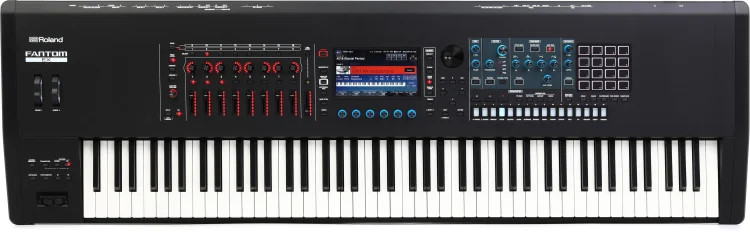
Electronic Musician (undated review excerpt, p.1) called the Fantom's real-time control the most extensive it had encountered on any workstation, and singled out the touchscreen's responsiveness and hold-and-drag gesture support. That's the kind of claim that usually reads as press-release filler, but it lines up with the physical layout: a large color touchscreen, an ergonomic panel loaded with knobs, buttons, and sliders, plus 16 RGB pads for triggering sounds, samples, and clips. The pads, notably, do their work independently of Scenes, which means you can mute, solo, and trigger without disturbing the scene you've built.
The Fantom 8 is a synthesizer and a workstation, and it doesn't pretend to be a home piano. There are no built-in speakers and no batteries — you'll need AC power and external amplification to hear anything. It also has no built-in learning system, which is worth knowing if you were hoping for a teaching tool. This is a machine aimed at players who want to create and modify their own sounds, and the editing depth is there to match.
Key Features
88-Key Weighted Hammer-Action Keyboard with Channel Aftertouch
The keybed is the argument for the 8 over its siblings. Full-size, piano-weighted, hammer action, touch-sensitive, with channel aftertouch — that last item is what separates a controller-grade board from a performance instrument. Aftertouch lets you press into a held note to bring up vibrato, open a filter, or swell a pad, and on a weighted action it feels natural rather than tacked on. The Fantom 6 and 7 use synth-action keys; the 8 is the one you buy if piano technique matters. Sustain, soft, and expression pedal inputs are all present, so a three-pedal setup is on the table.
ZEN-Core and the SuperNATURAL Behavior Modeling Engine
Two engines do the heavy lifting. ZEN-Core is Roland's unified, scalable synthesis and sampling platform, and SuperNATURAL Behavior Modeling blends samples with physical behavior models to produce acoustic and electronic tones that respond to how you play. The practical result is that an acoustic piano patch can shift articulation based on your touch rather than just switching between velocity layers. The Fantom 8 also carries the V-Piano and SuperNATURAL piano engines, so the piano sounds are modeled rather than simply sampled.
Model Expansions: JUNO-106, JUPITER-8, JX-8P, and SH-101
Four classic Roland instruments are available as Model Expansions on the Fantom 8 — the JUNO-106, JUPITER-8, JX-8P, and SH-101. For anyone who has priced an original JUPITER-8, this is the headline feature: the Fantom 8 can host those voices inside a modern workstation. It's the kind of thing that makes a flagship board earn its keep in a working rig, where one keyboard has to cover a lot of ground.
Virtual ToneWheel Organ from the VK Series
The VTW Organ engine is derived from Roland's VK series, which means drawbar-style tonewheel organ is part of the package. Electronic Musician (undated review excerpt, p.1) noted that the Fantom lacks a dedicated drawbar organ mode of the sort found on the RD-2000 or VR-series combo keyboards, though it rated the organ tones themselves as quite good — a fair distinction between having the sound and having the interface.
Massive Effects Library and Master FX Processor
Roland describes a massive effects library plus a Master FX processor, and a 32-band stereo vocoder is included for vocal processing. The vocoder is a specific, characterful tool rather than a checkbox — 32 bands is a serious spec, and it gives the Fantom 8 a vocal-synthesis capability most workstations don't bother with.
Clip-Based Sequencing, TR-REC, and Piano-Roll Editing
The onboard sequencer is built around a clip-based workflow rather than the linear multitrack approach older workstations emulated. TR-REC step sequencing and piano-roll editing are both on board, and Electronic Musician (undated review excerpt, p.1) observed that the sequencer is mindful of how modern music is made — short phrases assembled and rearranged rather than long linear takes. Accompaniments and a recorder/sequencer are both confirmed present.
Advanced Sampling with Multisample Support
Sampling goes beyond one-shot playback: the Fantom 8 supports pitched keyboard assignment and multisample support, so you can build playable instruments rather than just triggering loops. Combined with ZEN-Core's sampling platform, it makes the Fantom 8 a genuine sampling workstation, not just a ROMpler with a sampler bolted on.
16 RGB Pads and Touchscreen Control Surface
Sixteen RGB pads handle sound and sample triggering, clip launching, zone mute and solo, and rhythm-pattern manipulation. The large color touchscreen anchors an ergonomic panel dense with knobs, buttons, and sliders, and the pads operate independently of Scenes — a small architectural decision that pays off in live use. Electronic Musician (undated review excerpt, p.1) described the interface as intuitive and immediate, the sort of panel that makes onlookers assume you know what you're doing.
16x3 USB Audio/MIDI Interface and DAW Control Modes
Connectivity runs to multi-channel audio I/O, MIDI I/O, dual CV/gate outputs, and USB, with a built-in 16x3 audio/MIDI USB interface. There are dedicated software control modes for Ableton Live, Logic Pro, and MainStage, so the Fantom 8 can serve as the center of a computer-based rig as readily as a standalone board. Tablet connectivity is not supported.
FANTOM EX Upgrade on Roland Cloud
Roland offers an upgrade path to the complete FANTOM EX feature set via the FANTOM EX Upgrade on Roland Cloud. The FANTOM 8 EX also appears as a related product, so buyers should know the EX feature set is available as an add-on rather than assuming it's baked into every unit.
eBay Listings

As an eBay Partner, we earn from qualifying purchases. This helps support our independent vintage technology research.
Related Models
- Roland AX-Edge
- Roland D-5 (1985-1986)
- Roland GR-500 (1977)
- Roland JD-800 (1991-1995)
- Roland JP-8000 (1996–2001)
- Akai Ax73 (1986)
- E-mu Vintage Keys
- E-mu Vintage Pro
- Gates Kurzweil K2000
- Gates Kurzweil K2500