Roland Juno-60 (1982–1984)
Six analog voices, a chorus that sounds like a cathedral, and a patch memory system that finally let you save the sound you just dialed in.
Overview
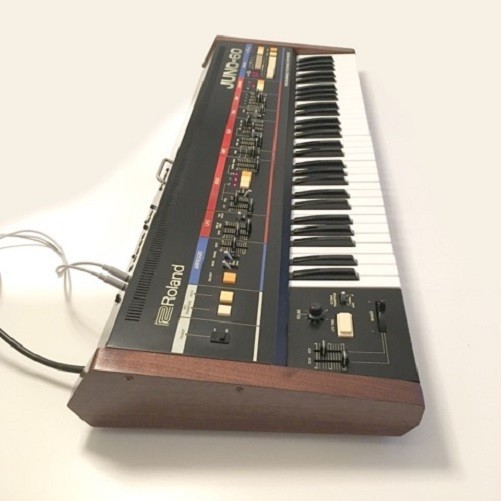
The Juno-60 is where Roland's budget polyphonic line grew up. The Juno-6 had the same six-voice engine and the same chorus, but no memory and no MIDI. The Juno-60, released in 1982, fixed both. It was programmable and connected, and still chorus-drenched. It also picked up the nickname JU-60, which still shows up in classified ads and service documentation today.
The architecture is simple on purpose: one digitally controlled oscillator per voice, a single ADSR envelope, and a resonant 24dB/oct low-pass filter built around the Roland IR3109 chip. Six voices, six filters, six VCAs, six envelopes. That's it. The DCO design keeps the pitch rock-stable. Owners report leaving one powered up for hours and coming back to find it exactly in tune, which was not a given in 1982 when VCO-based polysynths drifted with room temperature. Purists argue DCOs lack character. The counter-argument is that a Juno-60 in tune at the start of a set is worth more than a theoretically "warmer" oscillator that needs retuning between songs.
What sold the instrument, and what still sells it, is the chorus. Roland used an analog bucket-brigade device circuit built around MN3007 chips, and the effect is not a subtle thickening. It's a wide, swirling, slightly detuned stereo spread that makes even a single sawtooth wave sound like it's arriving from three directions at once. Engineers reportedly tested dozens of BBD configurations before settling on the MN3007 setup. That circuit is why the Juno-60 sounds expensive with waveforms that cost almost nothing to generate.
At $1,895 when new, it was a significant outlay for a working musician in 1982. For many of them it was also the only polyphonic synth they ever needed to buy.
Key Features
Analog Chorus Built on MN3007 Bucket-Brigade Chips
There are two chorus settings, both programmable, running through a genuine analog BBD delay line rather than a digital approximation. The Juno-60's chorus is widely described as the instrument's soul, the reason it sits so well in a mix without additional processing. It is also the most failure-prone part of a surviving unit. The MN3007 chips degrade with age, and a Juno-60 whose chorus has gone silent or developed flutter is missing the thing buyers are actually paying for. Replacement is possible but requires a skilled technician.
56 Patch Memory Locations (8 Patches × 7 Banks)
The biggest improvement over the Juno-6 was patch memory. The Juno-60 stores 56 patches across seven banks of eight, and any program can be edited live without overwriting the original until you deliberately write it back. The owner's manual walks through the write procedure: defeat the memory protect switch on the rear panel, hold the WRITE button, and press the target bank and patch buttons. A pedal connected to the patch shift jack cycles through the eight patches in the current bank one press at a time, which is handy on stage.
The catch is that this memory relies on a battery backup, and it is the Juno-60's most notorious flaw. Unplug the instrument for long enough and your patches are gone. The factory presets survive, but everything you programmed yourself does not.
Digitally Controlled Oscillators with Sub-Oscillator and Noise
Each of the six voices gets one DCO with switchable sawtooth and pulse waveforms, plus a sub-oscillator and a noise source. Pulse width modulation can be driven by the envelope, manually, or by the LFO. The DCO keeps tuning stable indefinitely, which made the Juno-60 a practical touring instrument in an era when that was not guaranteed.
24dB/oct Low-Pass Filter with Self-Oscillation
The resonant low-pass filter runs from zero resonance up to self-oscillation, with an envelope modulation amount control and a key-follow control that tracks the filter cutoff across the keyboard from 0 to 100 percent. A separate high-pass filter sits ahead of it. Feed an external source into the 1/4" audio input and the Juno-60 becomes a filter effects unit. Owners have used that trick for decades to run drum machines and vocals through the resonant sweep.
Arpeggiator with Up, Down, Up/Down, and Manual Modes
The onboard arpeggiator offers three range settings and a rate control spanning roughly 1.5Hz to 50Hz, with a hold function that sustains the arpeggio after you release the keys. It's a simple implementation, and it's the sound of a great many records made between 1982 and 1986.
DCB Digital Interface and MIDI
The Juno-60 carries a DCB (Digital Communication Bus) interface for linking to external digital instruments, and it was among the first Roland synths to include MIDI, arriving the same year the standard was introduced. It has MIDI In and Out but no Thru, a minor annoyance in a multi-synth rig. Later production units (serial numbers 253800 and up) reduced DCB-related ground loop noise through a revised ground path and an improved Panel Board B. Earlier units can be modified to the same spec. Owners who want more than the stock MIDI implementation can fit a Minerva kit, which brings fuller MIDI control to the instrument.
Historical Context
The Juno-60 arrived a few months after the Juno-6, as a more-featured version at a higher price, and the two were marketed alongside each other, as noted by Polyphony (December 1983, p.6). It was one of the first in Roland's Juno family, and it sat in an unusual position: a budget polyphonic synthesizer released in 1982, the same year the Korg Poly-61 appeared. The Poly-61 also offered MIDI and memory, but its digital control over analog circuits felt less immediate to players, and it had no built-in chorus. The Juno-60 simply sounded more alive.
It also arrived just before the digital tide. The Yamaha DX7 landed in 1983 and pushed the market toward FM and menus. The Juno-60 went the other direction, with analog warmth and a panel you could read at a glance. Production ran from 1982 to 1984, ending when the Juno-106 took over with MIDI Thru and a slightly updated chorus. The Juno-60 predates the 106's more ubiquitous, and to some ears less characterful, digital control. A JSQ-60 external sequencer was available for the Juno-60 and remains worth acquiring today.
Collectibility & Value
The Juno-60 is very highly desirable and commands a high premium on the resale market. In 2025, units trade between roughly $1,800 and $3,200 USD depending on condition, service history, and whether the chorus is intact. Recent listings show the spread: a bare body and chassis sold for $259, while complete working instruments have gone for $2,575, $2,597, and $3,218. In the UK, a Soundgas listing sat at £1,750 ( £2,100 including VAT) before selling, and an eBay UK listing asked £2,574.52 with free postage. It's uncommon rather than rare. Two years of production means units surface regularly, but not in unlimited numbers.
Two problems follow nearly every surviving example. Memory loss is the first: with a battery backup that needs replacing every five years, letting it fail erases every user patch. The second is the chorus. Degrading MN3007 BBD chips cause flutter, dropouts, or outright silence, and buyers should insist on hearing the chorus in person or on video before committing. Replacing those chips is possible but demands a skilled tech. The original Roland AD-12 power adapters are vintage now themselves, and third-party replacements must supply the full 1.2A the Juno-60 draws or the instrument can behave erratically. Re-manufactured slide potentiometers are available in packs of five for anyone rebuilding a tired control panel, and service and owner's manuals are archived online.
The artists who built records around the Juno-60 include early A-ha, Depeche Mode on Construction Time Again, and Howard Jones across his whole catalog. It was not a cheap-synth choice for them. They used it because it sounded like nothing else.
eBay Listings


As an eBay Partner, we earn from qualifying purchases. This helps support our independent vintage technology research.
Related Models
- Roland AX-Edge
- Roland D-5 (1985-1986)
- Roland Fantom 8
- Roland GR-500 (1977)
- Roland JD-800 (1991-1995)
- Akai Ax73 (1986)
- E-mu Vintage Keys
- E-mu Vintage Pro
- Gates Kurzweil K2000
- Gates Kurzweil K2500