Moog Minimoog Model D (1970–1981): The Synthesizer That Electrified the World—One Note at a Time
The Minimoog Model D was the first portable analog synthesizer designed for live performance. It took synthesis out of the academic lab and put it on the rock stage.
Overview
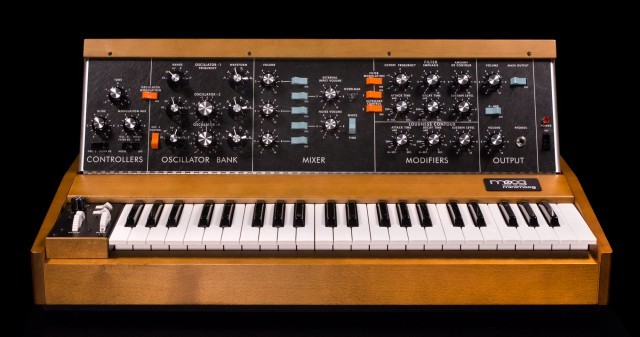
Parliament-Funkadelic's bass, Kraftwerk's squelching leads and the sweeps in Jan Hammer's Miami Vice theme all came from the Minimoog Model D. It was born in 1970 and built in Trumansburg, New York. It wasn't the first synthesizer, but it was the first one built to go on tour without patch cables. Before it, synthesizers like the Moog Modular 55 were room-sized and temperamental, and it took a team of engineers just to change a patch. With the Minimoog Model D you plugged it in, turned it on, and within seconds you had growls, screams and pads from your fingers and a few knobs.
It came in a walnut cabinet with only 44 keys (F to F, not the full 61 or 88 of its modular cousins). It wasn't trying to be a piano. It was used in jazz fusion (Herbie Hancock), progressive rock (Rick Wakeman) and early electronic pop (Gary Numan). It is monophonic, one note at a time, so it was an instrument for leads, basslines and effects, not chords. Three voltage-controlled oscillators (VCOs) feed the Moog ladder filter. By 1972 it had become the de facto standard for analog synthesis, and by the mid-70s it was everywhere - on records, on stages, in studios from Abbey Road to Sunset Boulevard.
Specifications
| Type | Monophonic analog synthesizer |
| Oscillators | 3 voltage-controlled oscillators (VCOs) |
| Waveforms | Sawtooth, square/pulse, triangle, white noise |
| Frequency Range | 0.5 Hz to 20 kHz |
| Filter | 24 dB/octave resonant low-pass filter (Moog ladder filter) |
| Envelope Generators | ADSR (Attack, Decay, Release; Sustain level set by front panel) |
| LFO | 1 low-frequency oscillator with triangle and square wave outputs |
| Pitch Control | Pitch wheel with adjustable spring return, ±1 octave |
| Modulation | Modulation wheel with selectable destinations |
| Keyboard | 44-note F-to-F keyboard with pitch and modulation wheels |
| Outputs | 1x 1/4" unbalanced (400 mV nominal) |
| Inputs | 1x 1/4" external audio input, 1x 1/4" pitch CV, 1x 1/4" gate/trigger |
| Power | 115 VAC, 60 Hz, 15 W (with optional 220 VAC version for export) |
| Dimensions | 44.5 cm × 41.9 cm × 14 cm (17.5" × 16.5" × 5.5") |
| Weight | 12.3 kg (27 lbs) |
| Signal-to-Noise Ratio | Greater than 70 dB |
| Total Harmonic Distortion | Less than 1% |
| Audio Frequency Response | 20 Hz to 20 kHz, ±0.5 dB |
Key Features
- Three VCOs with multiple waveform outputs: The Minimoog’s trio of oscillators could be tuned independently or stacked for detuned thickness. Oscillator 3 could be set to a fixed frequency for sub-octave effects or used as a modulation source—this wasn’t just tone generation, it was sonic alchemy. Want a bass that shakes the floor? Detune VCOs 1 and 2 slightly, mix in a triangle wave from VCO 3, and let the filter do the rest.
- Iconic Moog ladder filter: This is the heart of the Minimoog’s magic. Designed by Bob Moog himself, the 24 dB/octave resonant low-pass filter could go from warm and mellow to self-oscillating shrieks with just a twist of the knob. It’s not hyperbole to say this filter defined the sound of analog synthesis. When you hear a synth “wah” that feels like it’s alive, you’re hearing the ladder filter in action.
- Real-time performance controls: The pitch and modulation wheels weren’t just tacked on—they were central to the Minimoog’s identity. For the first time, synth players could bend notes like a guitarist or add vibrato on the fly. The pitch wheel’s spring return was perfectly calibrated: push it up for a soaring lead, let go, and it snaps back to center with satisfying precision.
- Hardwired signal path: Unlike modular systems, the Minimoog had no patch cables. The signal flow—oscillators → mixer → filter → amplifier—was fixed, with switches and knobs to shape the sound. This made it instantly playable, even for musicians with zero synth experience. No patch bay, no confusion—just turn it on and start twisting.
- External audio input: A subtle but revolutionary feature: you could route a guitar, microphone, or even another synth through the Minimoog’s filter and envelope. Suddenly, this wasn’t just a keyboard—it was a sound processor. Run your voice through the ladder filter with resonance cranked, and you’ve got a monster from a 1970s sci-fi film.
Historical Context
The Minimoog grew out of the Moog Modular 55, a $10,000 machine that lived in universities and elite studios. In the late 1960s, artists like Wendy Carlos (Switched-On Bach) proved synthesizers could make music, not just noise, but they were still impractical for live use. The Minimoog Model D took the best parts of the modular system, stripped out the complexity, and put them in a road-worthy case.
It sold well. Released in 1970 at $1,495 (roughly $11,000 today), it was still expensive, but within reach of serious working musicians. By 1972, Keith Emerson, Sun Ra and Chick Corea were using it. It faced competition, most notably the ARP Odyssey, which offered duophony and a more aggressive marketing push. The Minimoog had the ladder filter, which was unbeatable in warmth and character. The Odyssey could be brighter and more cutting, but the Minimoog had *weight* in the mix.
Its influence went beyond music. The Minimoog helped democratize electronic sound, which was no longer just for academics or avant-garde composers. It became a tool for funk, jazz, rock, and eventually hip-hop (listen to Dr. Dre's early G-funk for Moog-style bass). Production ended in 1981, not because the instrument failed but because digital synths like the Yamaha DX7 were on the horizon, promising polyphony and presets.
Collectibility & Value
Production ran from 1970 to 1981, and no official production records were released. Surviving units are considered rare, and those in good condition command serious money. As of 2025, prices range from $8,000 for a project restore to $15,000 for a fully serviced, stable example with original walnut casing and gold lettering.
These are 50-year-old analog instruments, so buy carefully. The most common issues are oscillator drift (they go out of tune as they warm up) and noisy potentiometers, especially the filter cutoff and resonance knobs. Many units have been recapped or fitted with modern voltage regulators, which improves stability but may reduce the "vintage mojo" for purists. Look for a firm keyboard (no mushy keys), responsive wheels, and minimal crackle when turning knobs. Serial numbers below 1000 are especially prized, though not necessarily more valuable. If a unit still has its original foam damping under the keybed, treat it like a fossil. Replacement foam is available, but original is vanishingly rare.
Moog Music reissued the Model D from 2016 to 2022 with authentic circuitry and improved reliability. Collectors still favor the originals for their quirks. The 1970s Model D has a certain instability, a slight imperfection in the oscillators, that makes it feel more human.
Market Value
┌──────────────────────────────────────────────────────────────────────────┐
│ MOOG MINIMOOG MODEL D                                           Nov 2026 │
├──────────────────────────────────────────────────────────────────────────┤
│ High      $8,175                                  Latest          $6,650 │
│ Median    $3,999                                  Trend                — │
│ Low       $1,538                                  Volume           ~2/mo │
├──────────────────────────────────────────────────────────────────────────┤
│ $9,000 ┤                                                                 │
│        │                                                   .             │
│        │                                                                 │
│ $5,571 ┤                                                      .         .│
│        │                         .                                       │
│        │                                      .  .             .   .     │
│        │  . .                         .                                  │
│ $1,000 ┤.                                                                │
│        ├─────────────────────────────────────────────────────────────────│
│    vol │█ █ █                    █    █       █  █         █  ██   █    █│
│        └─────────────────────────────────────────────────────────────────│
│         2026-01                      2026-04                      2026-06│
└──────────────────────────────────────────────────────────────────────────┘
eBay completed sales. Excludes accessories, parts, and non-working units. Hover points for details.
eBay Listings
Recently sold on eBay: $2,575–$6,650 (median $3,999, based on 12 completed sales, past 12 months)



As an eBay Partner, we earn from qualifying purchases. This helps support our independent vintage technology research.
Service Manuals & Schematics
- Schematics — archive.org
- Service Notes — archive.org