Korg Micro Preset (M-500)
Thirty-two keys, one shoulder strap, and the argument that a synthesizer should be as easy as an electronic organ.
Overview
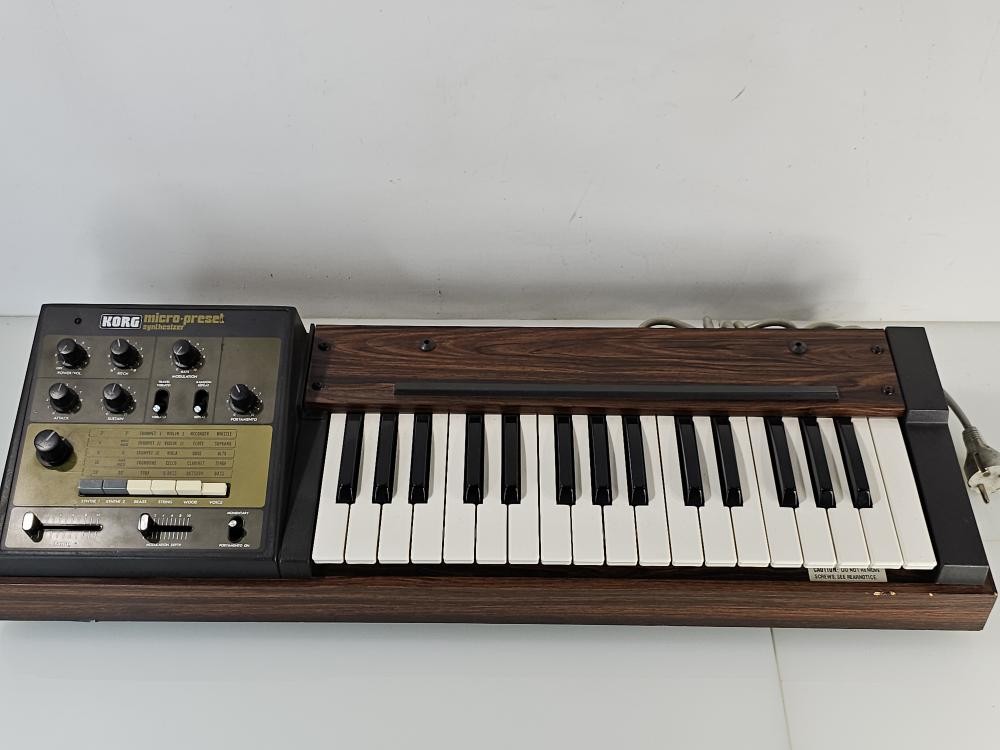
Don't judge the Micro Preset by its spec sheet. The spec sheet is the least interesting thing about it. Korg's own manual makes the pitch: a synthesizer had long been considered difficult and complex to play, and this one was designed so an amateur electronic organ player and a professional keyboard artist could both use it. The manual is blunt about the layout. The knobs on the operation panel are part of the keyboard, so the controls were crammed together as tightly as possible. The effect knobs (Traveler, Modulation Depth, Portamento) sit at the bottom of the panel where the left hand alone can reach them. That is a design thesis, and it explains everything else about the instrument.
The keyboard runs F to C across 32 keys, with a 6.5-octave scale spanning 32', 16', 8', 4', and 2'. These are organ-style footage markings, not the octave numbering a synth player would expect. The sound source is listed as pink noise and white noise alongside the preset voices. There is no filter to sweep and no envelope to draw. Instead there are switches for Vibrato and Travel Vibrato, Repeat and Random Repeat, and Portamento and Momentary Portamento, plus a row of knobs covering pitch, attack, sustain, modulation speed, modulation depth, portamento, and the Traveler. Depth of programming isn't the point. A player can reach all of it without moving a hand far.
The preset selectors are where the Micro Preset earns its name. The manual's headline claim is that pressing more than two preset select switches at once mixes the preset sounds, giving a wider variety of tones than a conventional preset-type synth. That is the whole trick. A fixed-voice organ can't stack its presets. The preset list reads like a combo organ's stops: Trumpet, Trombone, Recorder, Whistle, Flute, Clarinet, Bassoon, Alto, Cello, String, Brass, Voice, plus noise and synth settings. Output is specified as two jacks. Output 1 is 2Vp-p with an output impedance under 4kΩ, and Output 2 is 0.3Vp-p under 5kΩ. The manual directs users to the H (high) jack for an electronic organ or stereo amplifier and the L (low) jack for a guitar amp or PA system.
The physical package is the other half of the story. The circuitry is IC-based, which the manual credits for the small size and light weight. The whole thing weighs 4.9 kg at 730 mm wide, 250 mm deep, and 125 mm tall. Korg says that light weight means the synth can be played standing, hung from a shoulder with a strap. A separate M-500SP variant builds in a compact amp and speaker rated at 600mW with a 10cm full-range 8Ω driver, so the instrument can be played by just plugging in the power cord. Plugging headphones into the M-500SP switches the speaker off automatically, and Korg recommends 8Ω headphones. Owner's documentation for the M-500SP notes it weighs 5.1 kg. The M-500SP also carries an earth warning and a mains-lead wiring note. Korg's manual includes a caution about using it near neon lamps, fluorescent light transformers, or motors, because the synth may pick up noise.
The manual's own framing is unusually honest about the market it was selling into. Korg's introduction points out that synthesized sound had become commonplace on radio and television, in music programs, commercial background music, and drama theme music. It then asks why the synthesizer had become so popular. The answer given is that it can imitate existing instruments and produce sounds no one has used before. The manual concedes that polyphonic synthesizers capable of chords existed by then, but at very high prices. The Micro Preset is positioned as the opposite of that: not the most capable instrument, but the one an organ player could actually operate. The manual also lists accessories for expanding it - an echo machine, a phase shifter (Korg Mr. Multi), and a volume pedal (Korg 2-channel) - connected between synth and amplifier to double the effects.
The Micro Preset is not a synthesizer for someone who wants to design sound from first principles. There is no filter cutoff to ride, no resonant sweep, and no ADSR to sculpt beyond the attack and sustain controls provided. The trade was deliberate. Korg gave up programming depth for immediacy, and the preset-mixing trick is the compensation. The manual is upfront that the target user wants to play rather than patch.
eBay Listings


As an eBay Partner, we earn from qualifying purchases. This helps support our independent vintage technology research.
Related Models
- Korg 700 (1974-1978)
- Korg DS-8
- Korg DW-6000 (1985)
- Korg DW-8000 (1985–1987)
- Korg EX-800
- Akai Ax73 (1986)
- E-mu Vintage Keys
- E-mu Vintage Pro
- Gates Kurzweil K2000
- Gates Kurzweil K2500