Buchla Music Easel (1973–1975, 2015 Reissue)
A walnut-clad synthesizer where touchplates replaced keys and patch cords did the routing.
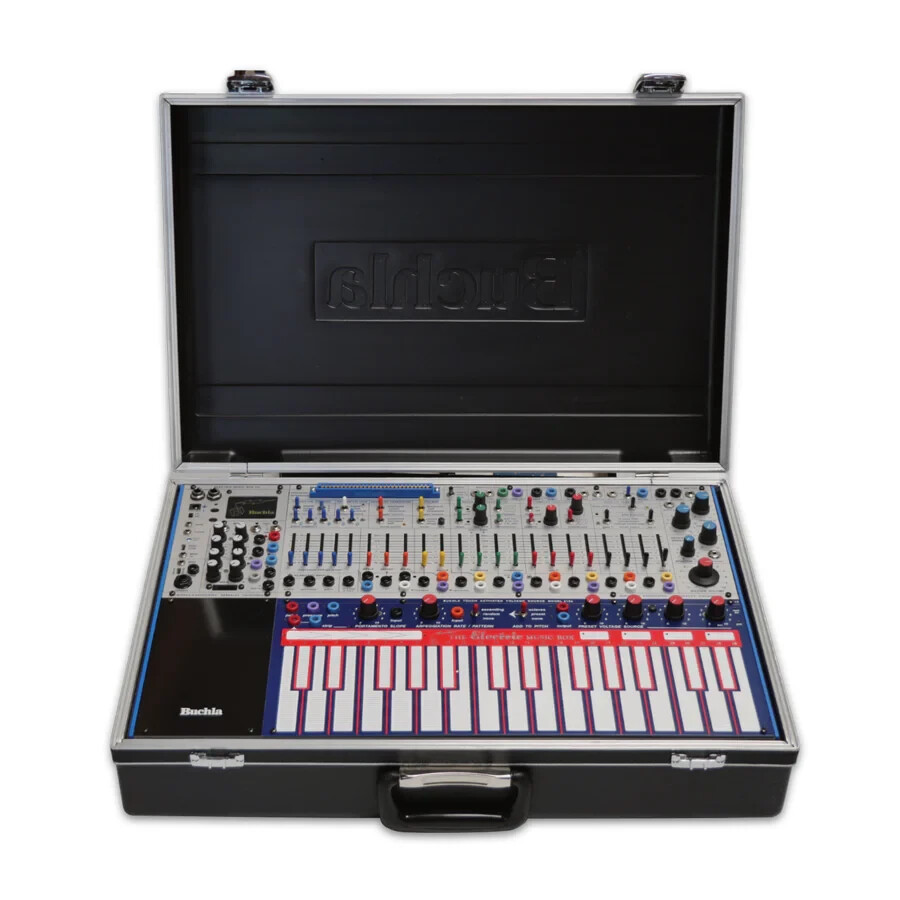
The Buchla Music Easel is a synthesizer in a walnut case with banana jacks. It came out in 1973, at the tail end of the countercultural ferment that produced the Bay Area's electronic music scene. The Music Easel (Model 208) was Don Buchla's answer to a simple question: could a modular synth fit in the backseat of a Datsun? Most modular systems of the time filled entire racks and needed armies of technicians. The Easel was self-contained and gig-ready, with a full voltage-controlled signal path in a 16.5-inch wooden briefcase. Composers like Suzanne Ciani, Morton Subotnick, and David Tudor could take their experimental rigs on the road, patching in hotel rooms, performing in galleries, or improvising in redwood groves.
The Easel was radical in its philosophy as much as its size. Moog was selling Moog Minimoog Model D with familiar piano-style keyboards and preset routings. Buchla went the other way, toward the avant-garde. The Easel's 18-note touchplate keyboard responded to both vertical pressure and horizontal position, so each note had two dimensions of control. That made it one of the first instruments to treat touch as a continuous performance parameter. There were no pitch bends or modulation wheels. You played the surface, coaxing wobbles, sweeps, and warbles from the oscillators with your fingers. With its built-in 4-step sequencer, AR envelope, and 36 patch points, it offered more sonic flexibility than many systems twice its size.
Specifications
| Model Number | 208 (1973), 208t (2015 reissue) |
| Years Produced | 1973–1975 (original), 2015–2018 (reissue) |
| Country of Manufacture | United States |
| Original MSRP | $1995 (1973) |
| Power Requirements | ±15 V DC, 500 mA |
| Dimensions | 16.5 x 12.5 x 3.5 inches (41.9 x 31.8 x 8.9 cm) |
| Weight | 12 pounds (5.4 kg) |
| Audio Output Level | 10 Vpp maximum |
| Control Voltage | 1 V/octave |
| Patch Points | 36 banana jacks |
| Keyboard | 18-note touch-sensitive keyboard (C3 to F4) |
| Oscillators | 2 VCOs: Oscillator 1 (sine, triangle, pulse, sawtooth), Oscillator 2 (sine, triangle, pulse), variable waveforms via timbre modulation |
| Filter | 2-pole 12 dB/oct low-pass voltage-controlled filter with resonance |
| Envelope Generator | AR (Attack-Release), manually or CV controlled |
| LFO | 1 LFO with sine, triangle, square, and random waveforms |
| Sequencer | 4-step sequencer with voltage control over step duration and output |
| Noise Source | White and pink noise |
Key Features
- 18-Note Touchplate Keyboard: Forget piano keys—this was Buchla’s signature capacitive touch interface, where vertical pressure controlled amplitude and horizontal position modulated timbre or pitch. It felt like playing light, and once you got the hang of it, it was unbelievably expressive. No other synth of the era offered this level of per-note control without external controllers.
- Self-Contained Design: The Music Easel was a complete ecosystem: power supply, signal path, sequencer, and even a speaker driver output (though you still needed an external speaker). It was the first truly portable modular synth that didn’t require a backpack full of adapters and wall warts. You could open it, patch, and perform in under a minute.
- 36 Banana Jacks with Intuitive Layout: Despite its compact size, the patch bay was thoughtfully organized. Inputs on the left, outputs on the right, with color-coded zones for oscillator, filter, envelope, and modulation. The banana jacks (a Buchla staple) allowed for semi-permanent patching with secure connections—no wiggling cables mid-performance.
- Voltage-Controlled 4-Step Sequencer: Tiny but mighty, this sequencer could loop melodies or modulate filter cutoff, and crucially, its step duration and output were voltage-controllable. That meant you could modulate the sequencer with itself—a recursive trick that birthed unpredictable, organic rhythms. It was like a tiny brain making its own decisions.
- Timbre Modulation for Waveform Morphing: Oscillator 1 offered not just standard waveforms, but the ability to morph between them via a dedicated timbre modulation input. Patch in an LFO or sequencer, and your sawtooth could melt into a pulse wave mid-note. This wasn’t just filtering—it was transmutation.
Historical Context
The Easel arrived in the early 1970s, when synthesizers were moving from academic curiosities to performance instruments. Buchla's earlier Buchla 100 Series had already redefined what electronic music could be. Subotnick's Switched-On Bach had proven synth records could sell, but the gear was still room-sized and institutionally owned. The Easel was Buchla's bid to put that power in more hands. It arrived the same year as the Moog Minimoog Model D, but where Moog embraced familiarity, Buchla stayed alien. No pitch wheel, no modulation lever, no presets - just a grid of jacks and a keyboard that didn't feel like a keyboard.
It was also a response to the limitations of Buchla's own 200 Series, which was more advanced but complex and expensive. The Easel boiled that philosophy down into something smaller and more personal. It wasn't meant as a studio centerpiece; it was a composer's sketchpad. Only around 100 original units were reportedly made, which feeds its mythic status. Decades later, the Buchla 200e and the 2015 reissue (the 208t) would follow its compact, performance-ready approach. Modern Eurorack designers also cite the Easel as an ancestor.
Collectibility & Value
Today, the original Buchla Music Easel is one of the most coveted pieces of vintage synth hardware. Fewer than 100 units were produced between 1973 and 1975, and many have been lost to time, bad repairs, or over-zealous modders. As of 2025, a fully functional, original Model 208 in good condition commands between $25,000 and $40,000 USD. The 2015 reissue, the 208t, was a faithful recreation with modernized power supplies and refined circuitry. Even those have become collectible, selling for $3,500-$5,000 on the secondary market after production ended in 2018.
Buying an original Easel is risky. The banana jacks are prone to oxidation and mechanical wear. The internal wiring is hand-soldered and routed through tight spaces, and it can degrade or short over time. The original power supply is a known failure point, and many units have been retrofitted with modern replacements. Purists see that as a red flag, but it is often a necessity. The most delicate part is the touchplate keyboard. Its sensitivity can drift due to aging capacitors or contaminated touch surfaces, and recalibrating it takes deep technical knowledge. Collectors want a unit with original finish, unmodified circuitry, and responsive touchplates.
eBay Listings


As an eBay Partner, we earn from qualifying purchases. This helps support our independent vintage technology research.
Service Manuals & Schematics
- Owner's Manual — archive.org
- Owner's Manual (1974) — archive.org
Related Models
- Buchla 200 Series (1970-1978)
- Buchla 200e (2004-2015)
- Buchla 248 MARF
- Buchla Touche
- 2hp DC
- 2hp Fold
- 2hp LPG V2
- 2hp Rash
- 2hp VCM
- 4ms Dual VC Octave Switch