Buchla 248 MARF
A microprocessor-driven voltage generator that redefined programmable control in the modular world — complex, precise, and ahead of its time.
Overview
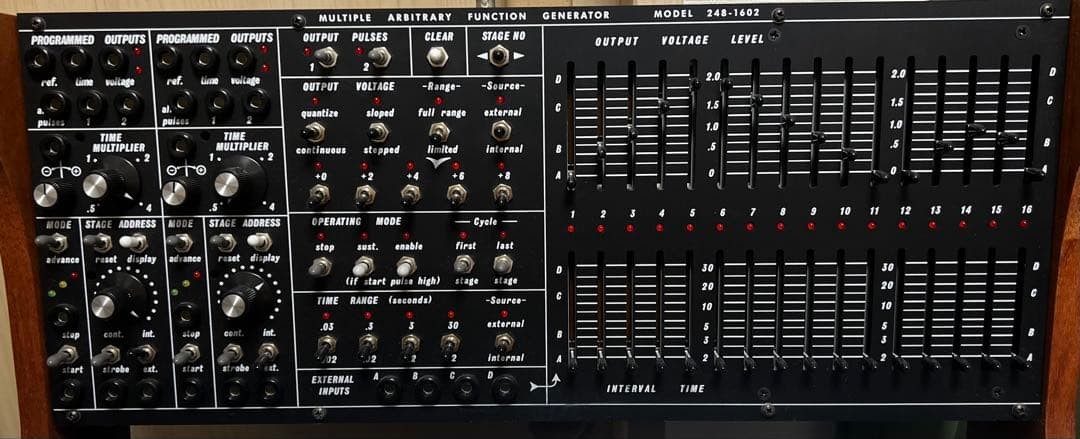
The Buchla 248 MARF (Multiple Arbitrary Function Generator) isn't just another sequencer or envelope — it's a programmable voltage brain built during the formative years of the Buchla 200 Series. Conceived in the 1970s and documented as late as 1977, this module represented a radical departure from analog-only design, integrating a microprocessor into its core architecture. That alone made it a rarity among its contemporaries. It’s not flashy or intuitive; the manual is famously dense, and programming demands a methodical approach. But for those who master it, the 248 MARF becomes a central nervous system for intricate voltage choreography.
Unlike simpler stepped generators, the 248 MARF operates in three distinct programming levels, sequenced from right to left across its interface. Level 1 sets the foundational analog voltages and stage timing via slide potentiometers — the raw material of control. Level 2 then overlays digital commands onto those settings, allowing for conditional behavior, transitions, and external control logic. This hybrid approach — analog voltage foundation with digital command layering — gives it a unique character: it feels both tactile and computational. The module supports up to 16 or 32 stages depending on configuration, offering extended sequences for evolving textures or complex modulation cycles. Its output spans 0 to +10 volts, a standard range in the Buchla ecosystem, but with added sophistication through quantization and slope control.
Specifications
| Manufacturer | Buchla |
| Product type | Module |
| Output voltage range (normal/full) | 0 to +10 volts |
| Quantized voltage range divisions | twelve equal intervals |
| Range compression settings | +0 = 0 to +2 volts, +2 = +2 to +4 volts, +4 = +4 to +6 volts, +6 = +6 to +8 volts, +8 = +8 to +10 volts |
| Number of external input ports | 4 (ports A, B, C, D) |
| Total number of available stages | 16 or 32 |
Key Features
Three-Level Programming Structure
Programming the 248 MARF unfolds in three stages, read from right to left — a design quirk that demands attention. Level 1 is where voltages and timing are physically set using slide pots, grounding the sequence in hands-on analog control. Level 2 attaches digital commands to these settings, enabling logic-based behavior such as conditional jumps or external triggers. This separation of voltage definition from command execution allows for complex, non-linear sequences that respond dynamically to external inputs. The process is deliberate, almost architectural, requiring the user to think in layers rather than linear steps.
Hybrid Analog-Digital Output Modes
The 248 MARF offers both normal and quantized output modes. In normal mode, it generates a smooth analog sweep across stages. When the quantize command is engaged, the 0 to +10 volt range is divided into twelve equal intervals — effectively mapping to chromatic pitch steps when used for pitch control. This makes it useful not just for modulation, but for melodic sequencing within the Buchla voltage paradigm. The quantization is not a simple snap-to-grid; it’s integrated into the command structure, allowing it to be applied conditionally or modulated over time.
Sloped and Stepped Transitions
By default, output voltages step abruptly from one stage to the next. However, the sloped command introduces integration, creating smooth voltage ramps between stages. This isn’t a simple slew — it’s a digitally timed integration that maintains precision while adding glide. The result is a transition that feels both controlled and organic, ideal for evolving filter sweeps or pitch bends. The combination of stepped and sloped outputs within the same sequence allows for rhythmic precision in one parameter and fluid motion in another.
External Source Mode with Direct Voltage Transfer
One of the 248 MARF’s more powerful features is its external source mode. When activated, it bypasses internal voltage settings and transfers an externally applied voltage directly to the output. This turns the module into a smart voltage router, capable of switching or modulating external signals based on its internal sequencing logic. With four external input ports (A, B, C, D), it can draw from multiple sources, making it a dynamic hub for complex patch configurations. This mode is particularly useful for conditional modulation, where external sensors or control voltages are selectively passed based on sequence position.
Five Operating Mode Commands
The module supports five operating commands: Cycle, Stop, Sustain & Enable. These dictate how the sequence behaves in real time. Cycle allows continuous looping, Stop halts progression, and Sustain & Enable introduces latching behavior, holding a stage until a new trigger is received. These commands can be triggered externally, enabling performance-oriented control. The integration of these commands into the Level 2 programming layer means they can be embedded within the sequence itself, creating self-modifying behaviors or conditional pauses.
Microprocessor-Based Architecture
The 248 MARF is notable for being one of the earliest modular synthesizer modules to incorporate a microprocessor. This digital core manages timing, command execution, and state logic, allowing for precise synchronization and complex decision-making. According to available documentation, this redesign made the module significantly more complex than its predecessors. It operates reliably at low frequencies — reportedly performing well at 5 Hz — though some variation in pulse width may occur due to synchronization with processor sampling. At higher rates, such as 15 Hz, performance remains stable, though users should account for digital timing artifacts in precision-critical applications.
Calibration Procedure with LED Feedback
The module includes a dedicated calibration routine: holding the left Advance switch during power-up initiates a sequence where the green/yellow/red LEDs cycle, indicating system readiness. Once the cycle begins, the switch is released, and a 10.0V reference is applied to calibrate the output stages. This procedure ensures voltage accuracy across the 0 to +10 volt range.
Historical Context
The Buchla 248 MARF emerged during the 1970s as part of the Buchla 200 Series, a line known for its experimental approach to electronic music. It followed earlier function generators but represented a significant leap in complexity and capability. It shares a developmental lineage with the Buchla 250e, which evolved from the 248 MARF’s architecture. Decades later, its influence resurfaced in the Tiptop Audio & Buchla 248t MARF, a Eurorack-format reissue that brought its functionality to a new generation of modular users.
Collectibility & Value
The Buchla 248 MARF is a rare and sought-after module among vintage synth collectors. Recent listings on Reverb show units selling for $2,000, while another unit was listed at €1,416.26. These prices reflect both its historical significance and functional complexity. Some units are described as "freshly built and calibrated," indicating active restoration and use. Build variations exist, with references to V1 and V2 versions, and specific hardware revisions such as the Electric Music Store v2.1 PCB with v2.0 firmware. However, no original MSRP or production run data is available, and information on common failures or long-term maintenance remains undocumented.
eBay Listings
As an eBay Partner, we earn from qualifying purchases. This helps support our independent vintage technology research.