Buchla 248 'MARF'
A reissue of a rare and complex 1970s control voltage generator, once part of the Buchla 200 Systems, now reborn for Eurorack
Overview
The Buchla 248 'MARF'—officially the Multiple Arbitrary Function Generator—was originally a module from the legendary Buchla 200 Series systems of the 1970s. Long shrouded in myth due to its scarcity and intricate design, it has since been reissued as the Buchla 248t MARF for the modern 200t Eurorack format. This isn't just another function generator; it's a programmable control voltage powerhouse, designed to shape sequences, modulate parameters, and generate complex timing structures with surgical precision. Its reputation as "rare and mythical" isn't marketing fluff—it stems from decades of absence and whispered stories in modular circles.
While the original 248 emerged from Don Buchla’s experimental West Coast synthesis philosophy, the reissue—developed over two years by the Buchla team—carries forward that spirit with updated reliability. It retains the core functionality of its predecessor but incorporates V2 modifications aimed at reducing CV jitter and improving compatibility with expanders. The module is not a simple clone; it's a total redesign, which means purists may debate its authenticity, but practical users appreciate the enhanced stability. Despite its complexity, it's built for deep interaction, rewarding those willing to wrestle with its three-tiered programming system.
Specifications
| Manufacturer | Buchla |
| Product type | Multiple Arbitrary Function Generator (MARF) |
| Output voltage range | 0 to +10 volts |
| Quantized voltage range | divide the voltage range into twelve equal intervals |
| Compressed voltage ranges | +0 = a stage bearing this command now has a voltage output range of from 0 to +2 volts. +2 = +2 to +4 volt output +4 = +4 to +6 volts +6 = +6 to +8 volts +8 = +8 to +10 volts |
| Number of stages | total number of available stages (16 or 32) |
| External input ports | 4 external voltages appearing at the external input ports marked A, B, C and D |
| Power requirement | Apply 10.0V |
Key Features
Three-Level Programming Architecture
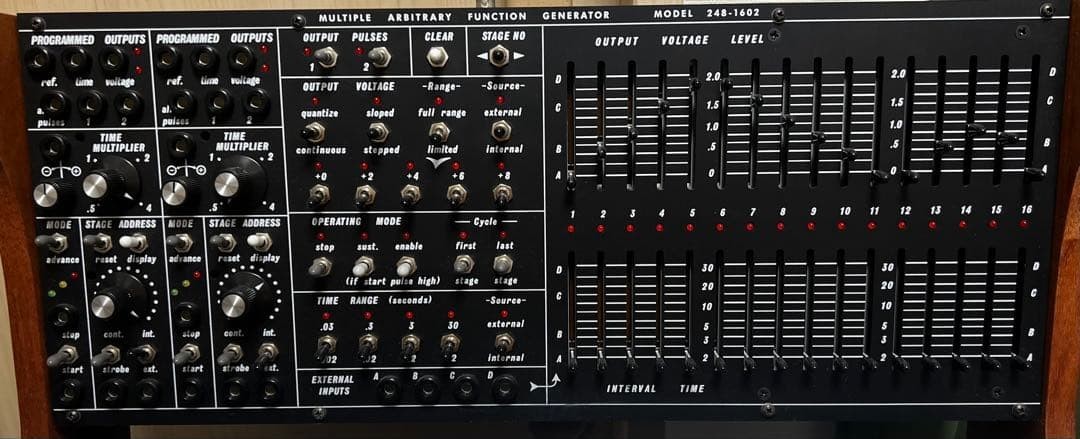
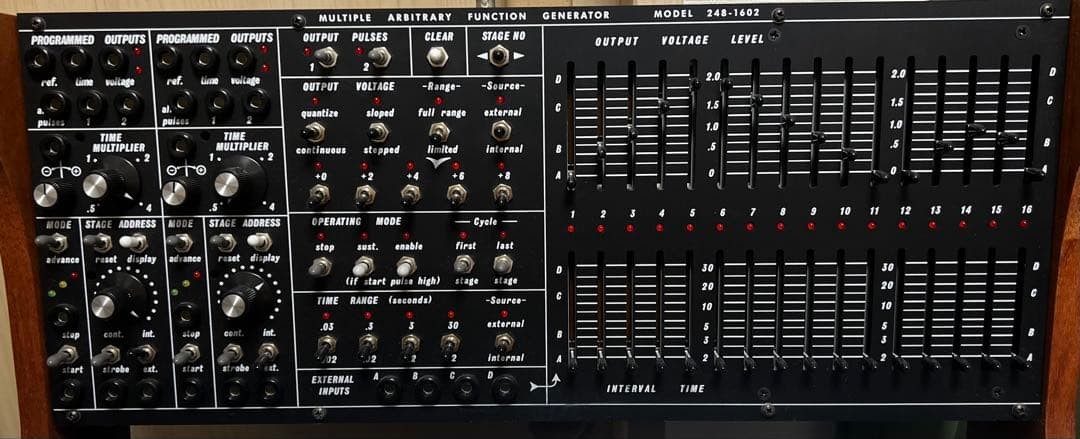
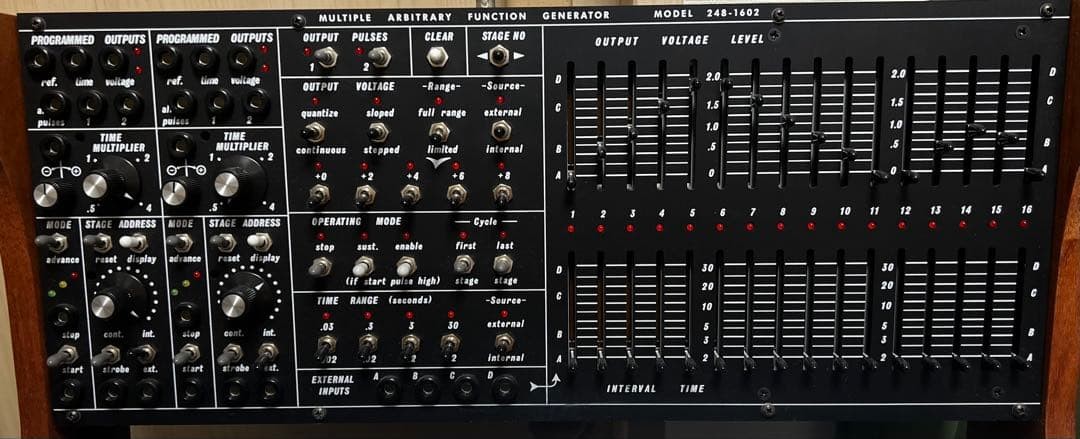
Programming the 248 'MARF' is an involved process, broken into three distinct sections. Level 1 handles basic output voltage levels and interval timing, setting the foundation for how long each stage lasts and what voltage it produces. Level 2 introduces more granular control, with commands for output pulses, voltage behavior, operating mode, and time range. This is where the module's flexibility becomes apparent—users can dictate whether voltages are quantized or continuous, sloped or stepped, and select their source from internal or external inputs. Level 3 dives deeper still, allowing control over output voltage ports, time multipliers, mode selection, and direct stage addressing. This hierarchical structure makes the 248 less of a plug-and-play module and more of a compositional tool.
Quantized and Compressed Voltage Ranges
The module divides its 0 to +10 volt output range into twelve equal intervals, enabling precise chromatic control when interfaced with voltage-controlled oscillators or other pitch sources. Beyond quantization, it offers compressed voltage ranges that partition the 10-volt span into five 2-volt segments: 0–2V, 2–4V, 4–6V, 6–8V, and 8–10V. These ranges are selectable via command codes (+0 through +8), allowing users to confine output voltages to specific bands. This feature is particularly useful for limiting modulation depth or restricting sequences to particular registers without external attenuators.
16 or 32 Stage Sequencing Capability
With a total of either 16 or 32 available stages, the 248 'MARF' supports extended sequences and complex control patterns. This flexibility in stage count gives composers room to build evolving modulations or long-form voltage curves, far beyond the capabilities of standard 8- or 16-step sequencers. The ability to address stages directly in Level 3 programming further enhances its utility for non-linear sequencing and conditional voltage routing.
Four External Voltage Inputs (A, B, C, D)
The inclusion of four external voltage inputs—labeled A, B, C, and D—allows the 248 to respond dynamically to other modules in a system. These inputs can serve as control sources for voltage output, time modulation, or conditional logic within the programming structure. This integration capability makes the MARF not just a generator, but a processor of control voltages, capable of reacting to and transforming incoming signals in real time.
Microprocessor-Based Redesign with V2 Enhancements
Unlike many vintage reissues that replicate original analog circuitry, the 248t MARF is a total redesign incorporating a microprocessor. This shift enables the complex programming logic and precise timing that define its operation. However, it also introduces a digital layer that some purists question. The V2 revision specifically addresses CV jitter—a known issue in earlier versions—improving timing accuracy and smoothing voltage transitions. It also adds support for an expander module, along with various fixes and enhancements that improve reliability and functionality over the original V1 design.
Historical Context
The original Buchla 248 MARF was part of the Buchla 200 Series systems developed in the 1970s, a period of intense innovation in modular synthesis. These systems were known for their experimental interfaces and non-traditional approaches to sound generation and control. The 248 emerged as one of the most complex modules in that ecosystem, designed for users who wanted deep programmability and generative control. Decades later, the Buchla 248t MARF was reissued as part of the 200t Eurorack series, bringing its capabilities to a new generation of modular users. The reissue was reportedly in development for two years, reflecting the challenges of translating such a sophisticated design into a modern format.
Collectibility & Value
Original vintage units are exceptionally rare, with no documented original price or production numbers. The reissued Buchla 248t MARF, however, is available on the market at a price of $999.00 for new units. Used examples have appeared for sale and sold on platforms like Mercari Japan, indicating active collector interest. Calibration is noted as a critical step—listings often emphasize that units are "freshly built and calibrated." Given the complexity and the V2 modifications aimed at reducing CV jitter, collectors and users tend to prefer updated versions. DIY builders have also engaged with the design, with reports of individuals building and repairing the V1 version, suggesting a niche but dedicated community.
eBay Listings
As an eBay Partner, we earn from qualifying purchases. This helps support our independent vintage technology research.