ALM Tyso Daiko (2021–)
Two voices, one chaotic brain: this isn’t just a drum module—it’s a modular percussion philosopher with a voltage-controlled smirk.
Overview
You know that moment when a module surprises you not by doing what it says on the tin, but by rewriting the label entirely? The ALM Tyso Daiko lands like a dropped cymbal stack—unexpected, loud, and somehow musical in its chaos. At first glance, it’s billed as a dual-voice 12-bit wavetable drum module, the spiritual successor to the cult-favorite Dinky’s Taiko. But calling it just a drum module feels like calling a chainsaw a gardening tool: technically true, wildly insufficient. This thing breathes, mutates, and occasionally glitches its way through sound design with a kind of digital-analog hybrid intelligence that’s equal parts precise and unhinged. It doesn’t just make drum sounds—it argues with them, folds them, EQs them into submission, and then lets them fight each other via choke and accent. And yet, for all its complexity, it never feels like homework. Patch in a trigger, twist a knob, and within seconds you’re knee-deep in something that sounds like a robot learning to play congas for the first time.
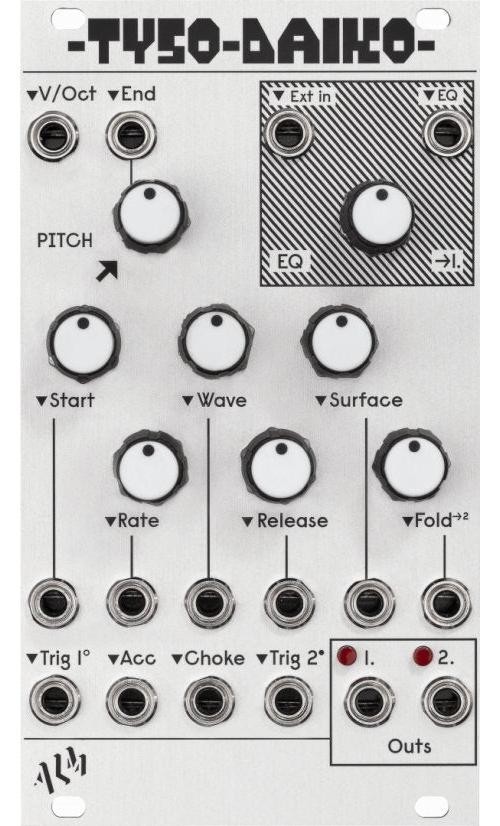
What makes the Daiko special isn’t just its dual-voice architecture—it’s how those voices diverge after sharing the same sonic DNA. Both start from the same swept wavetable oscillator, cycling through 11 waves that range from clean sines and saws to gritty noise, FM bells, cymbal textures, and buzzy spectra. But then they split: Voice 1 gets routed through an analog tilt EQ, letting you bias the tone toward bright or dark with a single knob (below noon = highs up, above = lows up). Voice 2, meanwhile, gets fed into a digital wavefolder that can gently shape or violently mangle the signal into something entirely new. This isn’t just stereo separation—it’s sonic divergence. One voice can be a deep, punchy kick while the other becomes a sizzling, metallic snare, all from the same initial waveform. And because every parameter is voltage-controllable, including the wave selector, rate of pitch sweep, surface texture, and envelope behavior, the Daiko doesn’t just respond to your system—it becomes part of the conversation.
It’s also the kind of module that rewards both precision and recklessness. Want a tight, punchy toms-and-cymbals kit? Dial in stepped CV to the wave knob and sequence it like a classic drum machine. Want something that sounds like a malfunctioning arcade cabinet falling down a staircase? Modulate the surface control with a chaotic LFO and let the wavefolder run wild. The “surface” parameter alone is a revelation—adding click, punch, or soft attack to the front of the sound, making it possible to go from a mallet thud to a snare crack with a twist. And the Rate knob, which controls how quickly the pitch sweeps from its starting point to its fundamental frequency, is where things get truly interesting: set it faster than the envelope, and it cycles, creating FM-like sidebands or rhythmic pulsing that blurs the line between percussion and pitched synthesis. It’s not just a drum voice—it’s a full-blown sound design engine wearing a taiko drum disguise.
Specifications
| Manufacturer | ALM / Busy Circuits |
| Model | Tyso Daiko (ALM031) |
| Production Years | 2021– |
| Original Price | £280 GBP / $349 USD |
| Format | Eurorack |
| HP | 14 |
| Depth | 32mm |
| Power Supply | +12V 70mA, -12V 35mA |
| Voices | Dual (shared oscillator, independent outputs) |
| Oscillator Type | 12-bit digital wavetable (11 waveforms) |
| Waveforms | Noise, sine, triangle, saw, pulse, voice, FM bell 1, FM bell 2, cymbal, spectra, buzz |
| Pitch Control | V/Oct input, Rate knob (pitch sweep speed) |
| Envelopes | Attack and Release (shared, but accent affects both differently) |
| Filter/Processing | Analog tilt EQ (Voice 1), digital wavefolder (Voice 2) |
| Inputs | Dual trigger inputs, V/Oct, Rate CV, Surface CV, Accent CV, Choke (Voice 1 only), External mix input (via tilt EQ) |
| Outputs | Dual audio outputs (Voice 1 and Voice 2) |
| CV Control | All parameters voltage controllable |
| Special Features | Self-FM capability via Rate modulation, choke function, accent response (halves release on Voice 1, doubles on Voice 2) |
| Construction | PCB with surface-mount components, reverse power protection |
| Country of Origin | England |
Key Features
The Shared Brain, Split Personality
The genius of the Tyso Daiko lies in its dual-voice design that feels less like two separate drums and more like a single instrument with a split identity. Both voices originate from the same digital wavetable oscillator—meaning they share pitch, waveform, and envelope behavior—but then diverge in processing. Voice 1’s analog tilt EQ is deceptively powerful: it’s not a filter in the traditional sense, but a broad tonal tilt that can push the sound from boomy and sub-heavy to crisp and cutting with a single knob. It even accepts an external signal, letting you route other modules through it for unified tonal shaping. Voice 2, though, is where the madness lives. The digital wavefolder doesn’t just add harmonics—it can transform a sine wave into a square, then into a buzz, then into something resembling granular noise, all while retaining a strange coherence. Patching Voice 2 through a low-pass gate or opto compressor can yield evolving, organic textures that sound nothing like their source. This duality means you’re not just playing two drums—you’re playing a dialogue between them, a call-and-response sculpted by voltage.
Surface Control: The Secret Sauce
Most drum modules obsess over attack and decay. The Daiko adds a third dimension: surface. This knob (and its CV input) controls an additional transient layer that can be anything from a sharp click to a soft thud to a smooth fade-in. It’s the difference between a stick hitting a drumhead and a mallet sinking into it. In practice, it’s transformative—turn it up and you get snappy, precise attacks perfect for hi-hats or rimshots; dial it back and the sound becomes more ambient, almost melodic. When modulated, it creates rhythmic variation that feels human, even when sequenced rigidly. And because it’s voltage-controlled, you can use it to add dynamic articulation across a pattern—say, a louder “hit” on every downbeat via accent CV. It’s a small parameter with massive expressive range, and it’s one of the reasons the Daiko feels so alive.
Choke, Accent, and the Art of Conflict
The Daiko doesn’t just play nice—it knows how to fight. The choke input applies only to Voice 1, cutting its output when triggered, which means you can use it to simulate acoustic drum behavior where one hit silences another (like a hi-hat closing). But in a modular context, it becomes a compositional tool: send rapid gates to the choke input and you can create stuttering, glitchy rhythms even with a steady trigger stream. The accent input is equally clever—when a high gate is received, it halves the release time of Voice 1 and doubles it on Voice 2. This creates a push-pull effect: one voice gets tighter and punchier while the other lingers, blurring the line between attack and sustain. It’s not just dynamic control—it’s a built-in tension generator. Used subtly, it adds groove; used wildly, it turns your drum pattern into a sonic wrestling match.
Historical Context
The Tyso Daiko didn’t emerge from a vacuum—it’s the evolution of ALM’s long-running obsession with redefining what a “drum module” can be. Its predecessor, Dinky’s Taiko, was already a cult favorite for its raw, digital character and hands-on control, but it was monophonic and limited in modulation. The Daiko, released in late 2021, arrived at a moment when Eurorack users were hungry for more intelligent, expressive percussion—not just sampled hits or basic analog kicks, but modules that could breathe, mutate, and interact. Competitors like MakeNoise’s René or Mutable Instruments’ Elements offered generative rhythm, but few tackled the physicality of drum synthesis with the same blend of digital precision and analog warmth. The Daiko filled that gap with a uniquely British flavor of controlled chaos. It also arrived as ALM was solidifying its reputation for modules that are deceptively simple on the surface but endlessly deep in practice—think Pamela’s PRO Workout or Jumble Henge. The Daiko fits that lineage perfectly: it’s not flashy, but it’s indispensable. And while it nods to traditional Japanese taiko drums in name and spirit, its sonic palette is global, futuristic, and thoroughly modern—less ritual, more rave with a PhD in signal processing.
Collectibility & Value
The Tyso Daiko isn’t a vintage relic—it’s a recent module, and as such, it doesn’t carry the mystique of 1970s synths or 1980s drum machines. But in the fast-moving world of Eurorack, “collectibility” is less about age and more about impact, availability, and staying power. The Daiko has all three. Since its 2021 release, it’s become a staple in many advanced racks, praised for its versatility and character. Used units typically sell between $250 and $300, depending on condition and region, while new units still command the original $349 MSRP. Unlike some limited-run modules that inflate in price, the Daiko’s value has remained stable—partly because ALM has kept production consistent, and partly because it’s seen as a tool, not a trophy.
That said, there are quirks to watch for. Some early users reported minor slew artifacts on the V/Oct input—small delays or glitches when pitch changes rapidly. While not a failure, it’s a characteristic some find charming (a “digital patina,” if you will) and others find distracting. Firmware updates have minimized this, but it’s worth testing if buying used. The module is solidly built with reverse power protection, so catastrophic failure is rare, but like any digital module, it’s sensitive to power spikes or incorrect cabling. No known failure-prone components have emerged, and the surface-mount design means repairs are possible but not beginner-friendly. If you’re buying, test all CV inputs and outputs, check for firmware updates, and listen for consistent behavior across the wave selector—some users report slight stepping inconsistencies when modulating the wave knob with CV, though this can often be tuned via calibration.
For those considering the Daiko versus its predecessor, the Dinky’s Taiko, the choice is clear: the Daiko is the upgrade in every way—dual voices, more waveforms, better modulation, and refined controls. The Dinky has charm, but the Daiko has depth. And while some collectors might want both for completeness, the Daiko alone is enough. It’s not the kind of module that gets traded out after a few months—it tends to stay on the rack, quietly becoming essential.
eBay Listings

As an eBay Partner, we earn from qualifying purchases. This helps support our independent vintage technology research.