ALM Dinky's Taiko (2016–2023)
A 12-bit digital drum voice that doesn’t just imitate drums—it invents them, one chaotic, glorious fart sound at a time.
Overview
Plug in the ALM Dinky’s Taiko and you’re not getting a drum machine—you’re getting a drum alchemist. This isn’t the kind of module that politely recreates a snare or hi-hat; it’s the one that, left unattended, starts muttering in glitchy tongues and spitting out sounds like a malfunctioning arcade cabinet having a nervous breakdown. And that’s exactly why people love it. Built around a 12-bit digital core, the Taiko trades pristine fidelity for character—lots of it. That bitcrushed grit isn’t a flaw; it’s the whole point. It’s the sonic equivalent of finding a perfectly weathered leather jacket at a thrift store: it just feels right. The module thrives on imperfection, delivering everything from punchy, snappy snares to industrial clangs, synthetic thuds, and textures so abstract they border on malfunction. But don’t mistake its lo-fi nature for simplicity—this thing is deep. Under the hood, it’s a hybrid beast: digital sound generation with analog output shaping, giving it both the precision of code and the warmth of circuitry.
Positioned in ALM/Busy Circuits’ eccentric lineup, the Taiko isn’t the flagship, nor is it the entry-level novelty. It’s the weirdo in the middle that somehow became a cult favorite. At 12 HP, it’s skiff-friendly and power-efficient, drawing about 80mA on the ±12V rails, making it a practical addition even to tightly packed systems. But its real value isn’t in its size—it’s in its flexibility. While marketed as a drum voice, experienced users quickly discover it pulls double (or triple) duty as a sound effects generator, a chaotic oscillator, or even a makeshift synth voice when patched unconventionally. Unlike more rigid drum modules that lock you into specific sound types, the Taiko encourages exploration. Turn a knob too far? Great—you’ve just discovered your next rhythm track. Patch in some wild CV? Even better. The module rewards experimentation, though it doesn’t always play nice. There’s a fine line between “delightfully unpredictable” and “uncontrollably farty,” and the Taiko straddles it with a smirk.
It’s also not the kind of module you casually add to a rack expecting polished results. You need to wrestle with it. The controls aren’t always intuitive, and the sweet spots are often buried under layers of digital noise and pitch instability. But that’s part of the charm. When it clicks—when the oscillator’s pitch sweep aligns with the noise decay just right, and the analog EQ tilts the tone into something punchy and alive—it feels like you’ve hacked a secret frequency no one else has found. And because nearly every parameter accepts CV, you can automate the chaos, letting sequencers and LFOs turn its instability into structured mayhem. In a world of sterile, sample-based drum modules, the Taiko is a defiantly analog-feeling digital anomaly.
Specifications
| Manufacturer | ALM/Busy Circuits |
| Model | Dinky's Taiko |
| Model Number | ALM-005 |
| Production Years | 2016–2023 |
| Original Price | £199 / $389 AUD |
| Format | Eurorack |
| Width | 12 HP |
| Depth | 32mm (including power header) |
| Power Supply | ±12V |
| Current Draw | ~80mA on both +12V and -12V rails |
| Reverse Polarity Protection | Yes |
| Sound Engine | 12-bit digital |
| Oscillator Type | Digital wavetable oscillator with 24 waveforms |
| Noise Generator | Digital noise source with frequency and release control |
| Output Stage | Analog tilt EQ |
| Trigger Inputs | Strike, Accent, Choke (3 inputs) |
| CV Inputs | Multiple, including oscillator start/end frequency, noise release, mix, and more |
| Audio Output | 1x 3.5mm jack |
| Construction | PCB-mounted controls, metal front panel |
| Country of Origin | United Kingdom |
Key Features
Dual Sound Sources: Noise and Wavetable in Constant Tension
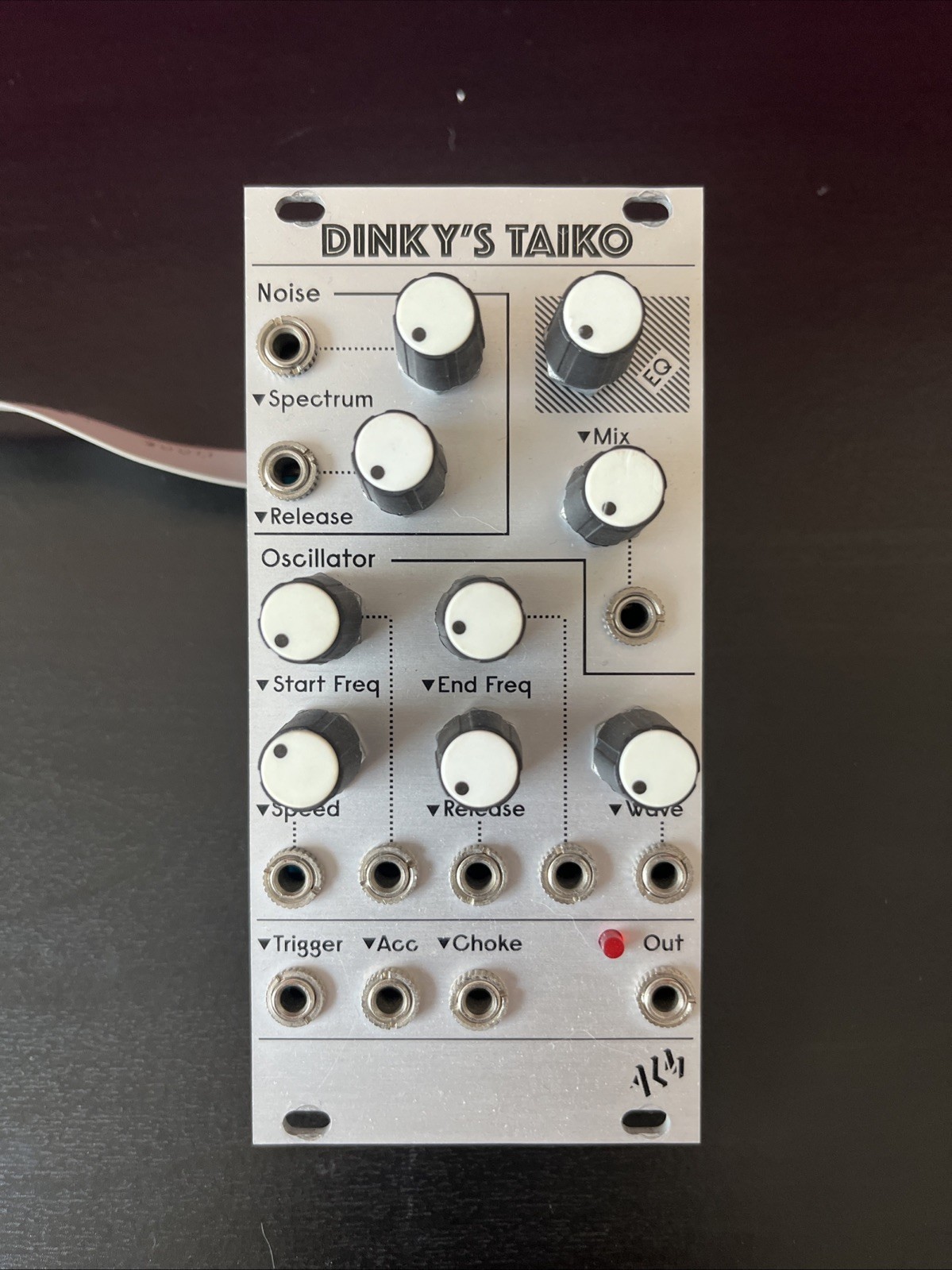
The Taiko’s architecture is built on a simple but potent duality: noise and tone. On one side, a digital noise generator offers a spectrum from crisp white noise to lo-fi, granular bursts that sound like a ZX Spectrum exploding. The noise section isn’t static—it has its own release control, letting you shape how long the hiss lingers after a trigger. Patch in CV and you can modulate the noise frequency, turning a simple hi-hat into a sweeping metallic scrape. On the other side sits a digital wavetable oscillator with 24 waveforms, including sines, triangles, and more complex digital shapes. This is where the “drum” part of the drum module really lives. By setting a start and end frequency, you can create pitch sweeps that mimic the snap of a snare or the thud of a tom. But crank the speed knob too high and the oscillator starts cycling through its pitch range repeatedly, generating FM-like overtones and metallic resonance. This isn’t true FM synthesis, but it flirts with it in the best possible way—unpredictable, rich, and slightly unstable.
Analog Output Path: The Secret Sauce
Despite being a digital module at heart, the Taiko ends its signal path in analog. After the noise and oscillator are mixed, the combined signal passes through an analog tilt EQ—a simple but effective tone control that boosts highs while cutting lows (or vice versa). This subtle analog coloring is what keeps the Taiko from sounding clinical. It rounds off the digital edges, adding warmth and presence that pure digital modules often lack. It’s not a full filter, but it’s enough to shape the character of the sound in real time. Turn it one way and your snare cuts through a mix; turn it the other and it becomes a muffled thump buried in the back. Because the EQ is analog, it responds to voltage changes with a smoothness that digital tone controls sometimes miss. It’s a small detail, but it’s critical—this is the part that makes the Taiko feel alive, not just programmed.
Chaos by Design: CV Control and Unintended Consequences
What sets the Taiko apart from most drum modules is how deeply it embraces control voltage. Nearly every parameter—oscillator start and end frequency, noise release, mix level, even the speed of the pitch sweep—can be voltage-controlled. This turns the module into a dynamic sound generator rather than a static drum machine. Patch in an LFO to the oscillator speed, an envelope to the noise frequency, and a random voltage to the mix, and suddenly you’re not just playing drums—you’re conducting a small electronic storm. The accent and choke inputs add another layer of performance control. Accent lets you dynamically shift the intensity of a hit, while choke truncates the sound immediately when triggered, perfect for tight hi-hat closures or stopping runaway decays. But the real magic happens when you overmodulate. Push the CV inputs too hard and the Taiko starts to break apart in beautiful ways: oscillators jump to inharmonic frequencies, noise turns into digital screech, and the whole thing feels like it’s on the verge of collapse. Some modules fight against instability; the Taiko leans into it.
Historical Context
The ALM Dinky’s Taiko arrived in 2016, right when Eurorack was shifting from boutique curiosity to mainstream staple. At the time, drum modules were mostly split between faithful recreations of classic machines (Roland 808/909-style voices) and more experimental digital designs. The Taiko didn’t fit neatly into either camp. It wasn’t trying to be vintage, nor was it a polished, sample-based powerhouse. Instead, it leaned into the DIY, hacker-friendly ethos of the modular community, offering a raw, tweakable platform for sound design. Its 12-bit resolution was a deliberate aesthetic choice—enough fidelity to be musical, but coarse enough to feel gritty and alive. This placed it alongside other “character” modules like the Noise Engineering Basimilus Iteritas Alter (BIA), though the Taiko was less about algorithmic complexity and more about hands-on, immediate sonic manipulation.
ALM/Busy Circuits, led by Matthew Allum, had already built a reputation for quirky, utility-driven modules like Pamela’s PRO Workout and the Joranalogue Fold 6. The Taiko continued that tradition—functional, yes, but also deeply idiosyncratic. It wasn’t designed to be the only drum module in your rack; it was meant to be the wildcard, the one you reach for when everything else sounds too safe. Competitors like Tiptop Audio’s Trigger Riot or Make Noise’s Mimeophon offered more structured approaches to drum synthesis, but they lacked the Taiko’s anarchic spirit. Even within ALM’s own lineup, the Taiko stood apart—later modules like Akemie’s Taiko leaned into FM synthesis and offered more refinement, but the original Dinky’s version remained the raw, unfiltered id of the brand’s percussion philosophy.
Collectibility & Value
As of 2026, the ALM Dinky’s Taiko is no longer in production, having been quietly discontinued around 2023. This has given it a quiet collectibility among Eurorack enthusiasts, though it’s not the kind of module that trades at absurd markups. In excellent condition, used units typically sell between $250 and $350 USD, depending on region and included accessories. Brand-new old stock (NOS) units, especially those still sealed, can fetch up to $400, reflecting both its cult status and the fact that ALM has no announced successor. It’s not a “grail” module, but it’s increasingly seen as a staple for experimental setups.
That said, buying one requires caution. While the module is generally reliable, there are known quirks. The PCB-mounted potentiometers and jacks, while space-saving, are more fragile than panel-mounted components. Heavy patching or rough handling can lead to cracked solder joints or loose controls. The 12-bit digital core, while charming, can introduce aliasing at high frequencies—especially when the oscillator is pushed into audio-rate modulation. Some users report a faint high-frequency whine under certain conditions, though this is often masked by the noise section in practice. The module does not have onboard memory or presets, so every sound must be recreated manually—a blessing for purists, a frustration for performers.
When buying, check that all knobs turn smoothly and that the trigger inputs respond consistently. Test each CV input with a known source to ensure modulation tracking is linear. Because the Taiko thrives on interaction, a unit that feels sluggish or unresponsive will never deliver its full potential. Also, verify that the power connector is intact and that the module has reverse polarity protection—though all units do, damaged headers can still cause issues. Repairs are possible but require surface-mount soldering skills, so unless you’re comfortable with a reflow station, stick to units in good working order.
eBay Listings
As an eBay Partner, we earn from qualifying purchases. This helps support our independent vintage technology research.