ALM Pamela's PRO Workout (2022–)
It doesn’t just keep time—it warps it, bends it, and throws it into a kaleidoscope of rhythmic voltage.
Overview
You patch in a clock, hit start, and suddenly your whole system is breathing in unison—like flipping a switch and waking up a sleeping brain. That’s the magic of the ALM Pamela’s PRO Workout: it’s not just a clock divider or an LFO source, it’s the central nervous system of a Eurorack rig. From the moment you see that vibrant color screen light up with crisp waveforms and real-time feedback, you realize this isn’t incremental evolution—it’s a full-body upgrade to one of modular synthesis’s most legendary modules. The original Pamela’s Workout was already a titan, found in nearly every serious rack by 2015. The PRO Workout doesn’t replace it so much as launch it into orbit, packing more processing power, deeper modulation routing, and a visual interface so intuitive you’ll wonder how you ever programmed rhythms without it.
Where the earlier Pamela’s NEW Workout expanded the concept into modulation and Euclidean rhythms, the PRO Workout goes further—much further. It’s faster, smarter, and infinitely more flexible. With clock divisions stretching down to /16384 and multiplications up to x192, it can generate glacially slow control voltages or hyperkinetic pulses that blur into tone. Each of the eight outputs isn’t just a trigger or a square wave anymore; they’re full-fledged modulation sources capable of producing envelopes, ratchets, exponential curves, trapezoids, and even quantized melodic sequences that dance across scales with precision. And unlike earlier versions, where deep editing meant squinting at a monochrome LED display, the PRO’s full-color screen renders everything in high resolution—waveforms, timing grids, Euclidean patterns—so you’re not guessing what’s happening, you’re seeing it.
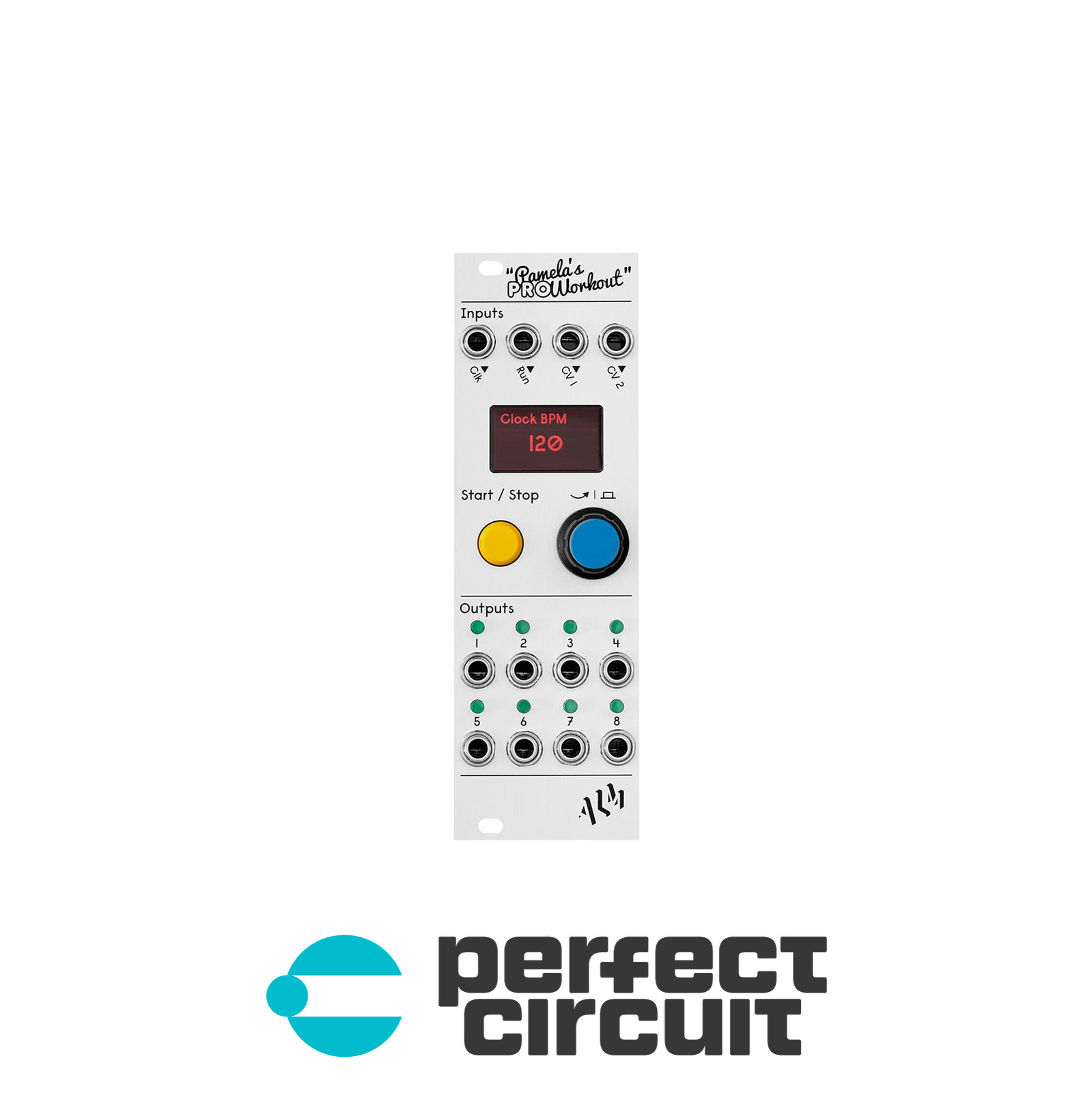
It’s also one of the few modules that genuinely earns the “do-it-all” label without sacrificing usability. The interface, built around a large clickable encoder and a bright yellow start/stop button, remains fast and tactile. You can tweak parameters on the fly, assign CV controls in seconds, and save entire setups—including individual output states—to one of seven banks (56 slots total). It remembers everything when powered down, so your favorite rhythmic chaos is never more than a button press away. But what really sets it apart is how it encourages play. The “Flex” timing system lets you nudge pulses off-grid for humanized swing, bouncing-ball rhythms, or stuttering micro-delays. Cross-modulation between outputs means one LFO can modulate another’s phase or slew, creating evolving, self-generating patterns that feel alive. It’s not just a tool—it’s a collaborator.
Specifications
| Manufacturer | ALM / Busy Circuits |
| Production Years | 2022– |
| Original Price | $375 USD |
| Size | 8HP |
| Depth | 32mm (approx with power header) |
| Power | +12V 60mA / -12V 10mA |
| Outputs | 8 x 0–5V buffered, low impedance |
| Resolution | 12-bit |
| Max Update Frequency | 3.8kHz |
| Clock Range | 10–303 BPM |
| Clock Division/Multiplication | /16384 to x192 |
| Waveform Types | Sine, triangle, saw, square, pulse, trapezoid, hump, exponential, logarithmic, random, ratchet, Euclidean, quantized |
| CV Inputs | 4 x 0–5V assignable |
| Inputs | Clock (rising edge, 700mV min), Run (rising edge) |
| Display | Full-color, high-resolution, themeable UI |
| Firmware Update | USB-C drag-and-drop |
| Memory | 7 banks (56 total slots), non-volatile |
| Expanders Supported | PPEXP1, PPEXP2, Axon-1, Axon-2 |
Key Features
A Display That Changes Everything
The jump from the NEW Workout’s monochrome display to the PRO’s full-color screen isn’t just cosmetic—it’s transformative. Suddenly, programming Euclidean rhythms isn’t an abstract math exercise; it’s a visual grid where you see each trigger’s placement in real time. The oscilloscope mode lets you watch any output’s waveform evolve, adjusting slew or phase with immediate feedback. You can even customize the UI theme—choose between bright, high-contrast modes for live use or darker palettes for low-light studios. This screen doesn’t just display data; it invites interaction. Want to see how a cross-modulated LFO is affecting another output’s timing? Scope it. Need to fine-tune a ratchet pattern’s density? Watch the pulses stack in real time. It turns what was once a menu-diving chore into something immediate and tactile.
Unmatched Clock Resolution and Flex Timing
Most clock dividers top out at /512 or /1024. The PRO Workout goes to /16384—slow enough to generate control voltages that shift over minutes, perfect for ambient drones or generative installations. On the other end, x192 multiplication spits out pulses so fast they verge on audio rate, ideal for FM modulation or chaotic digital textures. But the real genius is in the “Flex” system, which lets you detune timing off the grid. This isn’t just swing—it’s microtiming with character. You can create “bouncing ball” rhythms where each pulse lags slightly behind the last, or humanize a sequence with randomized micro-delays. It’s the difference between robotic precision and something that feels organic, almost nervous. And because it’s voltage-controllable, you can modulate the amount of flex in real time, making rhythms that breathe and shift with the music.
Cross-Modulation and Self-Generating Chaos
One output modulating another isn’t just possible—it’s effortless. The PRO Workout lets any output serve as a modulation source for any parameter on any other output. Want Output 3’s random voltage to control Output 5’s slew? Done. Need a Euclidean pattern to modulate an LFO’s phase? Patch-free and assignable in seconds. This turns the module into a self-contained ecosystem of interlocking rhythms. With firmware updates enabling “triggered” output modes (essentially envelopes triggered by CV), it starts to blur the line between modulation source and sequencer. You can build feedback loops where one output’s behavior alters another, which in turn reshapes the first—generative patches that evolve for hours without repetition. It’s not just powerful; it’s dangerously fun.
Historical Context
The original Pamela’s Workout, released around 2010, was ALM’s first Eurorack module—and it landed like a bomb. At a time when clock division was often handled by bare-bones utility modules, Pam offered eight fully editable, voltage-controllable outputs with randomization, pulse width, and delay in a compact 8HP package. It quickly became a staple, praised for its robust build, intuitive interface, and sheer utility. The follow-up, Pamela’s NEW Workout, doubled down by adding waveform selection, Euclidean rhythms, and CV control over nearly every parameter, transforming it from a clock module into a full modulation powerhouse. By 2020, it was ranked among the most popular modules on ModularGrid.
The PRO Workout arrives at a moment when Eurorack is maturing—users aren’t just building systems, they’re refining them. They want depth, reliability, and visual feedback. Competitors like Make Noise Tempi or Intellijel Metropolis offer advanced timing, but none match the PRO Workout’s combination of density, flexibility, and ease of use. It’s not trying to be a standalone sequencer or a full DAW replacement; it’s a focused, high-performance modulation engine that slots seamlessly into any rig. Its release also coincided with a broader trend toward firmware-upgradable modules, and ALM has delivered—regular updates have added features like new multipliers, cross-modulation options, and improved external clock syncing. It’s a module designed to grow with its user, not become obsolete in two years.
Collectibility & Value
Despite being a recent release, the PRO Workout has already achieved near-legendary status—partly due to its pedigree, partly due to its capabilities. New units sell for around $375, but prices on the used market vary widely based on condition and availability. Expect to pay $300–$350 for a clean, fully functional unit from a reputable seller. Units with screen issues or power damage are rare but can drop to $200 or lower—avoid these unless you’re prepared for repair. The module is solidly built, with reverse power protection and a robust PCB, but the USB-C port and display are the most vulnerable points. Some early firmware versions had bugs related to clock syncing or bank saving, so ensure the unit is updated to at least v1.25 (current as of 2025).
What breaks? Not much, honestly. The encoder and buttons are rated for tens of thousands of cycles, and the power draw is low enough to avoid stressing bus boards. The real risk comes from expanders—PPEXP1 and Axon-2 units must be properly seated, and misalignment can cause intermittent CV issues. Always test all outputs and CV assignments before buying. Also, while the module supports DIN Sync and MIDI via expanders, those features require additional hardware and aren’t built-in—a common point of confusion for new buyers.
For collectors, the PRO Workout isn’t a “future classic” in the vintage sense—it’s a current essential. It won’t appreciate like a vintage Roland, but it’s unlikely to lose relevance. If you’re building or upgrading a Eurorack system in 2026, this isn’t a luxury; it’s a strategic investment. Pair it with the Axon-2 for expanded CV control, or the PPEXP1 for extra outputs, and you’ve got a rhythmic command center in under 16HP. Just don’t expect aerobic benefits—the manual jokes about that, but the only workout you’ll get is from patching faster than the patterns evolve.
eBay Listings


As an eBay Partner, we earn from qualifying purchases. This helps support our independent vintage technology research.