ADDAC 402B (2013–Present)
The brain transplant that turns a rhythm module into a full-blown MIDI citizen—without turning your rack into a tangle of USB converters and DIN cables.
Overview
You know that moment when you’ve got your Eurorack system humming along with perfect, self-contained logic—until you need to sync it to a DAW or external sequencer, and suddenly you’re knee-deep in MIDI-to-CV boxes, configuration menus, and ground loop hum? The ADDAC 402B exists to kill that problem dead, but it’s not just another MIDI interface. It’s a surgical upgrade designed specifically for the ADDAC 402 Heuristic Rhythm Generator, transforming it from a clever standalone pattern engine into a full participant in your studio’s MIDI ecosystem. And it does it with a level of integration that still feels rare, even in 2026.
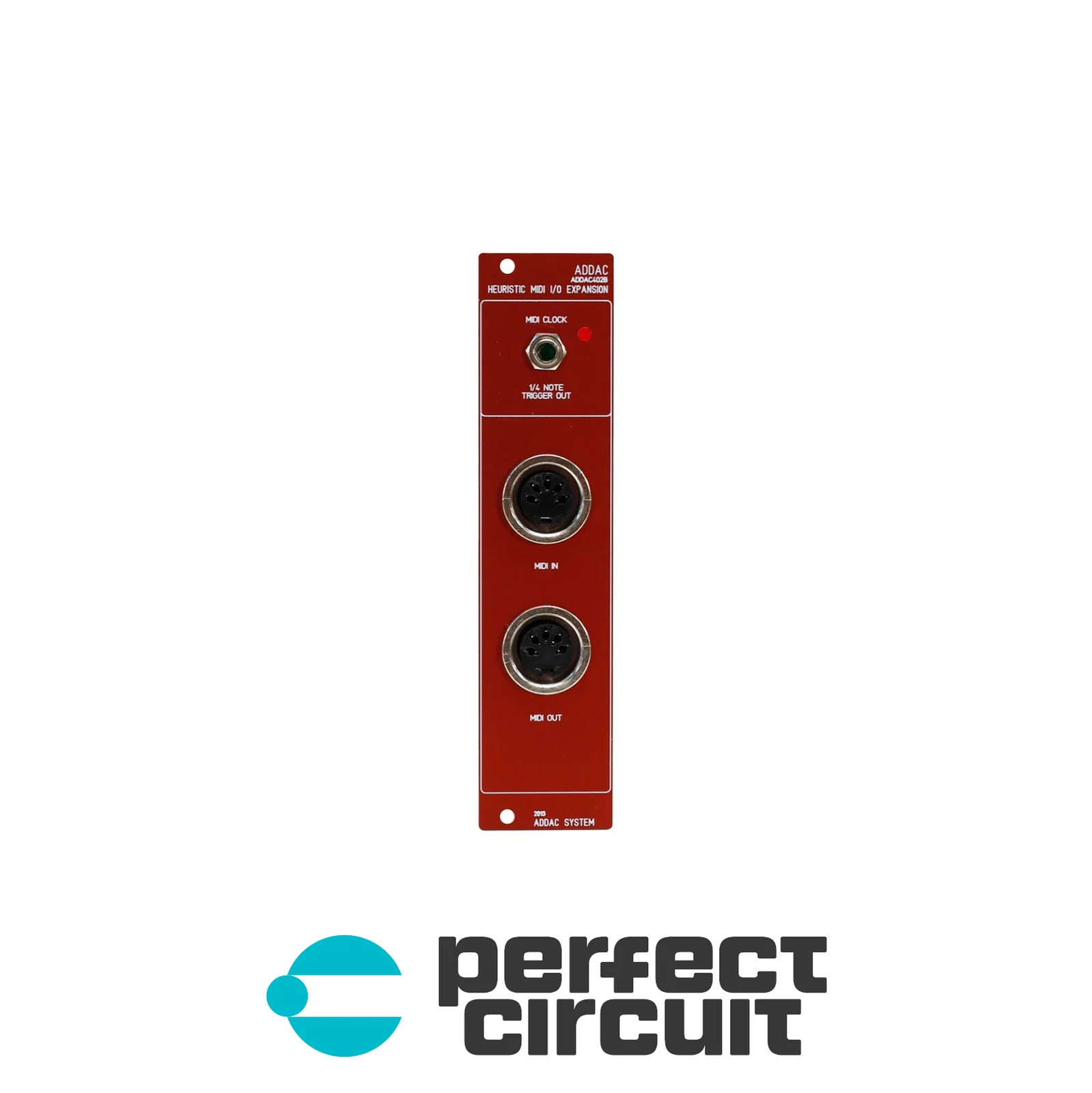
At its core, the 402B is a bidirectional MIDI expander. That means it doesn’t just let the ADDAC 402 receive clock and transport signals from your DAW or master keyboard—it also lets the module send MIDI data out, turning its CV inputs and front-panel controls into MIDI note and CC messages. That’s powerful. Imagine twisting the “Fill 3” knob on your 402 and having it send CC74 to automate a filter sweep in Ableton, or using the “Assign” button to trigger a scene launch. That kind of fluid, two-way dialogue between modular and digital is what makes the 402B more than just a convenience—it’s a bridge between worlds.
It’s also a module built with the realities of live performance in mind. The ability to sync to external MIDI clock with full transport control (play, stop, continue) means you can drop the 402 into a band setup or live rig and have it behave like any other MIDI device. No more awkward nudging to get it in time. No more manually starting sequences while the drummer counts off. And because every gate output can be controlled via incoming MIDI CC messages, you can sequence the 402 entirely from your DAW if you want to—use it like a four-channel MIDI-triggered percussion module with no patching required.
Specifications
| Manufacturer | ADDAC System |
| Production Years | 2013–Present |
| Original Price | €110 |
| Format | Eurorack |
| Width | 6 HP |
| Depth | 5.5 cm |
| Current Draw | 80 mA +12V, 40 mA -12V, 0 mA 5V |
| Bus Board Connector | 8×2 IDC (Doepfer style) |
| MIDI Sync | Yes, with transport control (play, stop, continue) |
| CV to MIDI | 5 CV inputs (Fills 1–4, Assign) to MIDI Notes and/or CC |
| MIDI to Gate | 4 gate outputs controllable via MIDI CC |
| MIDI Controller | All 9 knobs, 4 toggle switches, 11 push buttons as CC out |
| MIDI Control In | All panel controls automatable via MIDI CC with MIDI learn |
| Preset Control | Change presets and modes via MIDI |
| MIDI Channels | CV inputs can be assigned to independent MIDI channels |
| Configuration | Menu-based setup with MIDI learn function |
| Weight | 180 g |
| Custom Panel Options | Black, Green, Blue, White, Silver Gray, Yellow, Gold |
Key Features
Seamless Bidirectional MIDI Integration
The 402B doesn’t just bolt MIDI onto the ADDAC 402—it weaves it in. Unlike generic MIDI-to-CV modules that treat your rack like a dumb terminal, the 402B respects the 402’s architecture and enhances it. The five CV inputs (Fills 1–4 and Assign) can each be mapped independently to MIDI notes or CC messages, and they can even transmit on separate MIDI channels. That means you could have Fill 1 triggering a snare in your DAW on channel 10 while Assign opens a filter on channel 3—all from the same module. The MIDI learn function makes setup intuitive: just press the learn button, move the control, and the 402B assigns the CC number automatically. No digging through hex codes or SysEx dumps.
Full MIDI Control Over the Host Module
What really sets the 402B apart is that it doesn’t just let the 402 talk MIDI—it lets it listen. All 24 front-panel controls (knobs, switches, buttons) can be automated via incoming MIDI CC messages. That means you can store and recall every parameter of the 402 in your DAW, turning it into a fully automatable rhythm module. Want to morph from a Euclidean pattern to a Game of Life sequence mid-song? Program it in your sequencer. Need to trigger a manual gate reset from a MIDI clip? Done. This level of control is rare even in modern modules, and it’s what makes the 402B feel like a studio-grade tool rather than a modular curiosity.
Compact, Purpose-Built Design
At just 6 HP, the 402B doesn’t demand much real estate, but it doesn’t cut corners either. It uses the same industrial-grade PCB and front panel construction as the rest of the ADDAC 400 series, and it shares the same 5.5 cm depth—meaning it fits comfortably in most skiffs and travel cases. The module doesn’t have its own audio or CV processing; it exists purely to extend the 402’s functionality. That focus is refreshing in an ecosystem where “feature creep” often leads to bloated, confusing interfaces. The 402B does one thing, and it does it well.
Historical Context
When the ADDAC 402 launched in 2013, Eurorack was still in the middle of a digital renaissance. Modules were getting smarter, more programmable, and more connected—but MIDI integration remained a pain point. Most solutions were either clunky (external breakout boxes) or limited (simple clock in/out). The 402B arrived as part of a wave of purpose-built expanders—modules designed not to stand alone, but to deepen the functionality of a specific host. Think of it like a firmware upgrade in hardware form.
At the time, competitors like Expert Sleepers and Kenton were offering universal MIDI interfaces, but they required complex patching and configuration to achieve what the 402B does out of the box. The 402B’s tight coupling with the 402 meant it could offer deeper integration than any general-purpose box. It wasn’t trying to be everything to everyone—it was solving a specific problem for a specific user: the modular artist who wanted their rhythm generator to play nice with the rest of their studio.
That philosophy reflected a broader trend in the mid-2010s: the rise of “smart” modular, where digital brains began to augment analog signal paths. The 402B wasn’t just a MIDI interface—it was a statement that modular could be both deeply hands-on and tightly integrated with digital workflows. It helped pave the way for later modules that blend CV and MIDI with even greater sophistication.
Collectibility & Value
The ADDAC 402B has never been a rare module, but it’s also never been common. It’s a niche product for a niche system, which means it doesn’t flood the used market. As of 2026, it typically sells for between €90 and €130 used, depending on condition and whether it includes the original firmware update cable. That’s close to its original €110 price, which speaks to its enduring utility. Unlike some early MIDI interfaces that have been rendered obsolete by USB-C and modern DAWs, the 402B remains relevant because it’s tied to a module (the 402) that still has a cult following.
That said, there are a few things to watch for. The 402B requires a firmware update to function at its full potential, and that update process relies on an FTDI USB-to-serial adapter—a cable that’s not included and can be tricky to source. Some sellers omit this detail, leaving buyers stranded. Always confirm whether the module has been updated or if the adapter is included. Also, while the 402B is solidly built, the MIDI DIN jacks can loosen over time if cables are frequently plugged and unplugged. Check for wobble or intermittent connections.
If you don’t own the ADDAC 402, the 402B is useless. It’s not a standalone MIDI interface. But if you do, it’s one of the most cost-effective ways to bring deep MIDI integration to your rack. It’s not flashy, but it’s one of those modules that, once installed, you wonder how you ever lived without.
eBay Listings

As an eBay Partner, we earn from qualifying purchases. This helps support our independent vintage technology research.