ADDAC 216 (2019–)
A deceptively deep utility that turns subtraction into an instrument—like finding a secret circuit behind your modular’s wall panel.
Overview
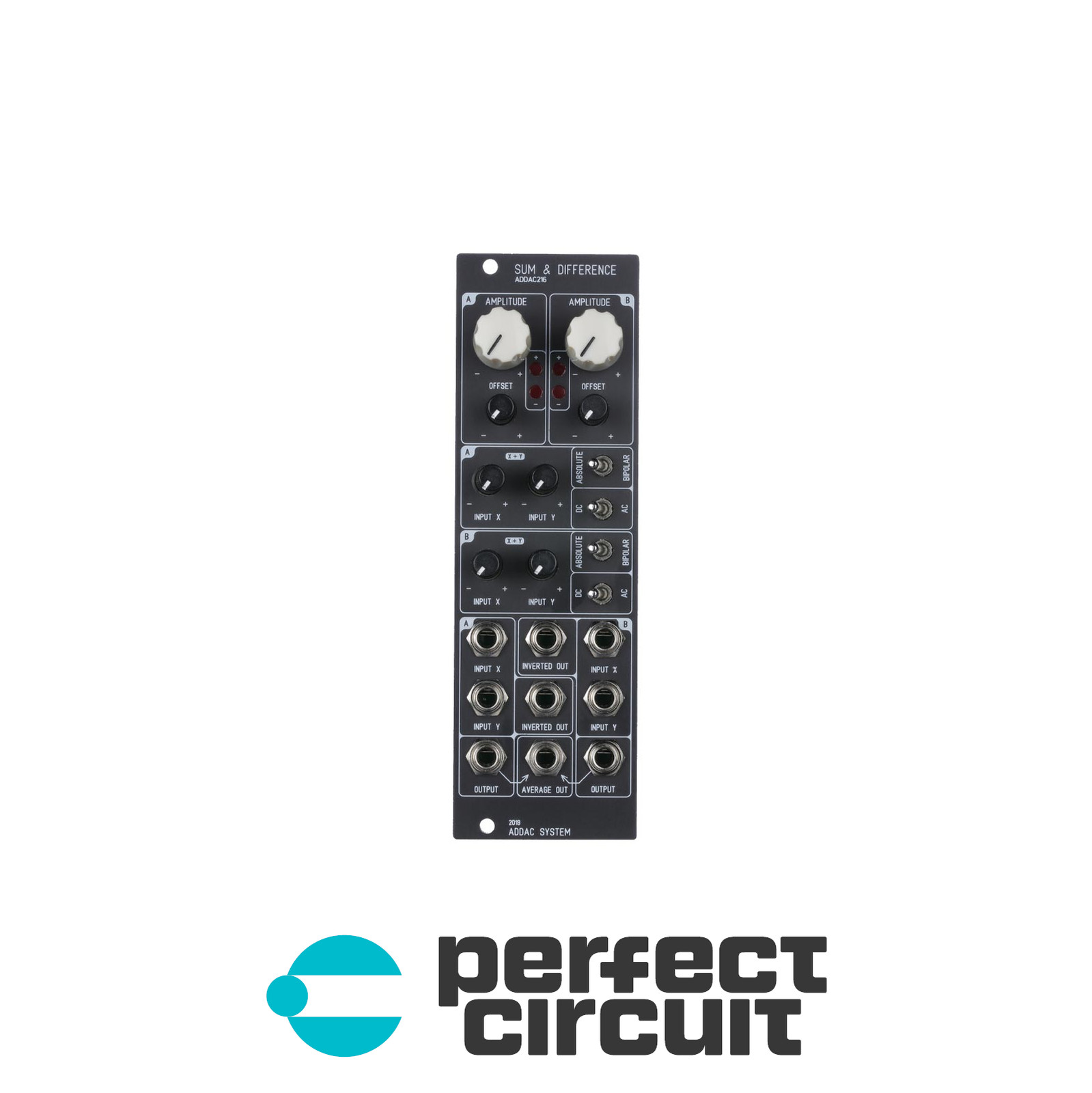
It doesn’t scream for attention: two mirrored sections, a few knobs, some switches, and a clean black faceplate. But the ADDAC 216 isn’t just another attenuverter or passive mixer—it’s a signal alchemist. Plug in two CV sources and instead of just blending them, you can subtract one from the other, opening up rhythmic modulations, differential envelope shaping, or phase-canceled audio textures that feel like they’re breathing in reverse. It’s the kind of module you install thinking, “Yeah, I’ll use this for basic offsetting,” and end up rewiring entire patches around its ability to generate entirely new control voltages from mathematical relationships. And because it handles both CV and audio, the line between modulation and sound source blurs in the best possible way.
This is the quiet brain of a complex system—the utility that solves problems you didn’t know you had. Want to derive a fluctuating LFO depth from the difference between two slow random walks? Done. Need to invert and rectify a pitch CV so it modulates in mirrored symmetry? The 216 eats that for breakfast. Each of its two sections (A and B) functions independently, with dual inputs (X and Y), their own attenuverters, and a sum/difference stage that can be toggled between adding or subtracting the signals. But it doesn’t stop there. After the math happens, the result runs through a switchable full-wave rectifier (“Absolute”), which flips negative voltages into positive territory—handy for turning bipolar LFOs into unipolar control or creating mirrored pulse patterns from smooth waves. Then comes the Amplitude attenuverter, which not only scales the output but can flip its polarity, followed by an AC/DC coupling switch and a bipolar offset knob that nudges the entire signal up or down. You get a standard output and an inverted output per section, plus an “Average” output that sums both A and B—essentially a mini mixer of the processed results.
It’s not flashy, but it’s fundamental. The 216 doesn’t make sound on its own, but it shapes how everything else behaves. It’s the difference between a patch that merely works and one that feels alive—responsive, dynamic, and full of hidden motion. And with LEDs monitoring polarity and gain on each section, you’re never guessing what the signal is doing. It’s the kind of module that makes you realize how much you’ve been approximating with workarounds in other systems.
Specifications
| Manufacturer | ADDAC System |
| Production Years | 2019– |
| Original Price | €135 (assembled), €100 (DIY kit, excl. VAT) |
| Width | 8hp |
| Depth | Not specified |
| Power | ±12V |
| Current Draw +12V | 80 mA |
| Current Draw -12V | 80 mA |
| Format | Eurorack |
| Panel Color | Black (standard), custom colors available |
| DIY Option | Yes, SMD/through-hole hybrid kit |
| Sections | 2 independent (A and B) |
| Inputs per Section | 2 (X and Y), with individual attenuverters |
| Processing per Section | Sum or difference (X+Y or X–Y) |
| Rectification | Switchable full-wave (Absolute) |
| Amplitude Control | Attenuverter with polarity inversion |
| Coupling | Switchable AC/DC |
| Offset | Bipolar knob per section |
| Outputs per Section | Normal and inverted |
| Average Output | Sum of A and B section outputs |
| LED Indicators | 2 per section (polarity and gain) |
Key Features
The Math is the Modulation
Most mixers add. The 216 lets you subtract—and that changes everything. Being able to take X–Y instead of X+Y opens up differential modulation that’s incredibly musical. Imagine two LFOs drifting slightly out of phase: their difference creates a slow, swelling waveform that can control filter cutoff or resonance with organic ebb and flow. Or patch two envelope followers from different audio sources—their difference becomes a dynamic CV that responds to spectral contrast. For audio, this means phase cancellation tricks that can thin out waveforms or create pulsating, amplitude-modulated textures. It’s not just utility—it’s composition.
Rectification as a Creative Tool
The “Absolute” switch isn’t just for signal cleanup—it’s a waveform transformer. Flip it on, and any negative portion of the signal gets folded into the positive realm. A sine wave becomes a bouncy full-wave rectified pulse; a random CV turns into a mirrored staircase. This is especially potent when applied to modulation sources. A bipolar LFO modulating pitch? Rectify it, and now you’re only shifting upward in pitch, creating a rising tension that never dips back. It’s like having a diode-based distortion stage for control voltages, and it feels distinctly analog in its behavior.
Attenuversion All the Way Down
Every gain stage here is an attenuverter—meaning you can scale and invert. That’s critical. The inputs have them, the output amplitude has one, and even the offset is bipolar. This gives you total control over signal polarity at every stage, which is essential when patching complex feedback loops or trying to balance positive and negative CVs. It means you’re not just attenuating—you’re redirecting, inverting, and rebalancing on the fly. And with both normal and inverted outputs per section, you can feed opposing signals into different parts of your system without needing extra inverters.
Historical Context
The ADDAC 216 arrived in 2019, right when Eurorack was deep into the golden age of utility modules. After years of explosive growth in sound-generating modules, builders and players alike started craving deeper control—more precise, more flexible, more intelligent ways to route and shape signals. The 216 fits squarely into that wave, but it stands out by doing more than just summing or offsetting. While other companies were releasing buffered multiples or basic attenuators, ADDAC went further, building a module that performs actual analog computation. It’s part of their 200 Series, which focuses on CV utilities, and it shares DNA with modules like the ADDAC 203 CV Mapper and 218 Attenuverters—but the 216 is the most conceptually ambitious of the bunch.
It didn’t emerge in a vacuum. Modules like the Intellijel Mutamix or the Mutable Instruments Veils had already shown that voltage manipulation could be musical, but the 216 leans harder into mathematical operations. It’s closer in spirit to the MakeNoise QPAS or the ALM Busy Circuits series—modules that treat signal flow as an algebraic playground. But where those can feel dense or intimidating, the 216 keeps its interface clean and its functions clearly labeled. It’s accessible without being dumbed down. And by offering a DIY kit version, ADDAC also tapped into the growing community of builders who wanted to learn by soldering, not just patching.
Collectibility & Value
The ADDAC 216 isn’t a rare bird, but it’s not generic either. Assembled units typically sell for between €130 and €160, depending on region and shipping, while the DIY kit goes for €100 (excluding VAT). Since it’s still in production, there’s no collector’s premium—what you pay new is what it’s worth. But condition matters, especially if buying used. Look for clean jacks, no bent knobs, and no signs of overvoltage damage—though the module is fairly robust, improper power connection could fry the rails. The DIY version is popular among builders, but if you’re not experienced with SMD soldering, it’s not the easiest starter kit. That said, the build guide is thorough, and the community support is solid.
Failures are rare, but the most common issue is mis-soldered joints on the kit version, particularly around the power header or the SMD op-amps. Always test continuity before powering up. The LEDs are a nice diagnostic touch—if one side isn’t lighting up, it’s probably a cold joint or a flipped component. There’s no firmware, no calibration, and no moving parts, so once it’s built and working, it should last indefinitely. No known design flaws or widespread recalls. If you’re buying used, ask if it’s been tested with both CV and audio signals—some sellers only check basic summing and miss the subtleties of the difference mode or rectification.
It’s not a “must-have” for beginners, but for intermediate to advanced users, it’s quietly indispensable. It doesn’t make noise, but it makes everything else smarter. And because it’s so flexible, it rarely gets “outgrown”—you’ll find new uses for it years into your modular journey.
eBay Listings
As an eBay Partner, we earn from qualifying purchases. This helps support our independent vintage technology research.