4ms Dual Looping Delay Black (2016–)
A 20HP slab of digital time travel that turns silence into symphonies and chaos into clockwork—if you’re brave enough to dive into its memory.
Overview
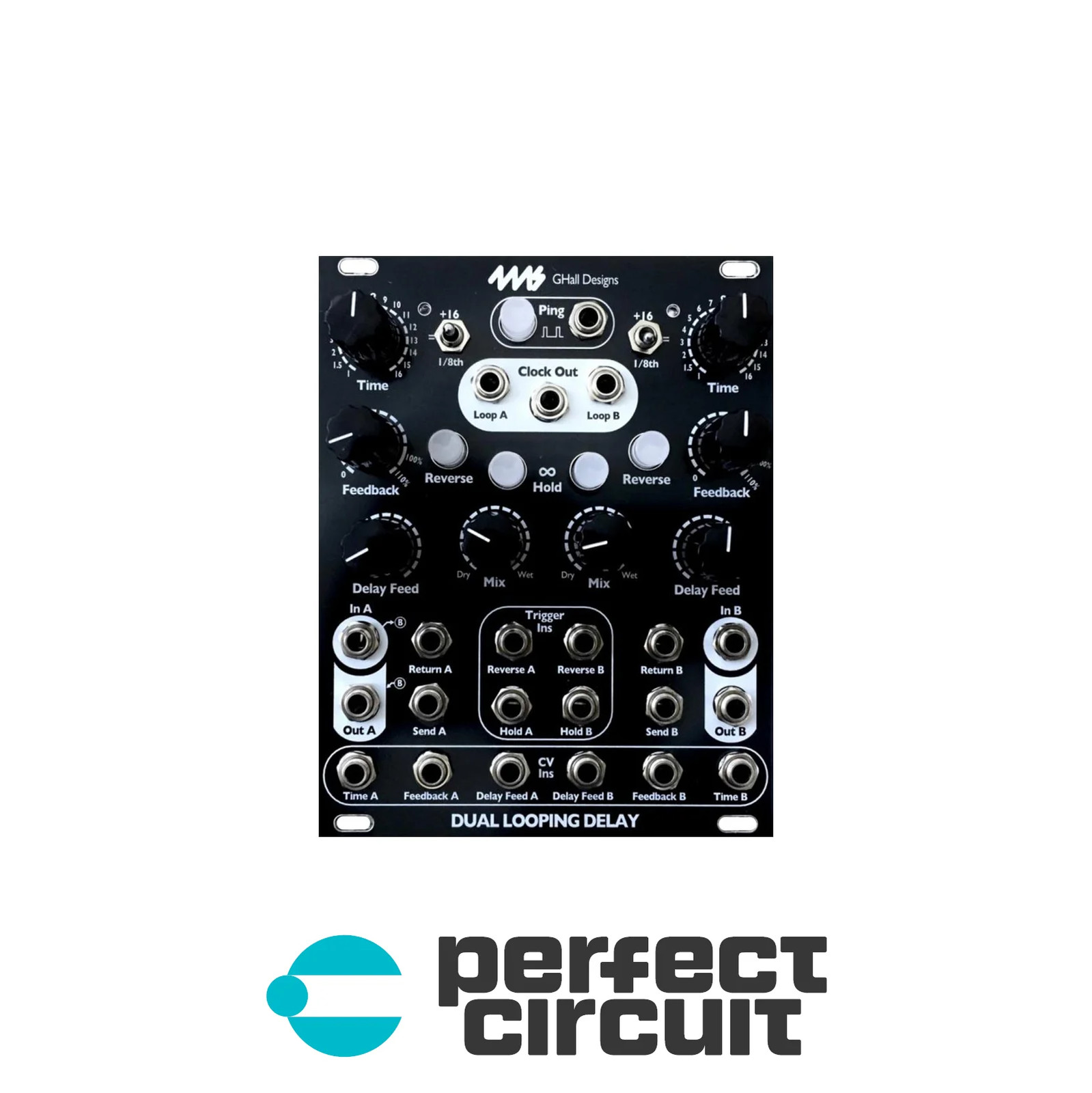
Plug in a signal and wait. Not for a warm-up hum or a tube glow, but for the moment the Dual Looping Delay (DLD) exhales three minutes of your past back at you in perfect clarity. That’s the magic trick: this isn’t a delay that echoes and fades—it’s a delay that remembers, rearranges, and resurrects. The 4ms DLD doesn’t just repeat what you played; it hoards it, loops it, scrambles it, and hands it back in ways you didn’t ask for but suddenly can’t live without. It’s not trying to be warm or degraded. It’s not whispering like tape or wobbling like bucket-brigade chips. It’s sharp, surgical, and unapologetically digital—like listening to your sound through a freshly polished window.
Built for Eurorack, the black-panel DLD occupies 20HP and draws a modest 180mA from the +12V rail, which is nothing wild by modern standards, but it’s enough to tell you this isn’t some lightweight utility module. This is a central nervous system for time-based processing. Two fully independent delay channels—A and B—share a common clock but otherwise go their own way, each capable of up to 174 seconds (nearly three minutes) of delay when running in 16-bit mode. Flip a jumper and switch to 24-bit recording, and you’re down to 88 seconds per channel, but with deeper resolution and less quantization noise. Most users never bother—the 16-bit sound is already pristine, with a frequency response from 0Hz (DC) to 24kHz and a maximum deviation of just -1.7dB. There’s no audible roll-off, no digital harshness—just clean, transparent repeats that don’t color your source, unless you want them to.
And that’s the point: the DLD doesn’t impose character. It’s a canvas. You bring the paint. Want to smear it with resonance? Patch the send into a filter. Want to glitch it into oblivion? Reverse the playback while modulating the clock. Want to build a polyrhythmic labyrinth? Lock one channel to a subdivided clock while the other runs wild. The DLD doesn’t just respond to CV—it thrives on it. Every major parameter—Time, Feedback, Mix, Delay Feed, Reverse, Hold—has a CV input, and because the Time knob can swing into audio rate when clocked fast, you’re not just delaying notes; you’re generating textures, tuning resonant feedback networks, and even creating Karplus-Strong-style plucked string simulations by feeding noise into a tightly tuned delay loop.
But here’s the thing most newcomers miss: the DLD isn’t a looper in the traditional sense. You don’t press record, play, and stop. Instead, it’s always recording. Always. The memory buffer is a rolling timeline, and your “loop” is just a window into that stream. Engage Infinite Hold, and you freeze that window—feedback stops, no new material gets written, and the loop plays back endlessly. But twist the Feedback knob while holding Infinite, and you’re not adjusting volume—you’re scrubbing the start and end points of the loop, digging backward into older recordings, pulling up fragments you forgot you even played. That’s when the DLD reveals its true personality: it’s not just a delay, it’s a time machine with amnesia.
Specifications
| Manufacturer | 4ms |
| Production Years | 2016– |
| Original Price | $415 USD |
| Format | Eurorack |
| Width | 20 HP |
| Power Consumption | 180mA (+12V), 50mA (–12V) |
| Delay Time (Per Channel) | Up to 174 seconds (16-bit), 88 seconds (24-bit) |
| Sampling Rate | 48 kHz |
| Bit Depth | 16-bit (default), 24-bit (jumper-selectable) |
| Frequency Response | 0 Hz (DC) to 24 kHz, ±1.7 dB |
| Inputs | Audio In A/B, Time CV, Feedback CV, Mix CV, Delay Feed CV, Hold CV, Reverse CV, Clock In |
| Outputs | Audio Out A/B, Send A/B, Return A/B, Clock Out, Loop Clock Out A/B |
| Feedback Range | 0% to 110% |
| Time Control | Manual knob with +16, =, 1/8 toggle ranges; CV controllable |
| Clock Options | Internal (tap tempo via Ping button), external clock input |
| Firmware Features | Quantised Change Mode, Ping Lock, De-jitter modes, Unquantised Time Mode |
| Special Functions | Windowing (loop start/end adjustment), Reverse playback, Infinite Hold, Send/Return processing |
| Construction | PCB with surface-mount components, black anodized aluminum panel |
Key Features
Time as a Playable Parameter
Most delays treat time as a fixed setting—set it and forget it. The DLD treats it like a musical instrument. With the Time knob mapped to beat divisions (via the +16, =, 1/8 toggle), you can dial in rhythmic delays that lock perfectly to your sequencer. But hold the Infinite button and twist the Time knob, and you enter Unquantised Time Mode—suddenly, the delay time becomes continuous, free from the grid. This is where the DLD starts to sing in microtonal harmonies. Patch in a VCO square wave to the clock input, set the Time knob to an eighth-note division, and you’re not delaying anymore—you’re tuning a resonant cavity. The Time CV input even shifts to a 1V/octave response in this mode, so you can play the delay time like a pitch. It’s a subtle but profound shift: from rhythmic echo to harmonic generator.
The Send/Return Trapdoor
Every delay has sends and returns. The DLD makes them dangerous. Patch the Send output to a filter, a second delay, a wavefolder—anything with character—and route it back into Return. Now, the feedback path isn’t just repeating your signal; it’s processing it in real time, recursively. That means every repeat gets darker, brighter, noisier, or more distorted, depending on what’s in the chain. But here’s the catch: because the DLD is always recording, those processed repeats get written back into the main buffer. So when you exit Infinite Hold or switch modes, you’re not just hearing the original loop—you’re hearing the ghost of every effect that ever touched it. It’s like leaving a message on a voicemail system that keeps re-recording itself through a distortion pedal. The results are unpredictable, often beautiful, occasionally terrifying.
Clock Independence via Ping Lock
At first glance, both channels share the same clock source. But firmware v5 introduced Ping Lock—a hidden superpower. Engage it on one channel, and that channel freezes its timing reference to the current Ping value, even if the actual clock changes. This lets you run Channel A at a snappy 1/16th note while Channel B crawls at 4-bar phrases, all from a single tempo source. It’s not full dual-clock independence, but it’s close enough for most polyrhythmic experiments. And because the loop clock outputs are also available, you can feed them into dividers, multipliers, or other modules to build complex timing hierarchies. The DLD doesn’t just follow time—it teaches it.
Historical Context
The DLD didn’t emerge from a vacuum. It arrived in 2016, right when Eurorack was shifting from analog obsession to digital experimentation. Before then, digital delays in modular were either cheap PT2399-based modules with lo-fi charm or expensive, closed-box processors. The DLD split the difference: it offered professional-grade digital clarity without sacrificing patchability or control voltage integration. It wasn’t trying to emulate the past—no tape wobble, no BBD warmth. Instead, it leaned into the precision of modern DSP, inspired more by the clean repeats of the Lexicon Prime Time or the Eventide H3000 than by the Echoplex or Space Echo.
At the same time, looping was having a renaissance. Artists like Tim Exile and Robert Henke were pushing the boundaries of live looping with software, but hardware loopers were still largely stuck in guitar pedal territory—record, overdub, play, stop. The DLD rejected that model. By making looping a subset of delay behavior—tied to clock, modulatable, and always recording—it redefined what a looper could be in a modular context. It wasn’t for singer-songwriters; it was for sound designers, ambient composers, and rhythm hackers who wanted to build evolving textures that unfolded over minutes, not measures.
And let’s not forget the firmware. The DLD shipped with v3, but v5—released a year later—was transformative. It added 24-bit recording, de-jitter modes for cleaner clock handling, and Quantised Change Mode, which prevented abrupt parameter jumps by syncing changes to the next clock pulse. These weren’t gimmicks; they were essential refinements that made the module more musical. But updating the firmware wasn’t plug-and-play: you had to play an audio file into the input while rebooting, and some older power supplies couldn’t handle the boot loader. It was a reminder that this wasn’t a consumer product—it was a hacker’s tool, built for those willing to dig into the guts.
Collectibility & Value
The DLD has never been rare—4ms has kept it in steady production since 2016—but it’s also never been cheap. New units still sell for around $415, and used ones typically fetch $300–$375 depending on condition. There’s no “vintage premium” here, no collector markup—just consistent demand from working musicians who need its unique capabilities. That’s a good sign: it means people aren’t buying it to flip, but to use.
Condition matters, but not in the way you’d expect. The black anodized panel is scratch-resistant, and the PCB is solid, but the real risk lies in firmware and power. Units that have never been updated to v5 are functional but missing key features. Buyers should verify the firmware version before purchasing. More critically, some early adopters reported boot loader issues with underpowered or noisy power supplies—especially older Doepfer units. While not a common failure, it’s a known quirk: if a DLD won’t update, try it with a clean, high-current supply before assuming it’s bricked.
There are no catastrophic failure points—no electrolytic caps to dry out, no fragile pots—but the module is densely packed with surface-mount components, making DIY repairs tricky. If a jack breaks or a chip fails, it’s not a simple fix. And because the DLD is always recording, a malfunctioning memory buffer could result in glitches, dropouts, or corrupted loops. These are rare, but when they happen, they’re showstoppers.
For buyers, the advice is simple: test it live if possible. Check both channels, verify clock sync, try a long loop with windowing, and patch in some CV modulation. Make sure the Infinite Hold and Reverse functions behave as expected. If it passes, you’re not just buying a delay—you’re buying a time machine with a 174-second memory span. And unlike most vintage gear, this one doesn’t degrade with age. If anything, it only gets smarter with firmware updates.
eBay Listings

As an eBay Partner, we earn from qualifying purchases. This helps support our independent vintage technology research.