4ms Rotating Clock Divider (2012–Present)
One of the most deviously clever clock manipulators in Eurorack—turns rigid timing into a swirling, evolving dance with a flick of voltage.
Overview
There’s a moment when you patch the Rotating Clock Divider for the first time and realize your sequencer just learned how to stutter, skip, and surprise itself—on purpose. It doesn’t just divide a clock signal; it rotates the divisions around its eight outputs like a carnival ride spinning out of control, all under CV command. You feed it a steady 120 BPM pulse, and instead of getting predictable /2 or /4 subdivisions, you get a shifting constellation of pulses—/3 here, /7 there, /1 suddenly becoming /5—all dancing in sequence as a control voltage nudges the division map forward. It’s not just a utility; it’s a compositional engine, the kind of module that turns a static loop into something alive, almost nervous in its rhythmic unpredictability.
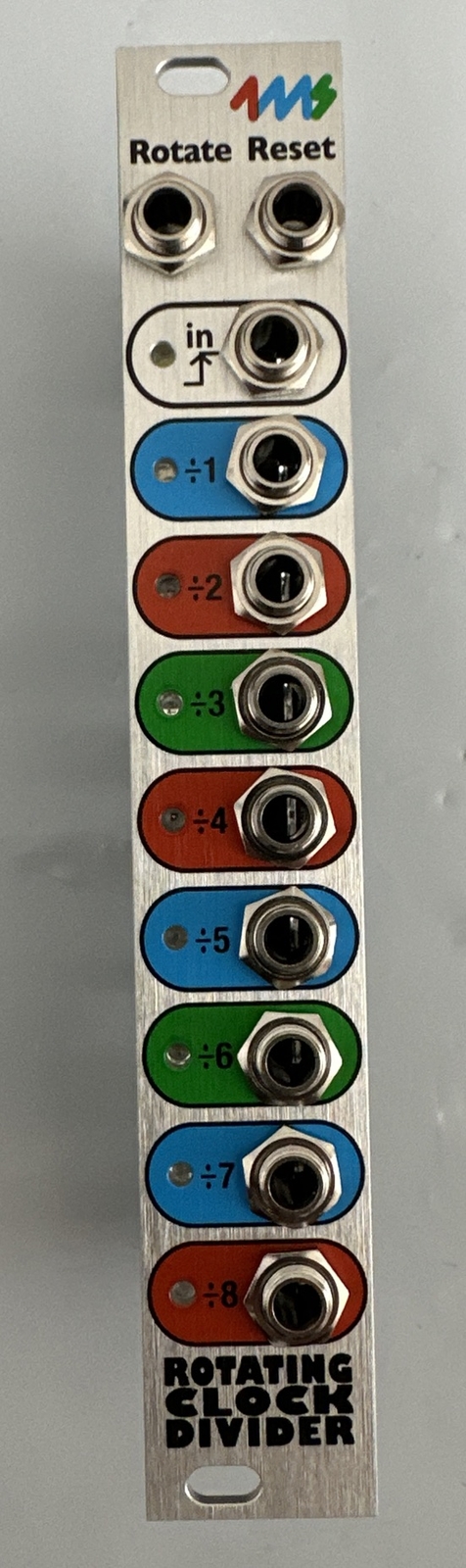
And yet, for all its brain-bending potential, the RCD sits in your rack like a modest little workhorse—4 HP wide, black panel, no flashy lights or endless knobs. But don’t let the size fool you. This thing is dense with possibility. It takes a single clock input (5V to 15V, rising edge triggered, up to 3kHz) and fans it out into eight simultaneous divisions, from /1 to /64. That alone would make it useful. But the magic is in the Rotate CV input: apply a voltage there, and the division values assigned to each output jack shift in unison. So /1 becomes /2, /2 becomes /3, and so on—wrapping around at the end. It’s like rotating a dial that reassigns which beat division each output spits out, and you can sweep that rotation manually or modulate it with an LFO, envelope, or sequencer. The result? A patch that evolves over time, where the rhythm itself becomes a parameter you can automate.
It’s not just for drum machines, either. Patch one of the divided outputs into a sequencer’s clock input, and suddenly your melody starts stuttering in rhythmic bursts. Feed it to a sample-and-hold, and your random voltages get triggered at irregular intervals. Use it to clock a delay’s feedback modulation, and the repeats start breathing in odd-numbered gasps. The RCD doesn’t just keep time—it warps it, questions it, makes it fluid. And when you add the Reset input—letting you re-sync the entire divider to an external trigger—you gain precise control over when the rhythmic chaos starts over, which is crucial when you’re trying to keep things from spiraling too far off the grid.
It’s also a module that rewards deep diving. The factory firmware (version 1.1 and later) added a “Spread” mode, which spaces out pulses more evenly across irregular divisions, making /3 or /5 feel less clunky and more musical. And while the base module is powerful, its real depth comes with the optional RCD Breakout (RCDBO), which unlocks features like selectable auto-reset intervals (every 16, 24, or 32 clocks), gate/trigger mode selection, and user-defined division ranges. Without the breakout, you’re limited to the default settings; with it, you can tailor the RCD’s behavior to fit anything from dancefloor grooves to abstract noise. That said, the breakout isn’t just a convenience—it’s practically a necessity if you want to avoid the “clunkiness” some users report when rotating through prime-number divisions. Auto-reset, in particular, keeps the timing from drifting into arrhythmia, making odd divisions feel intentional rather than broken.
Specifications
| Manufacturer | 4ms Company |
| Production Years | 2012–Present |
| Original Price | $179.00 (factory-built), $95.00 (kit) |
| Module Size | 4 HP |
| Depth | 35mm (factory-built), 48mm (kit) |
| Power Consumption (5VSEL = INT) | +12V: 33mA, -12V: 4mA, +5V: 0mA |
| Power Consumption (5VSEL = EXT) | +12V: 19mA, -12V: 4mA, +5V: 14mA |
| Clock Input | 5V to 15V, rising edge triggered, max 3kHz |
| CV Rotate Input | 0V to +5V |
| CV Reset Input | 5V to 15V trigger |
| Divided Clock Outputs | 8 (Divide-by-(1+R) to Divide-by-(8+R), where R = rotation value) |
| Division Range | /1 to /64, including odd and non-standard divisions |
| Auto-reset Functionality | Yes (via jumper or breakout panel, intervals: 16/24/32 clocks) |
| Selectable Gate/Trigger Mode | Yes (via jumper or breakout) |
| Selectable Divide Range | Yes (via breakout panel) |
| Up/Down Counting | Yes (via breakout panel) |
| Firmware Upgradable | Yes (AVR-based, hex files available) |
| Included Accessories | 16-to-16 pin power cable, 2 M3 knurled screws (factory-built) |
| Kit Availability | Yes (RCD Kit, beginner-level assembly) |
Key Features
The Rotate CV: Rhythm as a Moving Target
The heart of the RCD’s innovation is the Rotate CV input. Most clock dividers give you fixed outputs—/2 here, /4 there—and you patch them once and forget them. The RCD laughs at that. With Rotate CV, you’re not just choosing divisions; you’re choreographing how they move over time. Patch an LFO into Rotate, and your /3 output might become /4, then /5, then /6—all while still sending pulses. This isn’t just modulation; it’s metamorphosis. You can set up a patch where every 16 bars, the entire rhythmic structure shifts—maybe your hi-hats go from straight eighth notes to a polyrhythmic stagger, or your bass sequence starts skipping beats in a new pattern. It’s the kind of feature that turns a sequencer from a playback device into a collaborator. And because the rotation affects all eight outputs simultaneously, the entire rhythmic ecosystem evolves together, maintaining internal coherence even as it transforms.
But it’s not without its quirks. Because all outputs rotate in lockstep, you can’t independently modulate one division without affecting the others. Some users find this limiting—especially if they want to keep a steady /2 pulse while rotating only the odd divisions. That’s where firmware hacks come in. Enthusiasts have modified the code to allow selective rotation (e.g., only /1 rotates, others stay fixed), but that requires flashing the AVR chip yourself. For most, the all-or-nothing rotation is part of the charm—it forces you to think in terms of systemic change rather than isolated tweaks.
Reset and Sync: Keeping Chaos in Check
Left to its own devices, the RCD can drift into rhythmic oblivion—especially when using irregular divisions like /7 or /11. That’s where the Reset input saves the day. Feed it a trigger pulse (5V to 15V), and the entire divider resets its counters, snapping all outputs back into phase. This is essential when syncing to an external sequencer, drum machine, or master clock. Want your rotating pattern to restart every 32 beats? Patch a /32 divided clock into Reset. Need to re-sync after a tempo change? Hit it with a start pulse. The Reset function turns the RCD from a free-associative rhythm generator into a disciplined performer that still has room for surprise.
Even more useful is the auto-reset feature, accessible via jumpers on the back or the RCDBO panel. Set it to reset every 16, 24, or 32 clocks, and the module automatically re-syncs itself—perfect for keeping danceable grooves tight even when using “weird” divisions. Without auto-reset, a /5 division might slowly drift out of phase with the master clock over time; with it, the pattern snaps back into alignment at regular intervals, making odd divisions feel intentional rather than sloppy.
Expandability: The Breakout That Unlocks the Beast
The base RCD is powerful, but it’s the Breakout (RCDBO) that reveals its full potential. Without it, features like auto-reset, selectable division ranges, and gate/trigger mode are either fixed or require manual jumper adjustments. The breakout panel adds front-panel access to these parameters, letting you tweak them on the fly. Want to switch from /1–/8 to /16–/64 divisions mid-performance? Done. Prefer gates over triggers for your envelope clocks? Flip the switch. Need to toggle between up-counting and down-counting for reverse rhythmic effects? The breakout makes it possible. It’s not just an add-on—it’s a control surface for the module’s hidden depths. And because the breakout connects via a simple header on the PCB, it’s easy to install, though it does eat up additional panel space.
Historical Context
When the Rotating Clock Divider launched in 2012, Eurorack was still in its adolescence—growing fast, but still figuring out what modular synthesis could be. Most clock dividers were simple, static affairs: divide-by-two, divide-by-four, maybe a /3 or /5 if you were lucky. The RCD arrived as a wildcard, offering not just division, but transformation. It shared DNA with earlier experimental modules from MakeNoise and Doepfer, but its rotating concept was uniquely its own. At a time when many were still using modular for traditional synth voices, the RCD whispered a different idea: that rhythm could be generative, mutable, even emotional.
It also arrived alongside a wave of new timing modules—Mutable Instruments’ Grids, Qu-Bit’s Bloom, the 4ms Shuffling Clock Multiplier—each exploring how voltage could reshape time. But while others focused on probability or randomness, the RCD doubled down on structure. It didn’t randomize; it rotated. It didn’t scatter pulses; it reorganized them. That made it a favorite among composers who wanted controlled unpredictability—artists like Richard Devine, who used it to create intricate, lurching rhythms in his experimental electronic work. The RCD wasn’t for everyone, but for those who got it, it became indispensable.
Its closest sibling in the 4ms lineup is the Quadrature Clock Divider (QCD), which offers four independent, voltage-controllable divisions—more flexible for some, but lacking the RCD’s systemic rotation. The QCD lets you modulate each output separately; the RCD makes you think in terms of global change. They’re complementary, not competitors. If the QCD is a precision scalpel, the RCD is a kaleidoscope.
Collectibility & Value
The Rotating Clock Divider has never been rare—4ms has kept it in continuous production since 2012—but it’s highly sought after by rhythm-focused modular users. Factory-built units typically sell for $180–$220 on the used market, depending on condition and whether they include the breakout panel. Kits go for $90–$120, but buyers should be cautious: DIY assembly means quality varies, and poorly soldered units can have intermittent clock glitches. Look for clean PCBs, secure jacks, and consistent LED behavior across all eight outputs.
Failures are uncommon but not unheard of. The most frequent issue is power-related—especially if the 5VSEL jumper is misconfigured. Setting it to EXT when not using external 5V can starve the module, causing erratic rotation or reset behavior. The AVR microcontroller is also sensitive to static discharge, so units that have been frequently handled or poorly stored may have corrupted firmware. Fortunately, 4ms provides full hex files and flashing instructions, so a malfunctioning unit can often be revived with an AVR programmer.
When buying used, always test the Rotate CV input with a steady voltage sweep—watch for smooth, predictable shifting of divisions. Also verify that the Reset input cleanly re-syncs all outputs. If the module has the RCDBO installed, check that all switches and jacks function correctly. Units with the black PCB (2015 and later) are preferred over older green PCB versions, as they include the Spread mode firmware update, which makes odd divisions feel more natural.
For long-term ownership, the RCD is low-maintenance—no moving parts, no calibration. But its value lies in how deeply it integrates into a system. It’s not a one-trick module; it grows with your setup. And because 4ms still supports it with firmware updates and spare parts, it’s a safe bet for collectors who want a module that will keep working for decades.
eBay Listings


As an eBay Partner, we earn from qualifying purchases. This helps support our independent vintage technology research.