4ms Dual Looping Delay (2009–2022)
Two pristine digital delays in one module, locked to the same clock, built for deep sonic manipulation and fearless experimentation.
Overview
You power up your rack, patch in a simple sequence, and twist the Time knob on the 4ms Dual Looping Delay—suddenly, your synth line fractures into a perfectly synchronized echo dance, one side creeping forward, the other folding back on itself like a Möbius strip of sound. There’s no tape wobble, no grainy degradation—just crystalline repeats so clean they feel almost surgical. And yet, this isn’t a sterile effect; it’s a living, breathing processor that rewards chaos as much as precision. The DLD doesn’t just echo—it layers, loops, inverts, and time-warps, all while staying rock-solid in sync. It’s the rare digital delay that feels expansive instead of clinical, a module that can be as subtle as a rhythmic shimmer or as violent as a collapsing sonic architecture.
Born in 2009 and quietly discontinued in 2022, the Dual Looping Delay—often called DLD—was never trying to be a vintage emulator. It didn’t chase the warm warble of tape or the gritty charm of bucket-brigade chips. Instead, it leaned hard into its digital nature, offering 16-bit clarity at a 48kHz sampling rate with a frequency response that stretches from 0Hz (DC-coupled) to 24kHz, losing only 1.7dB at the extremes. That’s not just impressive for a Eurorack module—it’s exceptional for any digital delay of its era. Most BBD-based delays cap out around 12–15kHz and roll off fast, but the DLD delivers full-range audio with near-zero jitter, making it a favorite among modular users who wanted pristine repeats without artifacts or pitch instability.
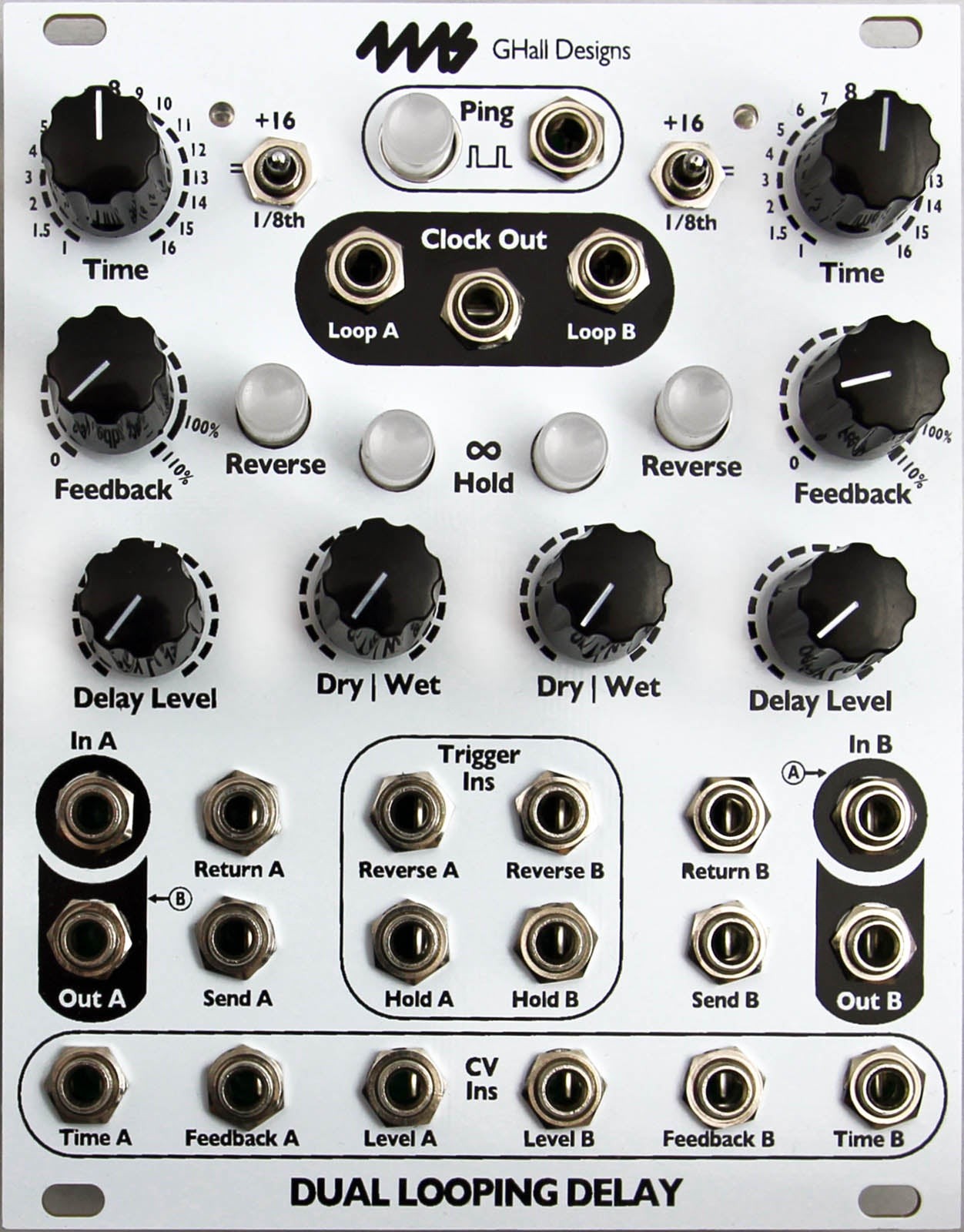
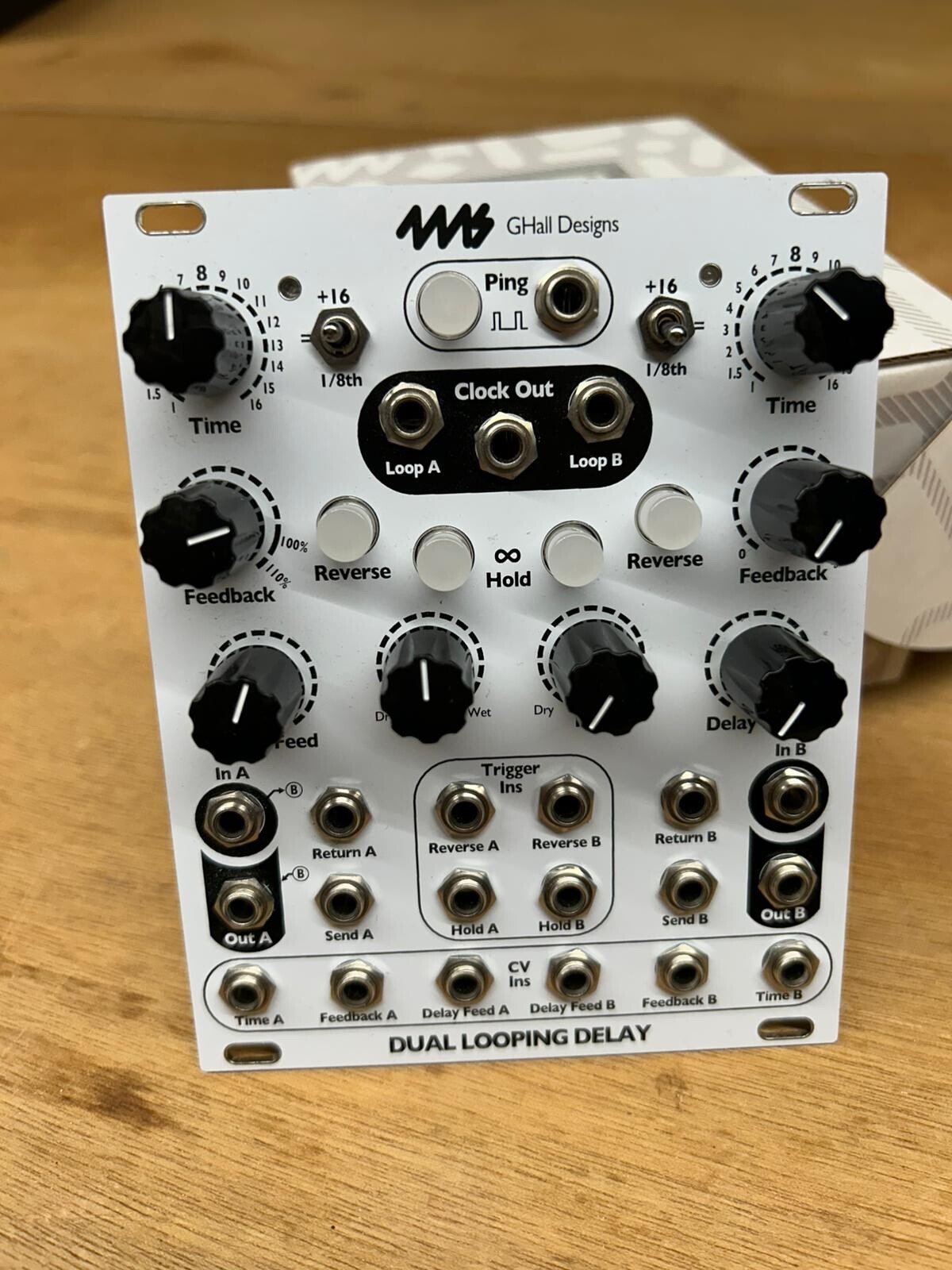
But specs only tell half the story. What makes the DLD special is how it binds two independent 88-second delay lines to a single clock source. You can’t just run them freely; they’re locked together, which means every rhythmic manipulation—every tap of the Ping button, every CV command—applies to both channels in unison. That constraint is actually its superpower. It forces a kind of disciplined creativity: you’re not just delaying sound, you’re composing with time. Want one side to repeat every four beats while the other cycles in ⅞ time? Done. Need both to stutter in 16th-note triplets while slowly modulating feedback into self-oscillation? Easy. The Time knob, combined with a three-position toggle (×1, +16, ÷8), lets you dial in complex rhythmic divisions without patching a single CV. It’s like having a built-in metronome that speaks fluent math.
And then there’s the looping. Flip the Infinite Hold switch and the DLD stops being a delay and becomes a dual-channel looper, freezing whatever’s in the buffer and letting you manipulate it—reverse playback, scrub through the loop window, modulate feedback past 100% to create self-sustaining drones. The reverse function is particularly mind-bending: when engaged, incoming audio records backward, but newly recorded echoes play forward, creating a kind of temporal palindrome. Turn off reverse, and those “forward” echoes suddenly flip—your brain won’t believe what it’s hearing. It’s the kind of feature that makes you stop, unpatch everything, and just listen.
For all its sophistication, the DLD isn’t a menu-diving nightmare. There are no screens, no hidden layers—just knobs, buttons, and CV inputs for every parameter. Feedback can go beyond 100%, Mix is continuously variable, and Delay Feed controls input gain, letting you overdrive the front end for subtle digital grit. The Send/Return jacks open up even more possibilities: route one delay line through a filter, a second delay, or a wavefolder, then bring it back in to be re-processed. Patch the output of a resonant filter into the Return, crank the feedback, and you’ve got a self-oscillating delay-resonator hybrid that can generate tones out of silence.
It’s not perfect, though. The DLD demands attention. It won’t forgive sloppy clocking or unstable CV sources—jitter in your clock signal will show up immediately in timing errors. And because it’s a high-resolution digital module, it’s sensitive to power supply noise; a poorly regulated bus board can introduce faint digital hash into the output. Some users report that older units, particularly those from the early 2010s, can develop intermittent issues with the push-button switches over time, especially with heavy use of the Infinite and Reverse functions. But these aren’t design flaws—they’re the trade-offs of a module built for precision and flexibility.
Specifications
| Manufacturer | 4ms Company |
| Production Years | 2009–2022 |
| Module Width | 20HP |
| Depth | 40mm |
| Power Consumption | +12V: 120mA, -12V: 30mA |
| Sampling Rate | 48kHz |
| Bit Depth | 16-bit |
| Max Delay Time | 88 seconds per channel |
| Frequency Response | 0Hz (DC) to 24kHz, -1.7dB max deviation |
| THD | Less than 0.05% |
| Signal-to-Noise Ratio | Greater than 90dB |
| Input Impedance | 100kΩ |
| Output Impedance | 1kΩ |
| CV Inputs | Time, Feedback, Mix, Delay Feed, Hold, Reverse |
| CV Scaling | 1V/oct for Time, 0–5V for other parameters |
| Inputs | Audio In, Time CV, Feedback CV, Mix CV, Delay Feed CV, Hold CV, Reverse CV, Clock In, Ping Button |
| Outputs | Audio Out A, Audio Out B, Send A, Send B, Return A, Return B, Clock Out, Loop Clock Out |
| Controls | Time Knob, Feedback Knob, Mix Knob, Delay Feed Knob, Infinite Hold Button, Reverse Button, Ping Button, Time Range Toggle (×1, +16, ÷8) |
| Weight | 380g |
| Construction | Steel front panel, PCB-mounted jacks |
Key Features
Synchronized Dual Delay Architecture
The DLD’s core innovation is its dual-channel, single-clock design. Unlike most dual delays that let you run each side independently, the DLD forces both channels to share the same timing reference. This isn’t a limitation—it’s a compositional tool. By locking both delays to one clock, the module ensures that rhythmic relationships stay tight, even when modulating time or feedback. One channel can be set to a straight quarter-note repeat while the other plays in ⅞ time, but they’ll always resolve together at the top of the phrase. This makes the DLD ideal for polyrhythmic exploration, generative music, and live looping where predictability matters. The three-position Time toggle (×1, +16, ÷8) expands this further, letting you jump from short delays to multi-bar loops without re-patching. The +16 function, for example, adds 16 beats to whatever the Time knob is set to—perfect for stretching a simple loop into an evolving ambient bed.
Infinite Hold and Reverse Playback
The Infinite Hold button transforms the DLD from a delay into a dual-channel looper. When engaged, the module stops recording and endlessly plays back the current buffer. This isn’t just a freeze function—it’s a gateway to structural manipulation. While in Infinite mode, turning the Feedback knob while holding the Infinite button lets you “scrub” through the loop, selecting start and end points manually. It’s a tactile way to edit loops on the fly, more intuitive than menu diving. The Reverse function is equally powerful: it inverts playback direction, but with a twist. New audio continues to record in reverse, so when you exit reverse mode, those segments play forward—creating a kind of echo inversion that’s hard to replicate elsewhere. This behavior isn’t a bug; it’s a feature that rewards experimentation, especially when combined with CV modulation of feedback or mix.
Full CV Control and External Processing
Every major parameter—Time, Feedback, Mix, Delay Feed, Hold, and Reverse—has a CV input, making the DLD one of the most modulatable delays in Eurorack. Patch in an LFO to the Time CV and you get rhythmic flanging or sweeping delays. Route a random voltage to Feedback and the echoes evolve unpredictably, sometimes collapsing into noise, sometimes stabilizing into new patterns. The Send/Return jacks add another dimension: you can route one delay line through external effects like filters, distortion, or reverb, then bring it back into the delay loop. This turns the DLD into a feedback processor, capable of generating complex textures from simple inputs. Pair it with a resonant filter and you can create self-oscillating delay networks that generate their own melodies.
Historical Context
The DLD arrived in 2009, just as Eurorack was shifting from boutique curiosity to mainstream adoption. At the time, most digital delay modules were either crude BBD emulations or simple PT2399-based designs with limited fidelity. The DLD stood out by embracing high-resolution digital processing at a time when many modular users still associated “digital” with “cold” or “lifeless.” 4ms didn’t try to hide the DLD’s digital nature—in fact, they celebrated it. Inspired by late-’70s and early-’80s digital delays like the Lexicon PCM42 and the EMT 250, the DLD shared their commitment to clean, stable repeats but reimagined them for a modular context. Where those studio units were expensive, rack-mounted, and fixed-function, the DLD was compact, patchable, and deeply integrated into the Eurorack ecosystem.
It also arrived before the wave of granular and spectral processors that would later dominate experimental modular circles. In that sense, the DLD was a bridge—a digital effect that felt modern but wasn’t overly complex. It didn’t try to do everything; it did delay and looping exceptionally well. Its closest competitors at the time were modules like the Qu-Bit Nebulae or the Make Noise Mimeophon, but those leaned more into texture and degradation. The DLD was different: it was about precision, timing, and control. It found a home in studios ranging from ambient composers to industrial noise artists, not because it sounded “pretty,” but because it could be ruthlessly precise or chaotically unpredictable, depending on how you patched it.
Collectibility & Value
As of 2026, the DLD is discontinued and highly sought after, with used prices reflecting its reputation. In excellent condition, with clean switches and full functionality, it typically sells for $550–$650. Units with cosmetic wear but full operation go for $450–$525. Heavily used or untested units—especially those with sticky or unresponsive buttons—can be found for $350–$400, but these carry risk. The Infinite Hold and Reverse buttons are mechanical switches that can degrade with heavy use; if they’re intermittent, replacement requires desoldering and is not trivial. Some early units (pre-2013) had issues with power supply sensitivity, so buyers should verify stable operation with a known-clean bus board.
The DLD’s value holds well because it’s not easily replaced. While 4ms released the single-channel Looping Delay (LD) as a more affordable, DIY-friendly alternative, it lacks the dual-channel sync and dual independent outputs of the DLD. Other modern delays like the ALM Tycho or the Bastl Dwarfs offer dual channels, but none lock both to a single clock with the same level of rhythmic precision. The DLD’s 88-second maximum delay per channel is still impressive, and its DC-coupled audio path makes it useful for processing control voltages, not just audio.
When buying, check for: consistent button response, clean knob tracking, no digital noise in the output when silent, and stable timing when clocked from an external source. Avoid units with oxidized or bent pins on the power connector—these can damage your case. Because the DLD is a digital module, firmware updates were rare and not user-serviceable, so there’s no benefit to seeking out a “latest version.” If it powers up and passes basic function tests, it’s likely good for years of use.
eBay Listings


As an eBay Partner, we earn from qualifying purchases. This helps support our independent vintage technology research.