Contax 137 MD (1980)
A 650-gram brick of brass and aluminum that winds its own film - and was among the first high-end SLRs to do it without a bolt-on motor.
Overview
Pick up a 137 MD and the first thing you notice is the density. At approximately 650 grams body-only, it sits heavier in the hand than its 145 × 94 × 51 mm dimensions suggest. The body is a die-cast aluminum chassis with brass components and weather-resistant seals, built by Yashica under the Contax brand as part of the Zeiss licensing agreement. This is a 35mm film single-lens reflex camera with the motor drive built into the body rather than bolted onto the baseplate. That one design decision defines how it handles.
Introduced in 1980, the 137 MD was the technologically enhanced successor to the earlier manual-wind Contax SLRs of the RTS series. It combined the mechanical foundation of the Contax RTS II with an integrated motor system. Contax's own instruction manual makes the claim plainly: the 137 MD Quartz carried what the documentation describes as the world's first fully integrated micromotor drive system, with a single micromotor governing both film winding and the camera's operating systems. A quartz crystal oscillator handled all time-related functions. The "electronic brain," crystal, and micromotor together ran the AE mechanism, the viewfinder display, and the film transport.
The camera advances and rewinds film automatically, at a continuous rate of approximately 2.5 frames per second. For photojournalists and event shooters of the early 1980s, that meant no thumb-cranking between frames and no separate winder to buy, charge, or lose. The 137 MD was one of the first high-end SLRs to offer fully automatic film transport without an external add-on. Contax positioned it for advanced amateurs and semi-professionals who wanted professional-grade build quality with minimal manual intervention.
What it does not do is chase program automation. Exposure is aperture-priority autoexposure and manual mode — the photographer picks the aperture, the camera picks the shutter speed. Metering is TTL center-weighted, full-aperture, via a silicon photodiode. The shutter is a vertical-travel, metal-bladed focal-plane unit running from 1 sec to 1/1000 sec plus B, with X-sync at 1/60 sec. Modest numbers by the standards of its successors, but the 137 MD was never trying to be the most programmable camera in the case — it was trying to be the one that never made you miss the frame.
Key Features
The Integrated Micromotor Drive
The integrated motor is the headline. Most high-end SLRs of the period, the Nikon FE2 among them, could shoot continuously only with a separate motor drive bolted underneath. The 137 MD put the motor inside. The manual describes a fully integrated micromotor drive system controlling film winding and the camera's operation systems with a single micromotor, handling automatic loading, advancing, and rewinding. Owners report the camera feels like one object rather than a body plus an accessory, and that it keeps its balance with the drive running. The trade-off is serviceability: because the motor is integrated, repairs are complex and require technicians familiar with Contax electronics.
Quartz-Controlled Timing
The "Quartz" in the full name, Contax 137 MD Quartz, as it appears on listings and in the manual, isn't decoration. A quartz crystal oscillator controlled all time-related functions, with the crystal governing the AE mechanism and the viewfinder information alongside the micromotor. The self-timer was quartz-controlled as well, running exactly 10 seconds once set. The self-timer LED and main lamp blink alternately, accelerating over the final two seconds to signal the release. Electronic shutter timing could drift as batteries weakened, and locking the clock to a crystal was an engineering answer to that.
Viewfinder and Focusing
The fixed pentaprism offers 0.85x magnification with a 50mm lens at infinity and covers approximately 97% of the frame. Focusing screens are interchangeable: split-image rangefinder, microprism, grid. The standard screen combines a central split-image surrounded by a circular microprism collar inside an outer matte field, which the manual notes permits fast, easy focusing. Shutter speed readouts sit on the right side of the finder, with LED indicators lighting steadily or flashing to show the speed in use. Red "LT" indicates an automatically controlled long-time exposure beyond 2 seconds, up to a maximum of 11 seconds, and "OVER" warns that the scene is too bright for correct exposure. Aperture is displayed at the top of the viewfinder. With lenses slower than f/5.6, auto bellows, or a microscope adapter, the reading stays fixed at f/1.4. That's not a malfunction, just the coupling limitation.
The Contax/Yashica Mount
The 137 MD takes the C/Y bayonet mount, which means the full range of Carl Zeiss T* lenses and third-party optics built for Contax/Yashica. For a lot of buyers, this is the real reason to own the body at all: the mount is the gateway to the glass, and the glass is what people stayed in the system for.
Power and the Battery Compartment
The camera runs on two 1.55V SR44 silver oxide batteries, or equivalents like LR44, stacked in series in a compartment on the base plate. They power the meter, shutter control, and the motor drive together. The manual is blunt that the camera will not operate without batteries, and warns that performance can suffer, particularly during continuous exposures, if the cells aren't in top condition. Original batteries are prone to leakage, so check that compartment for corrosion on any used example.
Historical Context
The 137 MD was developed alongside the non-motorized RTS II and shared much of its internal design. The motor drive was the divergence, and it marked a significant step toward modernization for the line. It belongs to the second generation of electronic Contax SLRs, between the original RTS of 1975 and later models like the 167 MT and AX. Its release reflected Contax's strategy of competing with Nikon's FE2 and Canon's A-series while keeping a distinct identity rooted in optical excellence and German-Japanese collaboration.
Contax's own documentation for the TLA20 Auto Flash Unit notes that the flash was designed specially for the 137 MD Quartz and the 139 Quartz. It has a built-in TTL control system using an independent SPD sensor that measures flash output directly at the film plane. That eliminates exposure calculation and synchronizes with all apertures. It also couples to a flash data indicator in the viewfinder that signals charge status and whether the subject fell within flash range. A dedicated 137 Data Back could imprint year, month, day, and exposure data onto the film, and it was interchangeable with the regular camera back.
Market reception was positive among professionals who appreciated the camera's reliability and smooth operation, though its high price limited broader adoption. The Nikon FE2 offered similar build quality and aperture-priority metering but required a separate MD-12 motor drive. The Canon AE-1 Program offered more automation but less rugged construction. The 137 MD stood out for integrating the motor directly into the body, a feature not widely adopted by other high-end SLRs until later models like the Nikon F3HP with MD-4.
Collectibility & Value
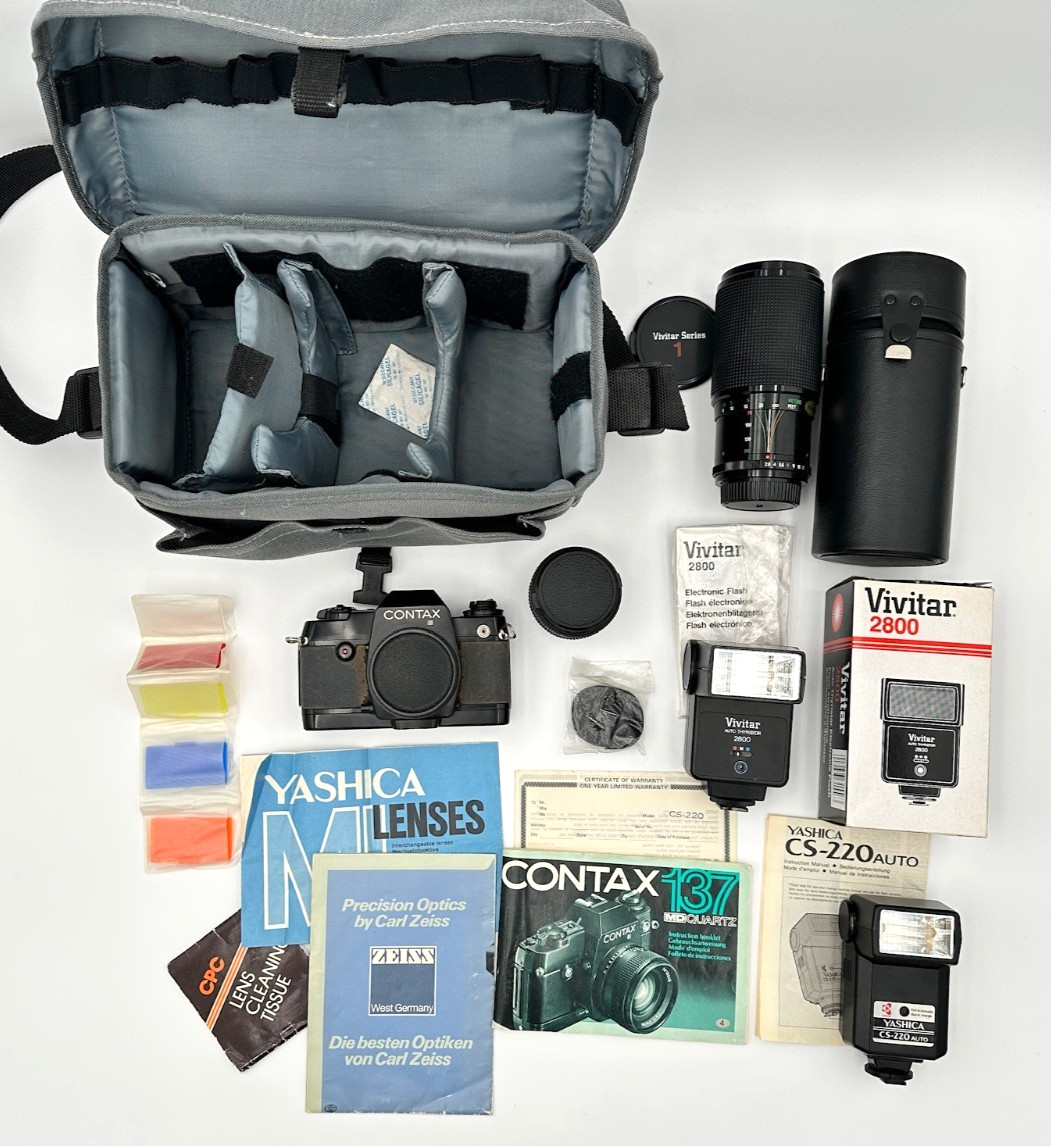
Today the 137 MD is a sought-after model among film photography enthusiasts and collectors of late 20th-century SLRs. Recent eBay listings on the source page show working bodies across a wide band: a near-mint body-only example at $49.22, a black body at $59.99, an excellent-plus body at $110, and a bundle with lenses at $200. The source notes that units in excellent working condition typically sell for $300 - $500, with rare configurations or factory-sealed examples commanding higher prices. The low end is where the risk lives.
Buyers should verify the motor drive, shutter operation, and light meter before committing. Common issues include worn drive gears, degraded rubber seals, and corrosion in the battery compartment, which is worth checking given how leak-prone the original cells are. Mechanical problems cluster around jammed film advance mechanisms from worn gears or dried lubricants, particularly on cameras stored for years without use. The motor drive can suffer belt degradation or gear slippage over time. Shutter accuracy should be tested with a timer or oscilloscope, since aging capacitors may affect timing at slower speeds. Because the motor system is integrated, repairs are complex and should go to technicians experienced with Contax/Yashica systems. Routine maintenance means cleaning the mirror and prism assemblies, checking light seals, and keeping film transport smooth. Long-term storage without use may necessitate cleaning and lubrication before the camera is trusted again.
eBay Listings



As an eBay Partner, we earn from qualifying purchases. This helps support our independent vintage technology research.