Agfa 254 (c.1926–mid-1930s)
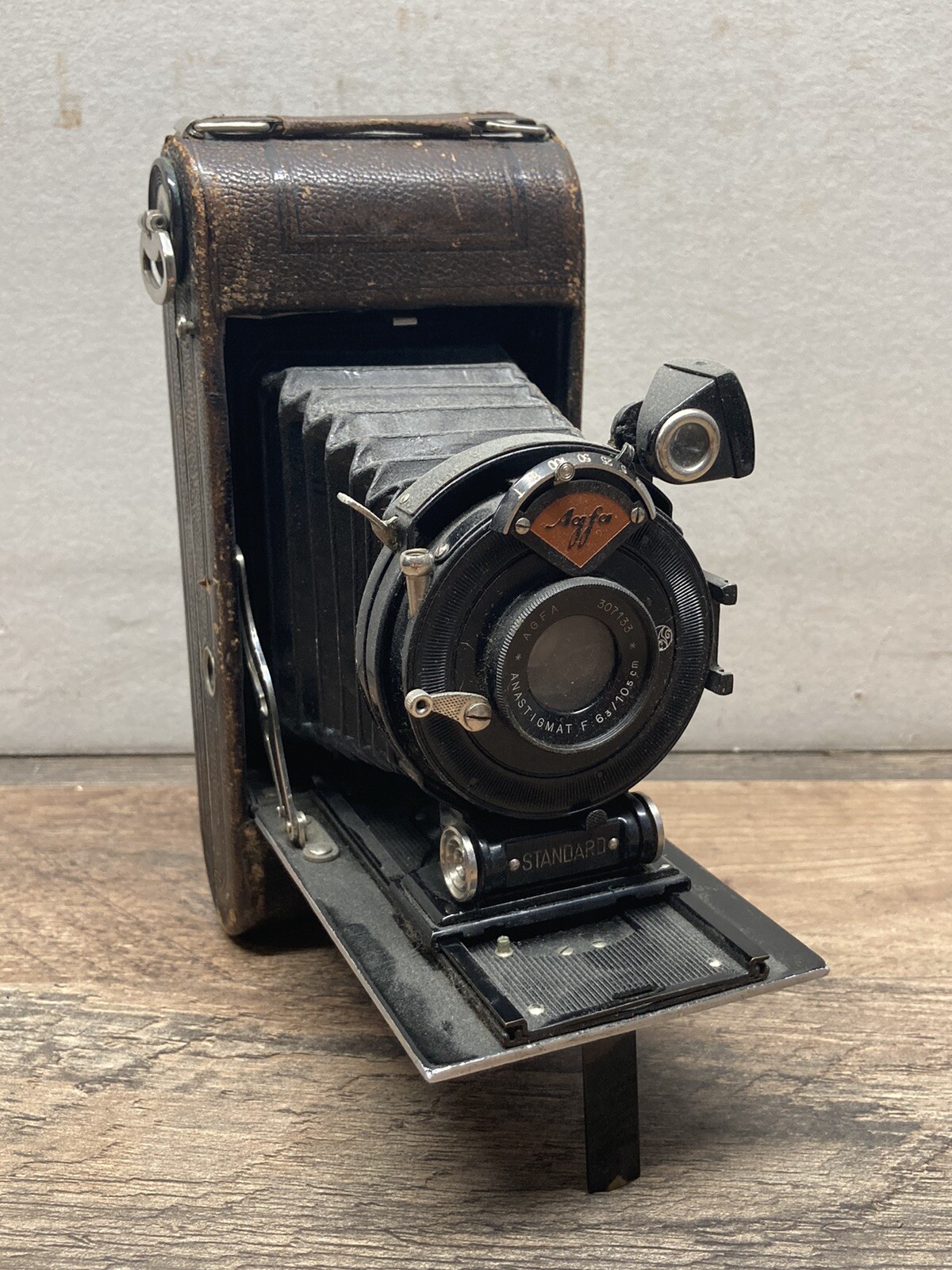
Little is documented about the Agfa 254 as a standalone model. The record shows that the 254 was a roll-film variant within Agfa's Standard series of folding cameras, introduced in the late 1920s and produced into the mid-1930s. It took 120 roll film, a format that is still easy to find today.
The Standard series was Agfa's first original camera design after the company acquired the Munich-based Rietzschel camera works in 1925. Production began around 1926. The lineup had several model numbers for different film types and frame sizes. The 204 and 208 took glass plates in 6.5×9 cm and 9×12 cm formats. The 254, 255, and 258 were roll-film models. The 254 used 120 film, while the 255 and 258 used the larger 116 film. Like other Standards, the 254 had a metal body covered in leather, leather bellows, and a helical focusing mechanism that moved the lens and shutter as a single assembly. Shutter options included the Gauthier Automat (1/2-1/100 plus B and T) and the Compur (1-1/250 with self-timer). Lenses ranged from a Trilinear Agfa Anastigmat f/6.3 to f/4.5, depending on the configuration.
Beyond its place in the Standard series, almost nothing is recorded about the 254's individual specifications, original price, or market reception. Surviving examples turn up now and then on the collectors' market, usually grouped with other Standard models and rarely identified by the 254 number alone. Condition matters more than any premium on the model number: dimple-free bellows, a working shutter, and an unclouded lens.
Known facts about the Agfa 254:
- Part of the Agfa Standard series (c.1926–mid-1930s)
- Roll-film camera accepting 120 film
- Metal body with leather covering, leather bellows
- Helical unit focusing (lens and shutter move together)
- Shutter options: Gauthier Automat or Compur
- Lens options: Trilinear Agfa Anastigmat f/6.3 or f/4.5
eBay Listings



As an eBay Partner, we earn from qualifying purchases. This helps support our independent vintage technology research.