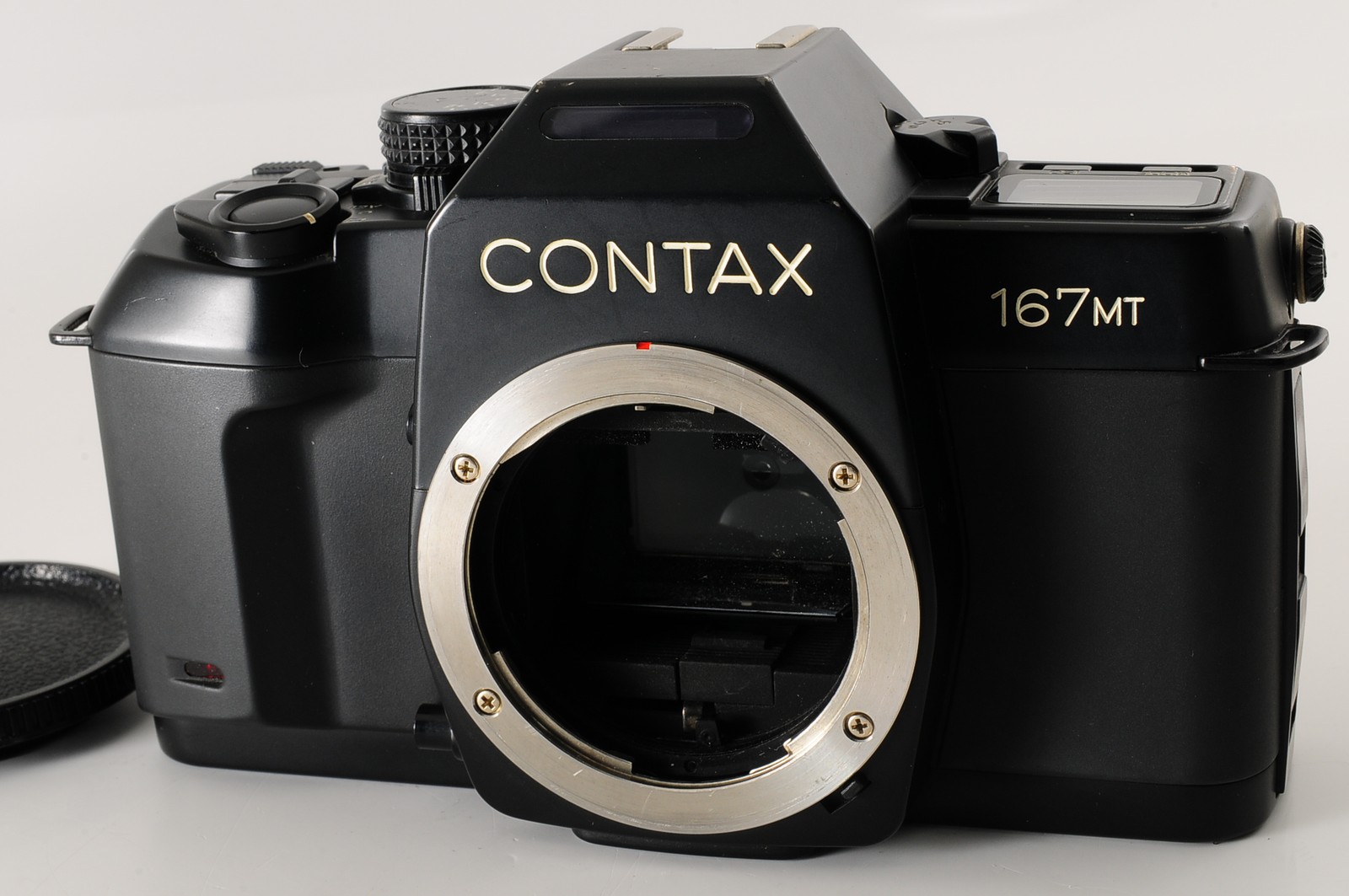
Contax 167 MT (1986)
At 720 grams, it sits in your palm like a promise—solid, serious, and ready to earn its keep.
Overview
The Contax 167 MT isn't a camera that shouts. It doesn't have the flamboyant lines of a Nikon F3 or the minimalist cool of a Leica M. But in the hand, it feels like a precision instrument built for people who care about how things work. This is a 35mm focal-plane shutter, auto/manual exposure SLR, part of the Contax/Yashica (C/Y) manual focus 35mm SLR system manual focus 35mm SLR system), and it arrived in 1986, slotting in as the successor to the 137 MA and 159MM models. It’s a camera that bridges eras—mechanically robust but packed with electronics that were cutting-edge at the time.
Its weight—720 grams without batteries—tells part of the story. This isn’t a travel camera for the hesitant. It’s dense, with a heft that suggests permanence. The body is built around a vertical-travel, metal focal-plane shutter, capable of speeds from 16 seconds to 1/4000 sec. across all exposure modes, plus a 'Bulb' option in Manual. That range alone made it competitive with the best of its day, letting photographers freeze motion in broad daylight or stretch time in near darkness. The shutter is electronically controlled, quartz-timed for accuracy, and released electromagnetically—no mechanical linkage, just clean, silent trigger action through a cable switch socket.
One of the standout features is the built-in motor drive, which advances film at approximately 2 frames per second in single-frame mode and up to 3 frames per second in continuous mode. That’s not blistering by modern standards, but for a mid-tier manual focus SLR in the late '80s, it was respectable. Film loading is automatic—the leader advances to the first frame without fuss—and rewind is fully automatic at the end of the roll, with mid-roll abort available if needed. The whole process is managed through an external LCD panel that shows film speed, frame count, battery status, and more, keeping the shooter informed without needing to peer through the viewfinder.
Specifications
| Manufacturer | Contax (partnership between Zeiss and Yashica) |
| Type | 35mm focal-plane shutter, auto/manual exposure SLR |
| Picture size | 24 x 36mm |
| Lens Mount | Contax/Yashica mount |
| Shutter | Electronic quartz-controlled, vertical-travel, metal focal-plane shutter |
| Shutter Speeds | 16 sec. to 1/4000 sec. in all modes. 'Bulb' also available in Manual mode. |
| Self-timer | Quartz-controlled electronic self-timer with 10-sec. delay. Indicator (blinks last for 2 seconds after the self-timer starts and again for 2 seconds before the shutter is released); exposure counter indicates remaining time. |
| Shutter Release | Electromagnetic release with cable switch socket. |
| Exposure Control | Exposure modes are set by pressing the Mode button and using the Operation Control. Exposure Modes: (1) Standard Program auto exposure. (2) High-speed Program auto exposure. (3) Low-speed Program auto exposure. (4) Shutter-priority auto exposure. (5) Aperture-priority auto exposure. (6) Manual exposure. (7) Programmed TTL auto exposure. (8) Aperture-priority TTL auto flash. (9) Manual mode auto flash. (10) Manual flash exposure. |
| Metering System | TTL full-aperture, center-weighted metering/ TTL full-aperture spot metering (spot metering LED turns on in viewfinder)/ TTL center-weighted direct metering with TCA System flash units. SPD(Silicon Photo Diode)cells. |
| Metering Range | EV0 to EV20 for TTL full-aperture center-weighted metering. (ISO 100, f/1.4 lens). |
| Film Speed Range | ISO 25- 5000 in DX auto mode. ISO 6- 6400 in manual mode. |
| Flash Synchronization | X-synchronization. Shutter speed is automatically set to 1/100 sec. in Program and Aperture-priority modes. In Shutter-priority and Manual modes, any speed from 1 sec. to 1/100 sec. can be selected. |
| Viewfinder | Fixed eye-level pentaprism. |
| Viewfinder Information | LED display of shutter speed, aperture, exposure compensation, exposure mode, flash ready, spot metering, film transport, self-timer, battery check, manual exposure warning, exposure compensation warning, and flash exposure warning. |
| Focusing Screen | Interchangeable; standard screen is Acute-Matte type with split-image rangefinder and microprism collar. |
| External Display Panel | LCD panel displays film speed, frame counter, battery condition, multiple exposure, exposure compensation, and self-timer. |
| Film Transport | Built-in motor drive for single-frame and continuous shooting. |
| Film Loading | Automatic loading; film leader is automatically advanced to the first frame. |
| Film Advance Speeds | Single-frame advance: approx. 2 frames/sec. Continuous advance: approx. 3 frames/sec. |
| Film Rewind | Automatic rewind at the end of the film; mid-roll rewind is also possible. |
| Power Source | Four 1.5V batteries (AA/LR6). |
| Battery Life | Approx. 100 rolls (24 exposures) with alkaline batteries at 20°C (68°F). |
| Dimensions | 154.5mm (W) x 101.5mm (H) x 67.5mm (D) |
| Weight | 720g (25.4 oz.) without batteries. |
Key Features
Slide System for Mode Selection
The 167 MT introduced a distinctive slide system for switching between exposure modes—a tactile, linear motion that replaced the rotary dials common on earlier models. This wasn’t just cosmetic; it made mode changes quicker and more deliberate, reducing the chance of accidental shifts. Owners report it feels satisfyingly precise, though some note wear over time, especially if grit gets into the mechanism. It was a major design change, signaling Contax’s intent to modernize the interface without abandoning physical controls.
In-Viewfinder LED Display
Inside the fixed eye-level pentaprism, a comprehensive LED display shows nearly every critical parameter: shutter speed, aperture, exposure compensation, flash status, warnings, and even self-timer countdown. This eliminates the need to look away during composition. The information is bright and clear, though some users report failures over time—faint or partially visible digits, sometimes cut off by a dark line in the viewfinder. These issues are often tied to aging LCD drivers or poor connections, not user error.
Multiple Exposure Modes with TTL Flash Integration
The exposure system is unusually flexible for its class. Ten distinct modes cover nearly every shooting scenario, including three program curves optimized for different lighting conditions. TTL flash control is integrated, supporting both aperture-priority and manual flash modes. Flash sync is X-type, with the camera automatically setting 1/100 sec. in Program and Aperture-priority modes, while allowing full manual control in other modes down to 1 second. This level of flash integration was rare outside high-end professional bodies.
Automatic Film Handling with Motor Drive
Film transport is fully automated—loading, advancing, and rewinding. The motor drive advances film at approximately 2 to 3 frames per second, depending on mode. While not the fastest, it’s consistent and reliable when the power supply is stable. The system relies heavily on electronics, which means battery choice matters. Some owners report jamming or hesitation, often traced to either weak batteries or overly powerful lithium types that exceed voltage tolerances. Alkaline AA cells are recommended for stable performance.
Historical Context
The Contax 167 MT arrived during a transitional period for SLRs—autofocus was emerging, but manual focus still dominated the prosumer market. It carried forward the C/Y mount legacy, ensuring compatibility with a wide range of Yashica and Zeiss optics, a major selling point. Unlike the fully professional RTS series, the 167 MT targeted advanced amateurs who wanted automation without sacrificing manual override. It didn’t try to be everything, but it did most things well, reflecting Contax’s engineering-first philosophy.
Collectibility & Value
Market prices for the 167 MT vary widely, suggesting inconsistency in condition and functionality. Listings show body-only units selling for as little as $46 and as much as $325, with European retailers asking €199. Some sale listings dip to €19.99, likely indicating non-working units. These fluctuations point to a market where working condition is everything. The most common failure reported is a dead or dim in-viewfinder LCD, often due to aging circuitry. Film transport issues—failure to wind or load—are also noted, typically linked to battery problems or misloaded film. Fresh alkaline batteries and proper loading technique often resolve these. No original MSRP is documented, but its position below the RTS line suggests it was priced as a premium mid-range option.
eBay Listings



As an eBay Partner, we earn from qualifying purchases. This helps support our independent vintage technology research.