Carl Zeiss Jena Pancolar 50mm f/1.8 (1964–1982)
At 230 grams, it balances like a promise—solid metal, smooth focus, and a bokeh that still stirs souls decades later.
Overview
The Carl Zeiss Jena Pancolar 50mm f/1.8 isn’t just another vintage lens—it’s a benchmark. Produced between 1964 and 1982, it served as Carl Zeiss Jena’s standard fast prime throughout the 1960s and 70s, a workhorse with soul. While not the fastest 50mm ever made, its f/1.8 aperture opened doors to low-light shooting and dreamy depth-of-field at a time when many kit lenses stopped at f/2 or slower. Built for the M42 screw mount, it also saw production in EXA and Praktica B mounts from 1979 to 1982, ensuring broad compatibility across Eastern Bloc SLRs. This lens earned its reputation not through specs alone, but through feel and character—something owners report few modern optics replicate.
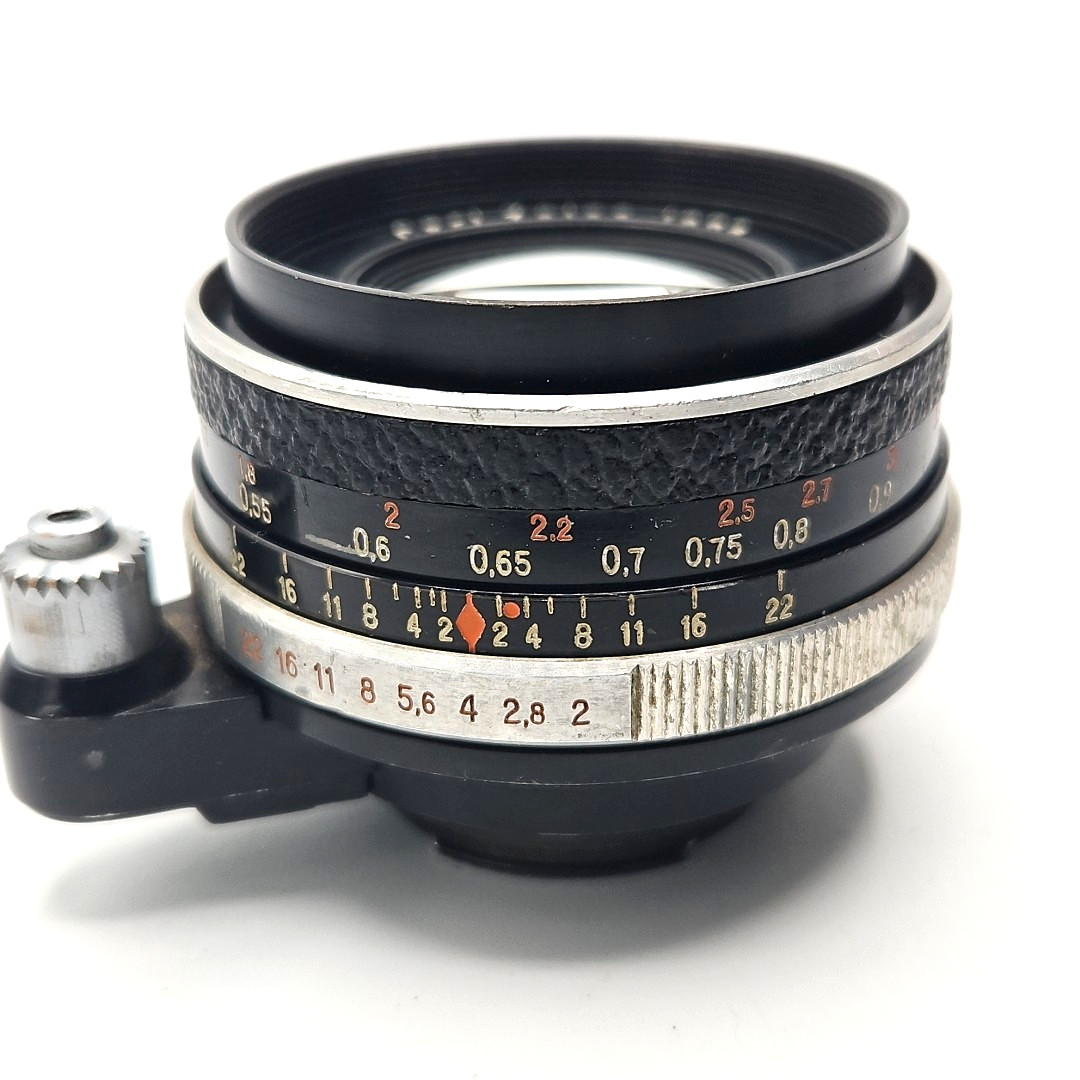
From the first twist of the focusing ring, the Pancolar announces itself as serious hardware. The all-metal construction feels dense and deliberate, not heavy for show, but weighted for balance. The minimalistic interface—just aperture and focus rings—puts the photographer in direct contact with the mechanics. No extraneous switches, no plastic compromises. It’s a tactile experience: the aperture ring clicks with a precise, ball-bearing-assisted certainty, while the focusing ring glides with a smoothness that suggests meticulous machining. Ergonomically, it’s a joy—ridges and knurling placed so that even in dim light, fingers find their marks without looking.
Optically, it’s a classic Double-Gauss design—6 elements in 5 groups—tuned for character rather than clinical correction. Distortion is present, as expected for its era, and flare resistance doesn’t meet modern standards, often leading to contrast loss when shooting into the light. But these aren’t flaws so much as traits. At f/1.8, coma is visible, especially in the corners, but stops down cleanly by f/2.8. Vignetting is surprisingly mild even wide open, a small victory in an age when many fast primes darkened the edges aggressively. The real magic, though, lies in the bokeh. It’s consistently described as “exquisite,” “creamy,” with out-of-focus highlights forming clean, even discs—no harsh outlines, no onion rings. This is the lens’s calling card, the reason it still draws admirers.
Specifications
| Manufacturer | Carl Zeiss Jena |
| Focal Length | 50mm |
| Maximum Aperture | f/1.8 |
| Minimum Aperture | f/22 |
| Lens Mount | M42 |
| Filter Size | 49mm |
| Weight | 230 g |
| Size (D x L) | ≈ 47 x 65 mm |
| Optical Construction | 6 elements in 5 groups (Double-Gauss type) |
| Aperture Blades | 6 |
| Minimum Focus Distance | 0.35m |
| Maximum Format | 35mm full frame |
Key Features
All-Metal Build with Dense, Sturdy Construction
The Pancolar feels like it was made to last. Every component—from the knurled focusing ring to the aperture selector—is machined metal, assembled with a tightness that inspires confidence. There’s no creak, no flex, just a reassuring heft. Owners report that even decades later, well-maintained examples retain their precision. The barrel’s density helps balance medium-weight SLRs without tipping the scales forward. While later budget lenses would trade metal for plastic, the Pancolar stands as a testament to a time when optical instruments were built like tools, not disposables.
Thorium Glass in Early “Zebra” Versions
Some early variants, particularly the “Zebra” model produced from 1964 to 1967 (up to serial number 8552600), contain thorium-doped glass elements. This radioactive compound was used to increase refractive index without adding excessive curvature, but it has a side effect: a gradual yellowing or amber tint over time. While this can shift color balance, especially in film photography, many users report that the tint can be corrected with post-processing or even bleached out with UV exposure. These versions are now sought after not just for their performance, but for their notoriety—collectors often label them “radioactive” with a mix of caution and pride.
Smooth Focusing Ring with Precision Helicoid
The focusing experience is one of the lens’s standout qualities. The helicoid moves with a buttery smoothness that few contemporaries match. There’s no grit, no sudden resistance—just a consistent, damped motion that makes manual focus a pleasure. Internally, the mechanism includes latches that secure the lens rotation and a stop screw to fine-tune infinity focus during servicing. However, this precision comes at a cost: disassembly and reassembly are notoriously difficult. The small parts—blade locking spring, focusing ring stop screw—are easily lost, and the helicoid must be carefully timed. Many repair guides exist, but owners warn that patience and the right tools (precision screwdrivers, lens spanner wrench, lithium grease) are essential.
Aperture Ring with Ball-Bearing Click Stops
The aperture ring operates with a distinctive, mechanical precision. A ball bearing engages detents to create the click stops, delivering a tactile and audible confirmation at each f-stop. The action is firm but not stiff, with a “reassuring” feel that many users praise. A side switch and pin at the base allow for automatic/manual aperture actuation, compatible with M42 cameras that support stop-down metering. While the number of blades varies by version—6 in later models, 8 in earlier thorium-equipped ones—the iris forms a near-circular opening, contributing to the smooth bokeh. One common complaint, however, is internal reflections from the iris blades, which can create distracting bright spots in certain lighting.
35cm Minimum Focus Distance for Close-Up Capability
For a 50mm lens of its era, the 0.35m minimum focus distance is unusually short. This allows for tighter framing in portraits and greater flexibility in confined spaces. Combined with the creamy bokeh, it gives the Pancolar a near-portrait-lens versatility despite its standard focal length. Users frequently highlight this as a key advantage over other 50mm primes from the period, which often required longer minimum distances. It doesn’t turn the lens into a macro, but it does open creative possibilities that many standard lenses of the time simply didn’t offer.
Collectibility & Value
The Carl Zeiss Jena Pancolar 50mm f/1.8 remains a popular vintage lens, though not particularly rare. Prices vary widely based on condition and version. A “rare” yellow thorium variant listed at one retailer carried an original price of $89.95, later discounted to $79.95. One owner reported paying around £50 for a body, plus £49 for a recent CLA (clean, lubricate, adjust), underscoring that servicing costs can rival the purchase price. Common issues include stiff focusing mechanisms and internal haze, both repairable but requiring expertise. The lens is a frequent subject of disassembly tutorials, but collectors caution that reassembly is unforgiving—small parts are easily lost, and forcing components can damage the helicoid. Despite these challenges, well-functioning examples continue to command respect and steady demand.
eBay Listings


As an eBay Partner, we earn from qualifying purchases. This helps support our independent vintage technology research.