Arsat 30mm f/3.5 Fisheye [MC]
At f/3.5 and 180 degrees, it bends light and expectations in equal measure
Overview
This is the Arsat 30mm f/3.5 Fisheye [MC] — a lens that doesn’t pretend to be anything it’s not. Announced in 1981, it was built for 645 medium format cameras, though owners report it performs well on both 6×4.5 and 6×6 formats. Marketed under multiple names including Zodiak-8 30mm F/3.5 and its Cyrillic variants (ЗОДИАК-8, ЗОДИАК-8Б, ЗОДИАК-8В), it carries the legacy of Soviet optical engineering, likely produced at the Arsenal factory in Kyiv. It’s a prime fisheye lens with an unmistakable character: extreme perspective and uncorrected barrel distortion are not flaws here — they’re the entire point. The “MC” designation suggests multi-coating, though exact coating specifications remain undocumented.
Despite its niche appeal, the lens has earned a reputation among medium format enthusiasts. Collectors note it as the 6×6 Arsat lens with the highest reputation, and that regard appears well deserved. It doesn’t aim for clinical sharpness or speed, but delivers a visceral, immersive look that few other lenses in its class can match. At its original list price of $269 for versions adapted to Mamiya 645, Contax 645, and Pentax 645 mounts, it occupied a modest tier in the specialty optics market. Today, owners find it still offers considerable value — one reported paying around 130€ and calling it “absolutely stunning” for the cost, while another on Reddit noted it’s “not bad,” albeit wishing it were faster.
Specifications
| Manufacturer | Arsat |
| Product type | Rectangular Fisheye Lens |
| Format | Medium Format |
| Zoom/Prime | Prime |
| Focal Length | 30mm |
| Maximum Aperture | f/3.5 |
| Minimum Aperture | f/22 |
| Diagonal Angle of View | 180 degrees |
| Flange Focal Distance | 74.1mm |
Key Features
180-Degree Diagonal Angle of View
The lens captures a full 180-degree diagonal angle of view, placing it firmly in the true fisheye category. This extreme field of vision wraps the world around the frame, creating a curved, almost planetary perspective. According to available documentation, achieving such a wide angle without significant barrel distortion is exceptionally difficult — the Arsat embraces the distortion as part of its design, making it a tool for expressive, rather than corrective, photography.
Strong Uncorrected Barrel Distortion
Barrel distortion is not minimized — it’s the lens’s language. Straight lines bow aggressively toward the edges, and spatial relationships warp in ways that challenge perception. This uncorrected characteristic is central to the fisheye effect, and the Arsat delivers it with consistency. The lens construction, while not detailed in element or group count, is clearly optimized for maximum angular coverage rather than flat field reproduction.
Flange Focal Distance of 74.1mm
With a flange focal distance of 74.1mm, the lens was engineered to work within specific back-focus requirements of 645 medium format systems. This measurement, confirmed in a scientific imaging application using the lens, suggests precise mechanical tolerances. Adapting it to modern mirrorless systems may require careful consideration of flange depth to maintain infinity focus, though no official adapter specifications are documented.
Collectibility & Value
The Arsat 30mm f/3.5 Fisheye [MC] occupies a modest but respected place in the vintage lens market. Its original list price was $269 for versions configured for Mamiya 645, Contax 645, and Pentax 645 mounts. Current market examples show variation: one eBay listing priced a pre-owned unit at $354.99, while a Facebook group member reported acquiring one for approximately 130€. Owners emphasize its value-for-money proposition, with one calling it “absolutely stunning” at that price point. Condition reports are sparse, but one used example was described as being in “good overall condition” with clean, oil-free aperture blades. No documented common failures or maintenance issues are recorded.
eBay Listings
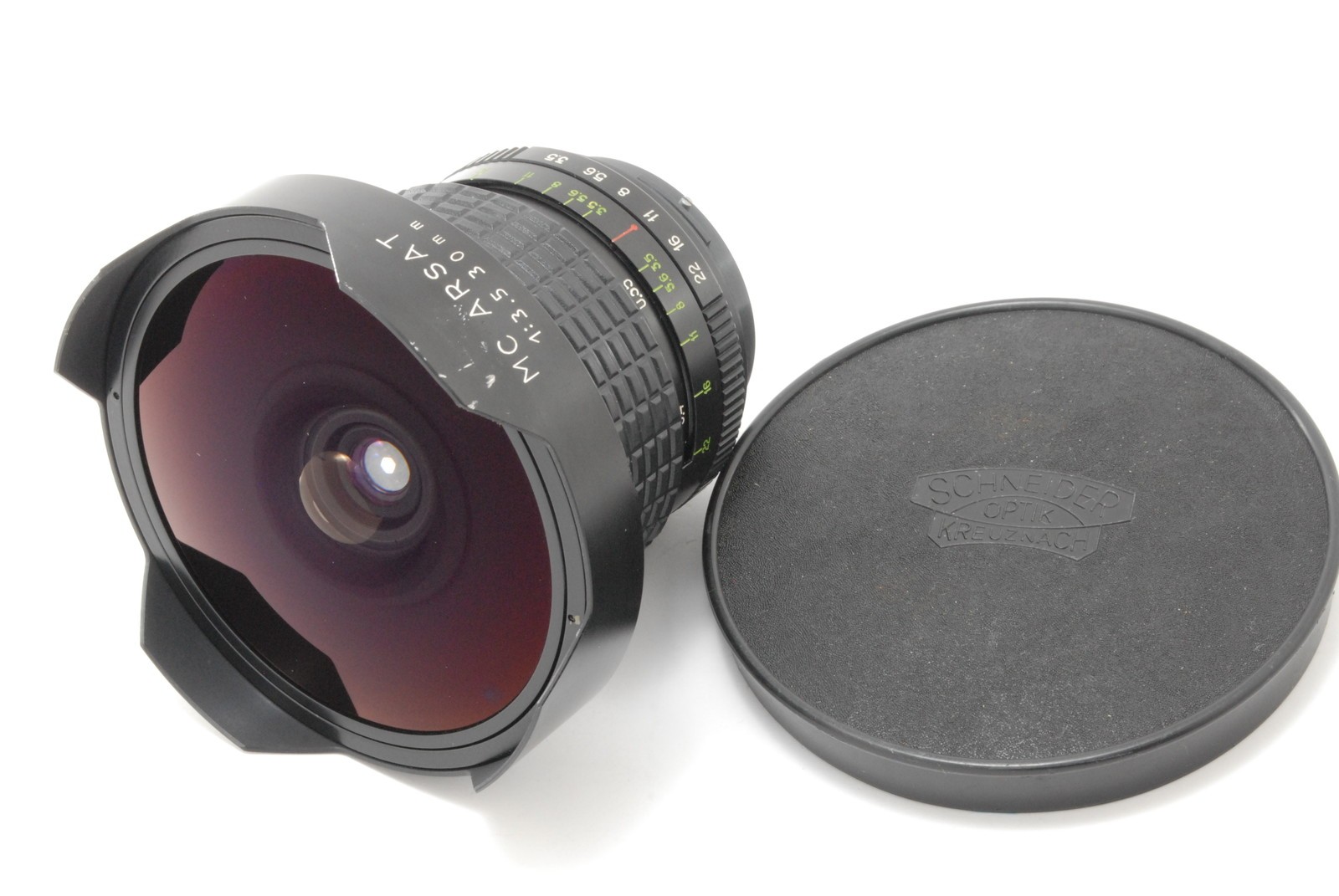
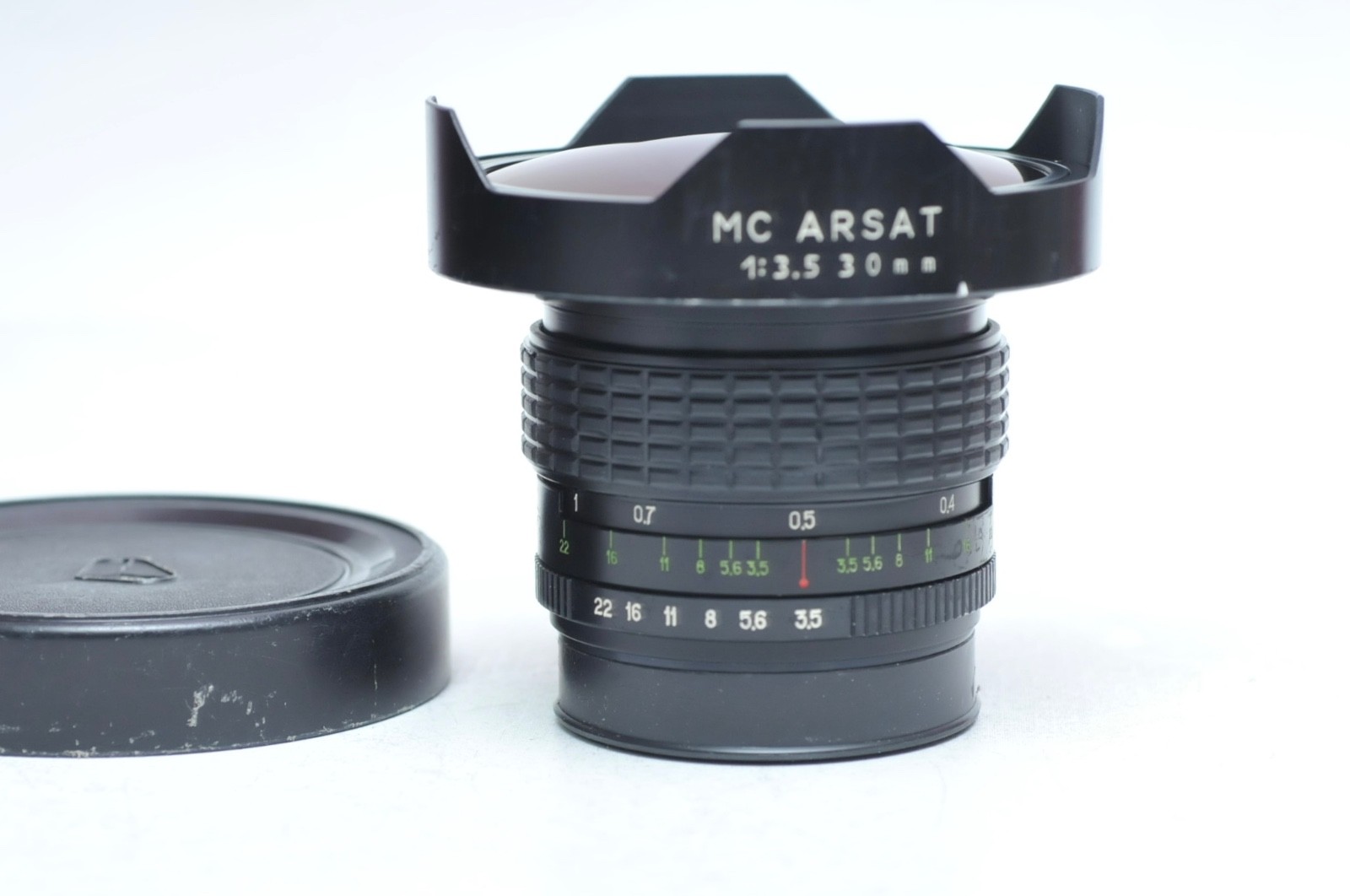

As an eBay Partner, we earn from qualifying purchases. This helps support our independent vintage technology research.