Canon EOS M (2012)
At 262 grams, it slips into a jacket pocket like a rangefinder. It also has an 18-megapixel APS-C sensor and a brand-new lens mount.
Overview
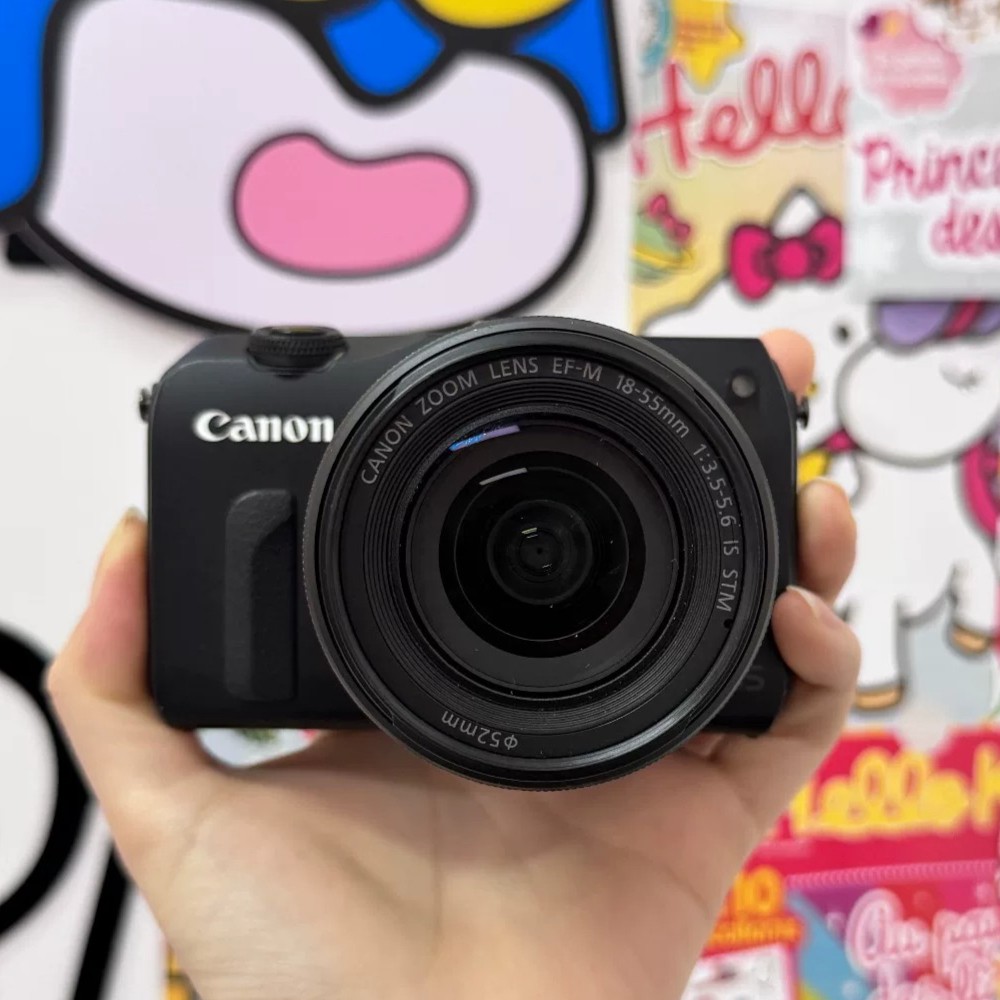
The Canon EOS M is Canon's first real answer to mirrorless. It launched in 2012 at $799.99, into an APS-C mirrorless category that Fujifilm, Olympus, and Sony had already stirred up. It shares its 18-megapixel CMOS sensor and DIGIC 5 processor with the EOS T4i, so it is basically a T4i squeezed into a point-and-shoot chassis. You can see that in every RAW file. The body is all plastic, compact (108.6 × 66.5 × 32.3 mm), and light, but it doesn't feel cheap. There's no viewfinder, just a fixed 3-inch LCD with 1,040,000 dots. That was standard for the price, but it's a limitation if you're used to eye-level composition.
The big new thing is the EF-M mount. It's a clean-sheet lens interface with a shorter flange distance, designed specifically for mirrorless. Native EF-M lenses could be smaller and faster, but there was friction right away. Canon's big EF and EF-S lens library couldn't mount directly. You needed an adapter. It worked well enough, but the extra step put off some pros who expected backward compatibility. The camera could still record Full 1080p HD video and shoot both JPEG and RAW, which many compacts of the era couldn't do.
Specifications
| Manufacturer | Canon |
| Sensor Type | CMOS |
| Sensor Size | APS-C (22.3 × 14.9 mm) |
| Effective Pixels | 18 megapixels |
| Max Resolution | 5184 x 3456 |
| Image Format | JPEG, RAW |
| ISO Range | 100-6,400 (expandable to 12,800) |
| Video | Full 1080p HD Video |
| LCD Screen | 3 in, 1,040,000 dots |
| Battery | Canon Rechargeable Battery LP-E12 |
| Dimensions (W x H x D) | 108.6 mm × 66.5 mm × 32.3 mm |
| Weight | 262 g (body only) |
| Lens Mount | EF-M |
| Compatible Lenses | Canon EF-M |
| Lens Mount Incompatibility | Won't fit EF and EF-S lenses without an adaptor mount |
Key Features
18-Megapixel APS-C CMOS Sensor from EOS T4i
The sensor is borrowed straight from Canon's DSLR lineup: the same 18-megapixel APS-C CMOS found in the EOS T4i. It isn't cut down or modified. Image quality matched contemporary DSLRs in daylight and held up reasonably well in low light, especially when shooting RAW. At base ISO it's clean and detailed, with Canon's color science that leans warm and skin-tone friendly. Noise is manageable up to 3200 at higher ISOs, and the expanded 12,800 setting is grainy but can salvage dimly lit scenes.
Introduction of the EF-M Lens Mount
The EF-M mount was Canon's first dedicated mirrorless lens interface, with an 18mm flange distance, shorter than the EF mount's 44mm. That allowed smaller, lighter lenses, like the pancake EF-M 22mm f/2. It also split the lineup. The EOS M couldn't natively accept Canon's EF or EF-S lenses, a major limitation for existing Canon shooters. The EF-EOS M adapter fixed that and preserved autofocus and aperture control, but it added bulk and cost. Some users reported sluggish autofocus with adapted lenses, especially in low light. Native EF-M glass performed better.
Compact Form Factor with Full DSLR Sensor
At 108.6 × 66.5 × 32.3 mm and 262 grams (body only), the EOS M was one of the smallest APS-C cameras on the market. It felt more like a high-end compact than a DSLR and slipped easily into a coat or small bag. The design favored portability over grip depth, so larger hands might find it cramped over long sessions. There's no built-in flash or viewfinder, just the rear LCD. There's also no weather sealing, and the construction is all plastic, so it wasn't built for harsh conditions.
Historical Context
The Canon EOS M arrived in 2012 as Canon's first mirrorless interchangeable-lens camera, its official entry into a segment that had been gaining momentum for years. Priced at $799.99, it aimed to challenge established players like the Sony NEX series and Fujifilm X100. Some early mirrorless models compromised on sensor size, but the EOS M went straight for APS-C. Canon's delayed response left it playing catch-up in lens ecosystem and autofocus speed.
Collectibility & Value
Today, the EOS M is not a sought-after collectible, and it doesn't command premium prices on the secondhand market. No current resale values are documented, but user reports point to some practical problems. Battery life is short. Owners report the LP-E12 depleting after just over 200 shots, which limits field use without spares. Some users have reported the camera failing to power on despite charged batteries and a functional SD card, suggesting potential firmware or circuit issues. Installing third-party firmware like Magic Lantern has been linked to shutter blockage, leaving the camera unable to take pictures. Other users have hit problems after lens changes, with the camera refusing to shoot, possibly due to sensor or mount communication errors. Image quality remains solid for casual use, but these reliability concerns and the lack of native lens variety have kept the EOS M from gaining cult status.
eBay Listings



As an eBay Partner, we earn from qualifying purchases. This helps support our independent vintage technology research.