Canon 110ED (1975)
At 26mm f/2, it punches above its 110-film weight class with a lens that still draws breath
Overview
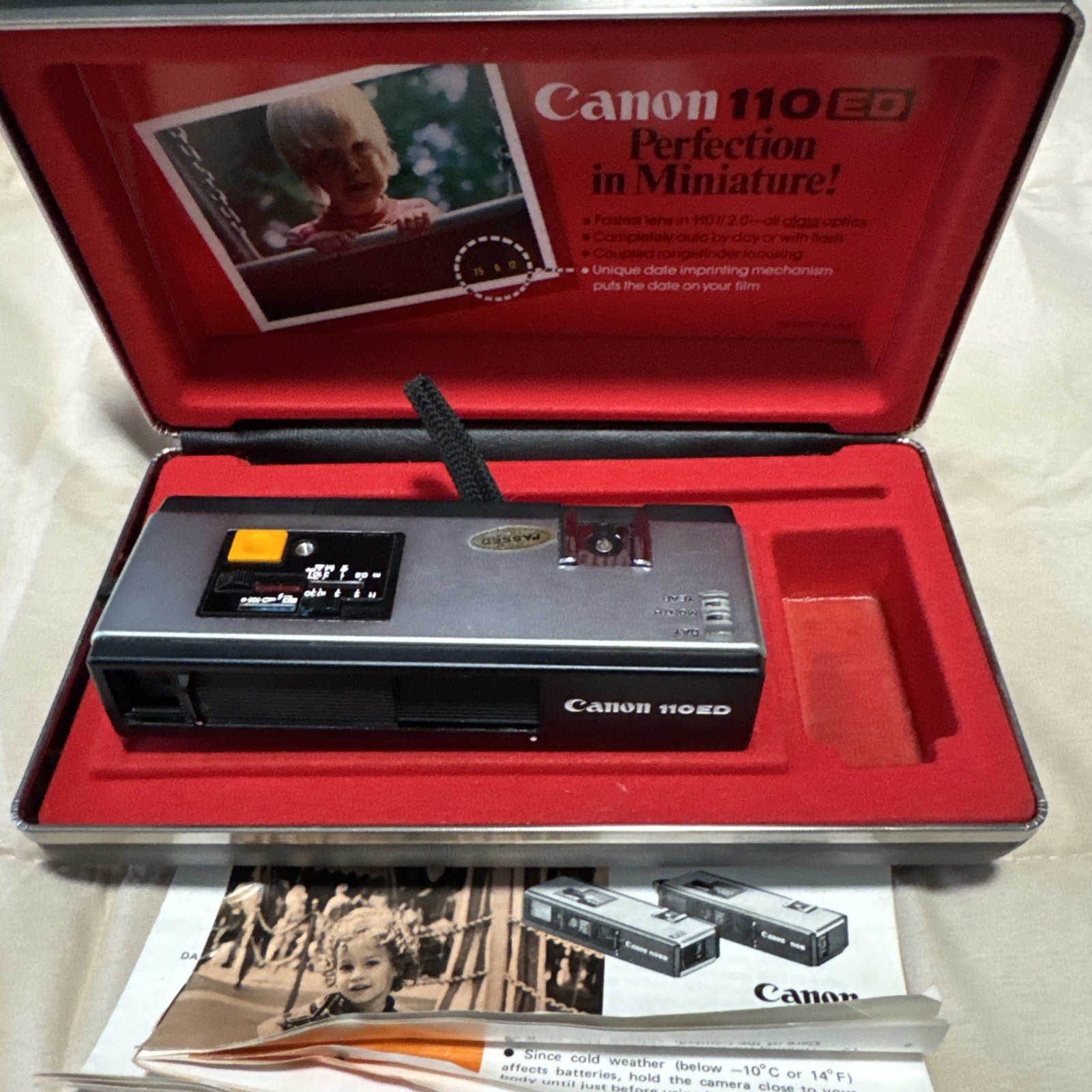
The Canon 110ED isn’t just another pocket film camera—it’s a precision instrument disguised as a credit card. Introduced in 1975, it was Canon’s answer to the growing demand for serious optics in the 110 format, a market otherwise flooded with plastic-bodied point-and-shoots. This was a camera built for photographers who didn’t want to compromise, even when downsizing. With its metal body, coupled rangefinder, and fast f/2 lens, the 110ED stood apart as a high-end offering in a category often dismissed for its limitations. It wasn’t just functional; it was a statement. Owners report it feels dense, almost heavy for its size, with a solidity that suggests engineering over economy. While the 110 film format itself constrained image quality, the 110ED did everything possible to extract the best from it—sharp optics, accurate focusing, and automatic exposure that worked reliably when the battery cooperated.
Specifications
| Manufacturer | Canon |
| Product type | rangefinder camera for 110 cartridge film |
| Lens | Canon lens 26mm f/2, with 5 elements in 4 groups |
| Focusing | Rectilinear movement of the lens, coupled to the rangefinder |
| Exposure | automatic exposure |
| Battery | powered by a PX28A battery |
| Viewfinder | coupled rangefinder |
| Body material | metal body |
Key Features
26mm f/2 Lens with 5 Elements
The heart of the 110ED is its 26mm f/2 lens—a full stop faster than the f/2.7 on the base 110E model. With five elements in four groups, it was unusually complex for a subminiature camera. The lens delivers a 50mm-equivalent field of view in 135 format, placing it in the sweet spot for everyday photography. Its speed allowed for lower-light shooting and a degree of subject isolation rare in 110 cameras. While the small negative still limited ultimate sharpness and dynamic range, the lens itself was optically competent, and surviving examples, when clean and functional, can produce surprisingly detailed images.
Coupled Rangefinder with Rectilinear Focusing
Unlike zone-focus competitors, the 110ED uses a true coupled rangefinder with rectilinear lens movement. This means the lens shifts in a straight line as focus is adjusted, minimizing optical aberrations that can occur with helicoid designs. The result is more accurate manual focusing, especially at close distances. However, owners must account for parallax error when shooting subjects under 1.2 meters, as the viewfinder and lens are offset. The patch in the viewfinder is reported to be bright and easy to use, though no magnification or coverage specs are documented.
Automatic Exposure with Battery Check
The 110ED relies on automatic exposure, a convenience for quick shooting but a potential failure point over time. The system uses a CdS meter and requires a PX28A battery (6V), which is now obsolete and difficult to source. A "Battery Check" function was included, allowing users to verify power before shooting—a thoughtful touch for its era. Whether the camera functions without battery power remains uncertain; available documentation does not confirm mechanical backup operation, and one user inquiry specifically questioned this limitation.
Metal Body with Thoughtful Control Layout
The metal body contributes to the 110ED’s premium feel, setting it apart from the plastic shells of most 110 cameras. Controls are logically arranged, with shutter speed selection (including a 1/125s setting for manual override) and film advance positioned for intuitive use. The updated 110ED 20 model reportedly added a 1/1000s top shutter speed, but this spec is not confirmed for the original 110ED. No dimensions or weight are documented, but the build quality is consistently described as solid and refined.
Historical Context
Canon introduced the 110ED in 1975 alongside the simpler 110E, which used a slower f/2.7 zone-focus lens. The 110ED was positioned as the premium option, aimed at discerning photographers who wanted better optics and accurate focusing in a pocketable form. It was part of a brief but ambitious push to elevate the 110 format, which Kodak had launched as a consumer convenience. The 110ED, along with the later 110ED 20—an updated version with improved shutter performance—represented the high-water mark of engineering in this format. While the film’s small negative ultimately limited its appeal to serious photographers, the 110ED remains a testament to what was possible within those constraints.
Collectibility & Value
The Canon 110ED trades at modest prices today, with recent examples found around $17 on secondary markets. Its value is limited by the obscurity of the 110 format and the difficulty of servicing the PX28A battery dependency. While it was once considered an expensive, high-tech jewel, it now occupies a niche corner of the collector world—appreciated by those who value compact camera design and optical ambition. No spare parts or service manuals are widely available, and the dead battery issue is common. Functionality often hinges on battery replacement solutions or meter bypass, though documentation on repair procedures is sparse.
eBay Listings


As an eBay Partner, we earn from qualifying purchases. This helps support our independent vintage technology research.