Sony ST-JX8 (1981)
At 4.6kg and just 80mm tall, this Sony tuner packs a dense array of digital synthesis tech into a low-slung slab of Showa-era precision.
Overview
The Sony ST-JX8 isn’t chasing warmth or vintage coloration—it’s a clinical FM/AM receiver built for lockstep tuning accuracy and rock-solid reception. Released in 1981 at ¥70,000, it This was high-end tuning in an era when "digital" still meant something novel, not just expected. The ST-JX8 leverages Sony’s in-house PLL (Phase-Locked Loop) IC technology, allowing direct frequency division up to 220 MHz, a notable feat for its time. It follows design cues from the ST-J75, refining the concept with a full FET front end and a dedicated detection driver IC for cleaner signal handling.
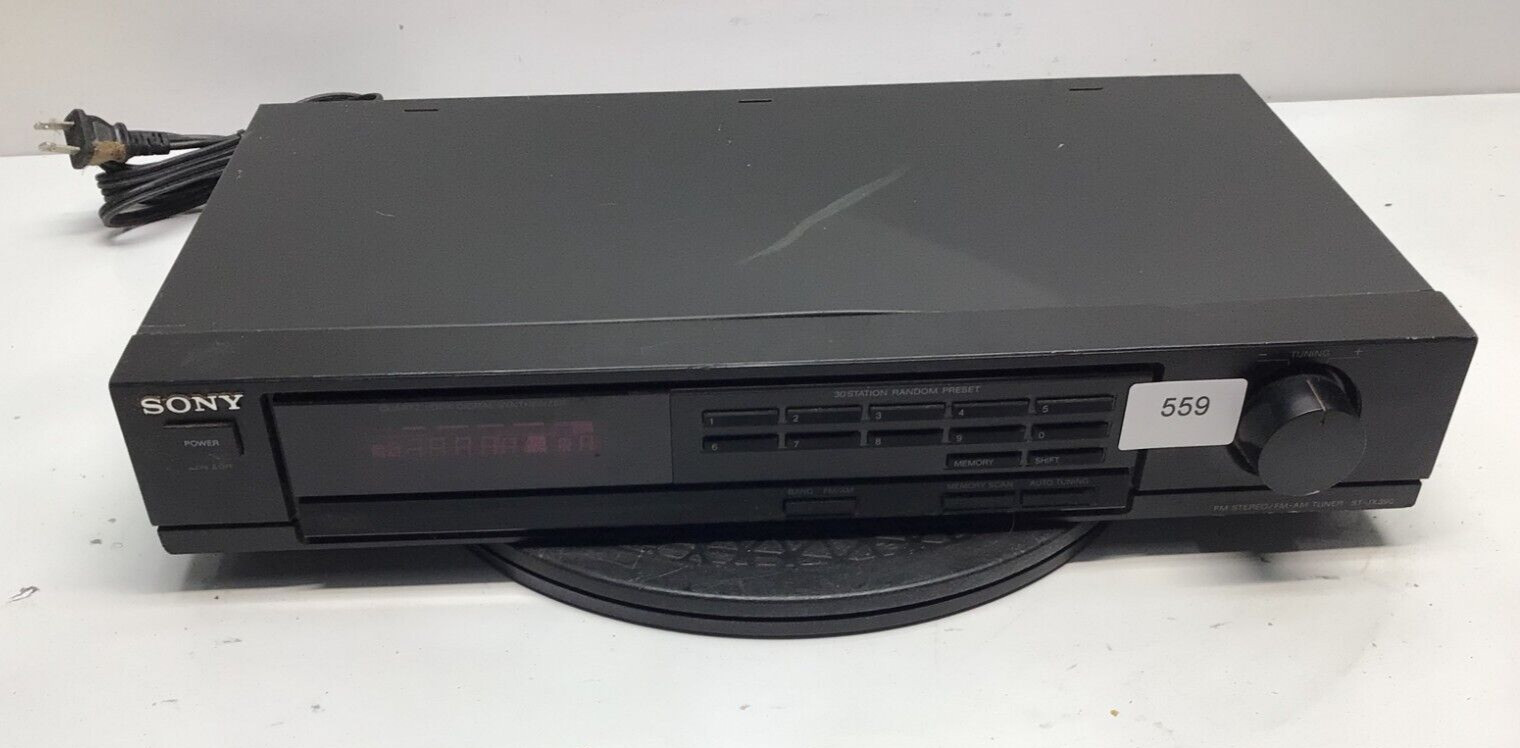
Tuning is handled through a 4-speed system: quick search (auto), sweep tune (manual), and step tune (manual), giving users fine control over station acquisition. Memory is managed via a proprietary non-volatile IC—no backup battery needed—supporting 8-station presets for both FM and AM bands. A timer-compatible program memory and memory scan function add convenience rarely seen at this level. The 7-segment digital display delivers clear frequency readouts, while a 5-step LED signal strength meter includes a strong-field indicator, helping optimize antenna placement. Despite its digital core, the audio path uses a 2-power supply system with FET buffering, aiming to preserve dynamics without sacrificing stability.
The FM section covers Japan’s 76–90 MHz band, not the more common 88–108 MHz, marking it as a domestic-market machine. It includes an F-type 75 Ω antenna jack, with a 300 Ω adapter (EAD-25) in the box for legacy antennas. AM reception relies on a built-in ferrite bar with an external terminal, and a notch filter helps suppress beat noise—a common annoyance in urban environments. Three selectivity settings (Distant, Normal, Local) let users tailor AM IF response to signal conditions.
Specifications
| Manufacturer | Sony |
| Product Type | Quartz-lock digital frequency synthesizer tuner (FM/AM) |
| Production Year | 1981 |
| Original Price | ¥ 70,000 |
| Circuit system | PLL digital frequency synthesizer Quartz lock system Superheterodyne FM/AM Tuner |
| FM Receiving frequency | 76 MHz to 90 MHz |
| FM Antenna terminal | 75 Ω F Type |
| FM Sensitivity | Mono : 3.8 μ V (IHF) / 16.8 dBf (new IHF) Stereo : 40 μ V (IHF) / 37.3 dBf (new IHF) |
| FM Signal-to-noise ratio | mono:92dB stereo:86dB |
| FM Harmonic distortion factor | mono: 0.05%(100Hz) 0.05%(1kHz) 0.05%(10kHz) stereo: 0.07%(100Hz) 0.06%(1kHz) 0.15%(10kHz) |
| FM Stereo separation | 50dB(100Hz) 60dB(1kHz) 45dB(10kHz) |
| FM Frequency characteristic | 30 Hz to 15 kHz ± 0.2 dB |
| AM Receiving frequency | 522 kHz to 1602 kHz |
| AM Antenna | Ferrite bar antenna with EXT terminal |
| AM Sensitivity | 200 μ V/m (when bar antenna is used) |
| AM Signal-to-noise ratio | 55dB(50mV/m) |
| Power supply voltage | 100 VAC, 50Hz/60Hz |
| Power consumption | 18W |
| External dimensions | Width 430 x Height 80 x Depth 330 mm |
| Weight | 4.6kg |
Key Features
High-Speed PLL IC with Direct Frequency Division
At the heart of the ST-JX8 is Sony’s proprietary high-speed PLL IC, capable of directly dividing frequencies up to 220 MHz. This eliminates intermediate stages in the synthesis chain, reducing phase noise and improving lock stability. The comparison frequency is derived from a crystal reference set at 100 kHz, ensuring long-term accuracy. Unlike earlier synthesizers that relied on indirect methods, this direct comparator approach minimizes drift and enhances tracking precision across the entire FM band.
All-FET Front End with Dual Gate MOS-FET Mixer
The RF section uses a fully FET-based design, including a 5-stage varicap tuning network, RF amplifier, and mixer—all built around dual gate MOS-FETs. This configuration offers high input impedance, low noise, and excellent linearity, critical for weak-signal reception. An FET buffer amplifier is placed at the front end’s output to ensure proper impedance matching with the IF stage, preserving signal integrity before further processing.
PLL-MPX IC with Pilot Cancellation Circuit
The stereo demodulation is handled by a dedicated PLL-MPX IC that integrates a pilot tone cancellation circuit. This reduces crosstalk and phase errors in the stereo signal path, contributing to the measured 60 dB of separation at 1 kHz. A 3-pole linear phase filter ensures minimal phase distortion across the audio band, aligning with the unit’s ±0.2 dB frequency response from 30 Hz to 15 kHz.
Non-Volatile Memory IC with 8-Station Presets
The tuner uses Sony’s proprietary non-volatile memory IC to store 8 FM and 8 AM station presets without requiring a backup battery. This was a significant advantage over volatile memory systems that lost settings during power outages. The memory supports direct random access, timer-compatible programming, and a memory scan function with NEXT CALL, allowing users to cycle through saved stations efficiently.
4-Speed Tuning System with Muting and Blend Logic
Tuning flexibility comes via a 4-speed system: quick search (automatic), sweep tune (manual coarse), and step tune (manual fine). A 3-stage muting switch (high/low/off) suppresses noise during weak reception. When muting is disabled, an FM blend circuit activates automatically, reducing stereo separation as signal strength drops to minimize noise—a feature tied to the SENS mechanism for smoother transitions.
5-Step LED Signal Indicator with Strong Field Display
A front-panel 5-step LED bar provides real-time signal strength feedback, with a dedicated indicator for strong-field conditions. This helps users optimize antenna positioning and avoid overloading the front end, especially in urban areas with dense RF activity. The display works in tandem with the practical sensitivity rating of 1.8 μV (IHF), indicating usable mono reception even below the stereo threshold.
Collectibility & Value
The ST-JX8 is consistently labeled "Rare Vintage" and "Showa Retro Vintage Rare" in listings, suggesting limited production or survival rate. Units appear sporadically on secondary markets, with conditions ranging from tested working to repair-only. A documented service record from Japan notes re-adjustment work on a one-owner unit, indicating some have remained in long-term use. The most commonly reported issue is capacitor degradation—"容量抜け" (capacitance loss)—particularly in the power supply and signal path, a typical failure mode for electronics of this age. Given its reliance on custom ICs and FET-based circuitry, repairs may require specialized knowledge. No official market value is documented, but listings suggest strong collector interest, especially for fully functional examples.
eBay Listings

As an eBay Partner, we earn from qualifying purchases. This helps support our independent vintage technology research.
Related Models
- Sony ps-5550 (1978-1980)
- Sony ps-lx5r (1983-1985)
- Sony ss-7220a (1970s)
- Sony ss-97 (Late 1970s (approximately 1977-1979))
- Sony ss-999 (Late 1970s (approximately 1977-1979))
- Sony st-j88 (1986-1988)
- Kenwood kl-888s (Late 1970s (approximately 1978-1980))
- Sansui sax-200 (Late 1970s)
- Sansui sax-600 (Late 1970s)
- Sansui sr-222 (1973-1975)