Sony ST-J88B (1978–1984)
It doesn’t beg for attention like a showpiece, but when you dial in a weak station in narrow selectivity and hear it pull clarity from the noise like a magic trick—that’s when you understand what this tuner was built for.
Overview
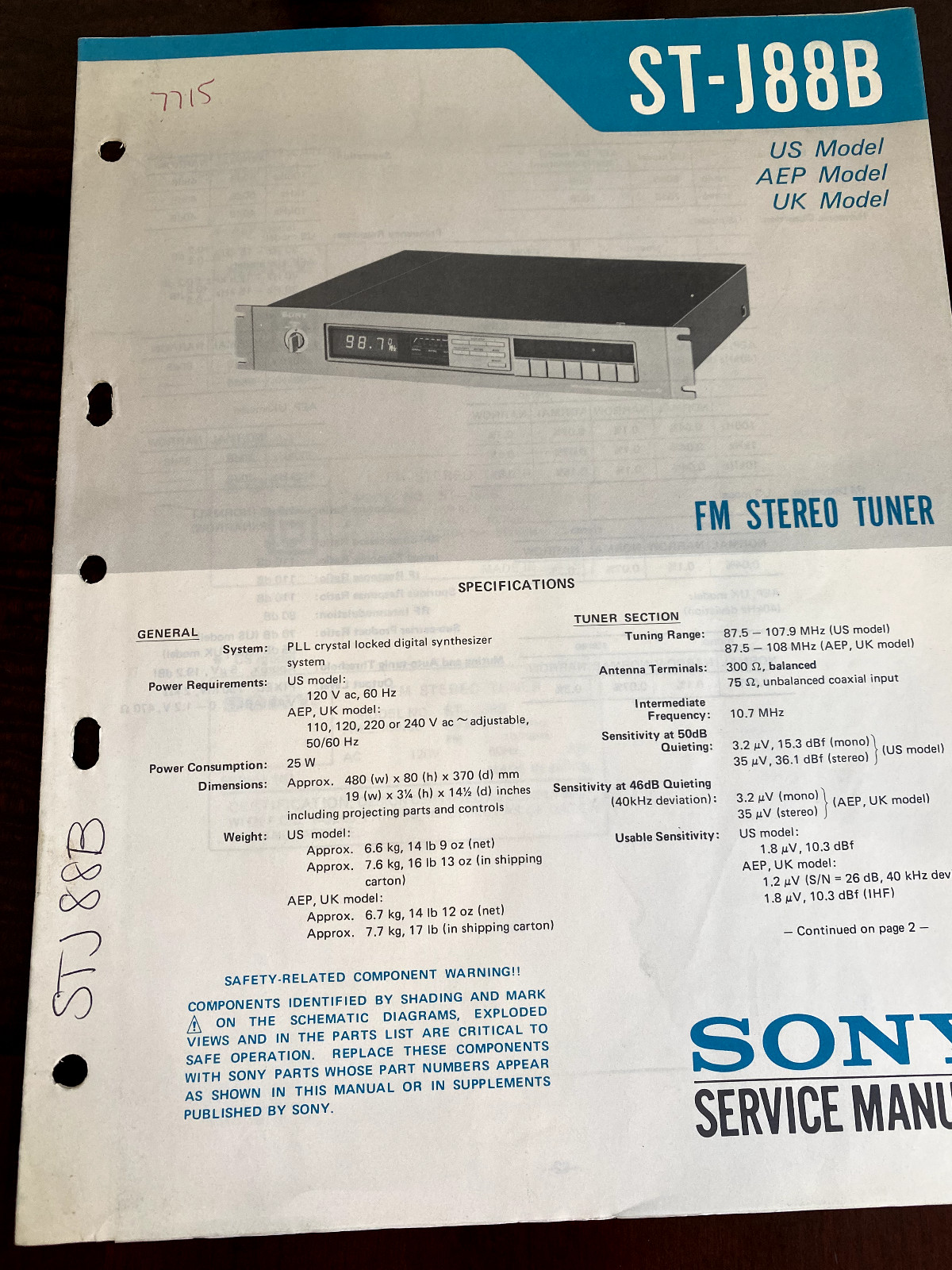
The Sony ST-J88B isn’t the loudest voice in the room, but it’s the one that listens the best. Marketed as the “Penultimate full-fledged pre-Esprit” tuner, it arrived in Europe and Japan in late 1978, reaching the U.S. a year later—right when digital tuning was shifting from novelty to necessity. This is a quartz-locked, frequency-synthesized FM stereo tuner, the kind of machine that replaced the fuzzy art of analog dialing with the precision of digital readouts and push-button memory. It doesn’t have a tuning meter—because it doesn’t need one. The synthesizer locks dead-on to the station frequency every time, no hunting, no drift. What you see on the display is exactly where you are.
And what a display it is: a crisp digital readout using “little pre-cut cards” to form the digits, a quirky but effective bit of 1970s industrial design that feels more hand-assembled than mass-produced. It’s not flashy, but it’s honest. The gunmetal grey chassis—shared with other high-end Sony “88” series components like the TC-K88B, N86B, and E88B—gives it a serious, almost military presence on the rack. At 6.6 kg and 480 mm wide, it’s substantial without being monstrous, and the dual antenna inputs (300 Ω and 75 Ω coaxial) mean it plays well with both rabbit ears and rooftop arrays.
Owners report it’s not quite in the same sonic league as the legendary ST-A7B, which seems to have overshadowed it in critical acclaim. “It is obvious the J88B cannot touch just about anything the ST-A7B has,” one comparison notes. But that doesn’t mean it’s lacking. Far from it. The ST-J88B is described as a “very good, ‘musical’, source,” with a sound quality that’s been called “exceptional.” It’s not a warm, romantic tuner—it’s more of a clean, precise listener, the kind that reveals what’s actually on the broadcast rather than coloring it. And when the signal’s weak or crowded, its selectivity becomes its superpower.
Specifications
| Manufacturer | Sony |
| Production years | 1978 to 1984 |
| Quieting sensitivity mono 30 dB | 10.3 dBf (1.8 µV) |
| Quieting sensitivity mono 50 dB | 15.3 dBf (3.2 µV) |
| Quieting sensitivity stereo 30 dB | 36.1 dBf (35 µV) |
| Mono Hi-Fi Sensitivity (60 dB quieting) | 9 µV |
| Stereo Hi-Fi Sensitivity (55 dB quieting) | 65 µV |
| S/N ratio | 80 dB (mono) 75 dB (stereo) |
| THD (norm. / narrow) mono 100 Hz | 0.04% / 0.1% |
| THD (norm. / narrow) mono 1 kHz | 0.04% / 0.1% |
| THD (norm. / narrow) mono 10 kHz | 0.04% / 0.1% |
| THD (norm. / narrow) stereo 100 Hz | 0.07% / 0.3% |
| THD (norm. / narrow) stereo 1 kHz | 0.07% / 0.3% |
| THD (norm. / narrow) stereo 10 kHz | 0.15% / 0.6% |
| IM (norm. / narrow) mono | 0.04% / 0.1% |
| IM (norm. / narrow) stereo | 0.07% / 0.3% |
| Alternate channel selectivity | 65 dB (normal) 120 dB (narrow) |
| Adjacent channel selectivity | 7 dB (normal) 22 dB (narrow) |
| Capture ratio | 1.0 dB (normal) 1.7 dB (narrow) |
| Frequency response | 30 Hz ...15 kHz (+0.2 / -0.5 dB) |
| L/R separation (norm. / narrow) 100 Hz | 50 dB / 45 dB |
| L/R separation (norm. / narrow) 1 kHz | 50 dB / 45 dB |
| L/R separation (norm. / narrow) 10 kHz | 45 dB / 40 dB |
| AM suppression | 60 dB |
| Image rejection | 110 dB |
| Spurious response | 110 dB |
| Subcarrier response | 70 dB |
| IF rejection | 110 dB |
| RF IM | 80 dB |
| Auto tuning (muting) threshold | 19.2 dBf (5 µV) |
| Output level | 750 mV (fixed) 1.2 V max. (variable) |
| Power consumption | 25W max. |
| Antenna Inputs | 300 Ω antenna, 75 Ω antenna (coaxial) |
| Dimensions | 480 x 80 x 370 mm (W x H x D) |
| Weight | 6.6 kg |
Key Features
Dual IF Selectivity: The Quiet Room Effect
The ST-J88B’s standout feature is its dual IF selectivity—normal (wide) and narrow. In narrow mode, the alternate channel rejection jumps to 120 dB, and adjacent channel selectivity improves from 7 dB to 22 dB. That’s not just a number—it’s the difference between hearing your station clearly and getting clobbered by the one next door. One owner put it plainly: “in the narrow mode we received full band of signals on alternate spacing, hearing many signals we did not even know existed.” If you’re in an urban area with crowded frequencies, this is where the J88B earns its keep. The narrow mode isn’t just a filter—it’s a scalpel.
Seven Non-Volatile Memories
For its time, seven memories was generous, and the fact that they’re non-volatile as long as the power cord stays plugged in is a small but meaningful convenience. Each memory stores not just the frequency, but also the desired selectivity (normal or narrow), whether muting is on or off, and whether the tuner is set to auto stereo or forced mono. That level of recall means you can optimize each preset for the station’s signal strength and interference profile. Weak station with a strong neighbor? Store it in narrow selectivity, forced mono, muting on. Strong local station? Wide open, full stereo. It’s a thoughtful implementation that shows Sony was thinking about real-world use.
Signal Strength Indicator in dBf
Instead of a vague needle or LED bar, the ST-J88B gives you a signal strength indicator directly calibrated in dBf—a unit of power relative to one femtowatt. It’s a pro-level detail that lets you objectively compare stations and fine-tune your antenna. When you’re chasing fringe reception, knowing you’re at 36 dBf instead of 30 dBf can mean the difference between noise and music. It’s not flashy, but it’s deeply useful.
Three Tuning Modes: Auto, Manual, Memory
The tuning system is straightforward but effective. Auto mode scans until it finds a signal, then stops—simple. Manual mode lets you step through frequencies one 200 kHz channel at a time, or sweep rapidly. Memory mode recalls your seven presets. There’s no attempt to reinvent the wheel here, but the execution is solid. The lack of a tuning meter might bother purists, but in a frequency-synthesized tuner, it’s redundant—the digital lock is precise by design.
Historical Context
The ST-J88B arrived at a crossroads. Sony and Wega in Germany were reportedly debating whether to develop an ESPRIT-branded tuner; in the end, Wega made one, but it never became part of the official Sony ESPRIT lineup. The ST-J88B and its companion cassette deck, the TC-K88B, were added “of late conviction and mainly to supplement the N86B / E86B and E88B bestsellers.” In other words, it wasn’t the centerpiece—it was the supporting player. But sometimes the supporting players steal the show.
The silver ST-J88 was made for the Japanese domestic market and reportedly has completely different internal boards and a toroidal transformer—a detail that’s sparked debate among collectors about which version is “better.” But the gunmetal grey ST-J88B, built for the rest of the world, is the one that found its way into most systems. It’s not a bridge to the future like the Esprit series might have been, but it’s a high-water mark of Sony’s late-1970s digital tuner engineering.
eBay Listings



As an eBay Partner, we earn from qualifying purchases. This helps support our independent vintage technology research.
Related Models
- Sony ps-5550 (1978-1980)
- Sony ps-lx5r (1983-1985)
- Sony ss-7220a (1970s)
- Sony ss-97 (Late 1970s (approximately 1977-1979))
- Sony ss-999 (Late 1970s (approximately 1977-1979))
- Kenwood kl-888s (Late 1970s (approximately 1978-1980))
- Sansui sax-200 (Late 1970s)
- Sansui sax-600 (Late 1970s)
- Sansui sr-222 (1973-1975)
- Sony apm-8 (1982-1984)