Sony st-j60 (1978)
At 4.1 kg, it carries the quiet authority of a tuner that means business—no frills, all function.
Overview
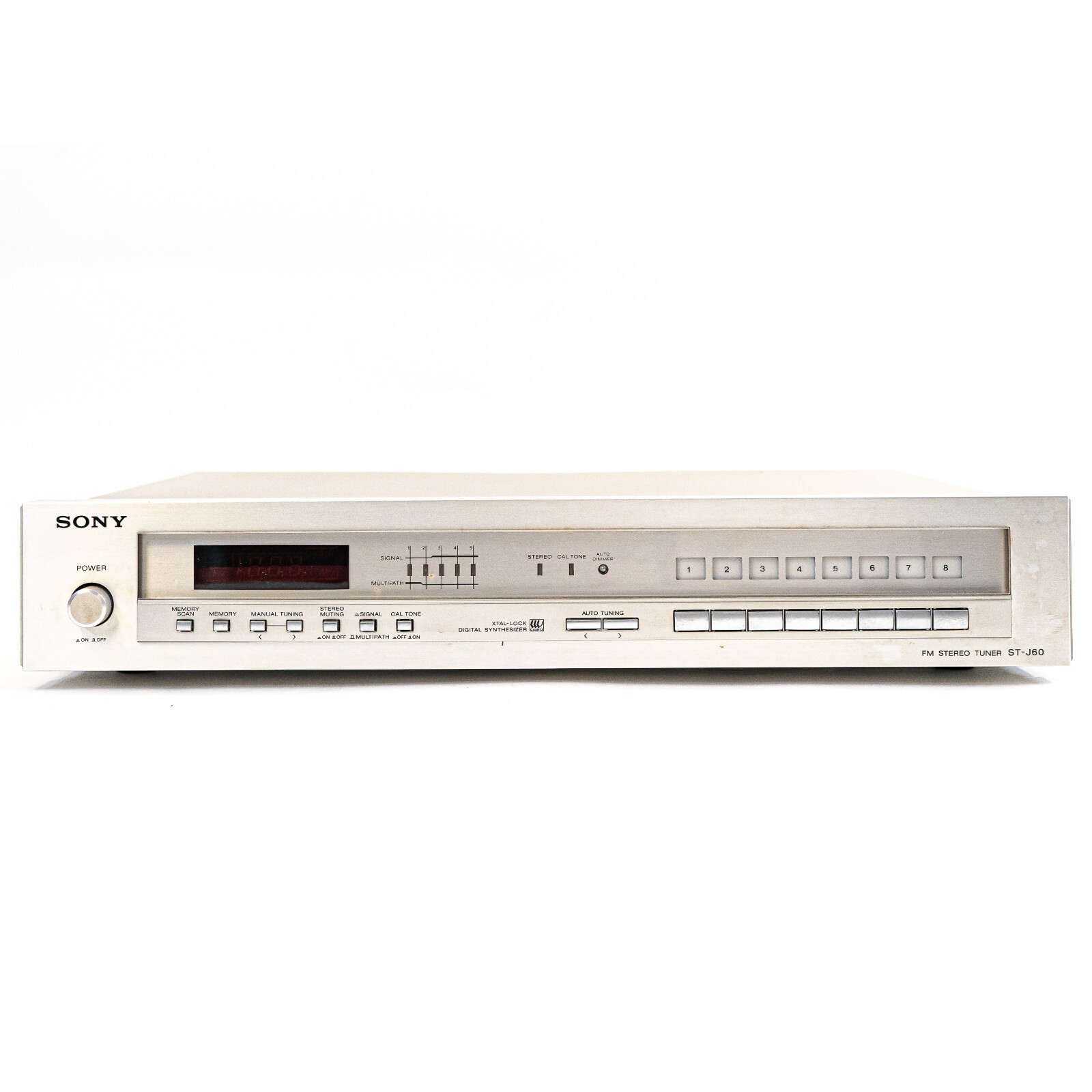
The Sony ST-J60 isn’t flashy, but it’s far from forgettable. Released in 1978, this FM/AM tuner arrived during a pivotal shift in receiver design—the dawn of digital synthesis in consumer audio. It wasn’t just another analog tuner with a digital readout; it used a full Crystal Lock Digital Synthesizer system. One collector noted they figured out every function without a manual, a rare compliment for a 1970s Japanese tuner. At its launch, it carried a price of ¥54,800 in Japan, though U.S. pricing is reported as $400 in 1978, suggesting a premium but not exotic positioning. Described by enthusiasts as a “real sleeper,” the ST-J60 delivers performance that seems to outpace its reputation. It's not a showpiece, but in a system built for clarity and reliability, it holds its ground.
The front end uses a varicap system equivalent to a 4-train varicon tuner, a design choice that improves tracking accuracy across the FM band. A dual gate MOS-FET is implemented to suppress cross modulation, a common issue in urban environments with strong adjacent signals. The IF section relies on Sony’s proprietary uniphase IF filter, a semiconductor-based solution that contributes to its strong selectivity ratings—85 dB at 400 kHz offset, which means it can pull a weak station out from next to a powerhouse without breaking a sweat. The MPX (stereo demodulator) section uses a PLL-IC, ensuring stable stereo decoding. While not the most powerful tuner on paper, its measured distortion is impressively low: 0.06% across frequencies in mono, rising only slightly in stereo mode. The frequency response spans 30 Hz to 15 kHz + 0.2-0.5 dB, which was solid for the era—especially considering it’s a tuner, not an amplifier.
Specifications
| Manufacturer | Sony |
| Product type | Tuner |
| Production year | 1978 |
| Circuit system | FM/AM superheterodyne system |
| FM Receiving frequency | 76.0 MHz to 90.0 MHz |
| FM Antenna terminal | 300 Ω Balanced Type, 75 Ω unbalanced type (coaxial cable connector) |
| FM Practical sensitivity | 1.8 μV (IHF) / 10.3 dBf (new IHF) |
| FM SN ratio 50 dB sensitivity | Mono : 3.5 μV (IHF) / 16.1 dBf (new IHF), Stereo : 40 μV (IHF) / 37.3 dBf (new IHF) |
| FM Signal-to-noise ratio | mono:77dB, stereo:72dB |
| FM Harmonic distortion factor | mono: 0.06%(100Hz) 0.06%(1kHz) 0.06%(10kHz), stereo: 0.08%(100Hz) 0.08%(1kHz) 0.15%(10kHz) |
| FM Stereo separation | 48dB(100Hz) 50dB(1kHz) 45dB(10kHz) |
| FM Frequency characteristic | 30 Hz to 15 kHz + 0.2-0.5 dB |
| FM Effective selectivity | 85dB(400kHz) 45dB(300kHz) |
| FM Capture ratio | 1.0dB |
| FM AM suppression ratio | 60dB |
| FM Image interference ratio | 90dB |
| FM IF interference ratio | 100dB |
| FM Spurious interference ratio | 100dB |
| FM Output Level / Impedance | 750mV/4k Ω |
| AM Receiving frequency | 531 kHz to 1611 kHz |
| AM Antenna | With ferrite bar antenna and external antenna terminal |
| AM Sensitivity | 250 μV/m (1000 kHz when bar antenna is used) |
| AM Signal-to-noise ratio | 50dB(50mV/m) |
| AM Harmonic distortion factor | 0.5% (50mV/m, 400 Hz) |
| AM Selectivity | 35dB(9kHz) 40dB(10kHz) |
| AM Image interference ratio | 35dB(1000kHz) |
| General Power supply voltage | 100 VAC, 50Hz/60Hz |
| General Power consumption | 12W |
| General External dimensions | Width 430 x Height 80 x Depth 325 mm |
| General Weight | Approx. 4.1 kg |
Key Features
Crystal Lock Digital Synthesizer System
This is the heart of the ST-J60’s precision. Unlike analog tuners that drift with temperature or age, the Crystal Lock system uses a quartz reference to stabilize tuning. The local oscillator frequency is digitally controlled and counted down to drive the display, ensuring the number on the front matches exactly what’s being received. This wasn’t just a gimmick—it meant consistent tuning, repeatability, and immunity to the frequency wobble that plagued even high-end analog tuners. The system supports bi-directional auto-tuning, letting users scan up or down the band, and manual step tuning in 100 kHz increments with a single button press.
8-Station Random Preset Memory
For 1978, 8 presets were generous, especially with random access—no cycling through stations one by one. The memory is permanent, retaining station settings even when unplugged, a convenience that wasn’t universal at the time. Combined with the last station memory function, which recalls the previously used frequency on power-up, the ST-J60 feels remarkably modern in daily operation. The presets cover both FM and AM bands, making it a practical centerpiece for a mixed-source system.
Uniphase IF Filter and Dual Gate MOS-FET Front End
Sony’s proprietary uniphase IF filter in the intermediate frequency stage contributes directly to the tuner’s strong rejection specs—100 dB on IF and spurious interference, 90 dB on image. Paired with the dual gate MOS-FET in the front end, which reduces cross modulation, the result is a tuner that performs well even in electrically noisy environments. The front end’s varicap design, equivalent to a 4-train varicon, ensures accurate tracking across the entire 76–90 MHz FM band, minimizing the need for manual alignment.
Auto-Dimmer Digital Display
The digital frequency readout isn’t just functional—it’s adaptive. An auto-dimmer circuit adjusts the brightness of the display based on ambient light, preventing glare in a dark room while remaining readable in daylight. It’s a small touch, but one that reflects Sony’s attention to real-world usability. The display is driven by the counted-down local oscillator signal, reinforcing the accuracy of the tuning system.
5-Step LED Signal Indicator and Multi-Pass Indicator
Visual feedback is clear and useful. The 5-step LED bar gives a real-time read on signal strength, helping users optimize antenna positioning. These features, combined with the CAL-TONE switch—which outputs a 400 Hz test tone at 50% modulation level—make the ST-J60 a tool as much as a component, suitable for both listening and system setup.
Muting Switch and Pilot Cancel
The muting switch allows silent tuning, eliminating the rush of noise when scanning between stations. Forum users have also noted the presence of a “Pilot Cancel” function, likely used to disable the 19 kHz pilot tone detection in specific servicing or test scenarios. While not a daily-use feature for most, it hints at the ST-J60’s engineering depth and serviceability.
Collectibility & Value
Original pricing was ¥54,800 in Japan, with U.S. sources citing $400 in 1978—though a conflicting report lists $599.99 in 1980, which may reflect regional or dealer markup. Current market examples appear sporadically on eBay, Reverb, and Facebook Marketplace, often in the $60–$70 range for working units, though some sell lower. No documented common failures are listed in the fact sheet, but one owner reported electrolytic capacitors were replaced around 2010, a routine maintenance step for gear of this age. With no official data on spare parts availability or widespread failure modes, upkeep relies on general vintage electronics knowledge. Still, its reputation for “beautiful sounding” performance and intuitive operation keeps it in the conversation among tuner enthusiasts.
eBay Listings

As an eBay Partner, we earn from qualifying purchases. This helps support our independent vintage technology research.
Related Models
- Sony ps-5550 (1978-1980)
- Sony ps-lx5r (1983-1985)
- Sony ss-7220a (1970s)
- Sony ss-97 (Late 1970s (approximately 1977-1979))
- Sony ss-999 (Late 1970s (approximately 1977-1979))
- Sony st-j88 (1986-1988)
- Kenwood kl-888s (Late 1970s (approximately 1978-1980))
- Sansui sax-200 (Late 1970s)
- Sansui sax-600 (Late 1970s)
- Sansui sr-222 (1973-1975)