Sony ST-5150D (1975)
At 7.0kg, it sits on the rack like a declaration—this is serious tuning, not just another box to fill space.
Overview
The Sony ST-5150D isn’t flashy, but it was never meant to be. Released in 1975 as a dedicated FM/AM stereo tuner, it was built for listeners who cared about signal purity and circuit integrity over cosmetic flair. Priced at ¥49,800 at launch—a meaningful sum at the time—it targeted audiophiles and tech-savvy buyers looking to extract every whisper of detail from broadcast radio. This isn’t an amplifier or receiver; it’s a tuner, pure and focused, designed to deliver clean, stable reception with minimal distortion. What it lacks in versatility, it makes up for in disciplined engineering.
Inside, the ST-5150D leans heavily on junction FETs and a four-row varicon tuning system, a combination that promised stability and low noise in the high-frequency amplifier stage. The local oscillator is described as stable, and the FET mixer circuit further reduces interference—critical for maintaining clarity in crowded FM bands. The intermediate frequency amplifier uses a 2-element solid-state filter backed by IC integration, which reportedly improves accuracy across the band. For AM, the design employs a triple-tuned IFT (intermediate frequency transformer) setup with a solid-state filter and high-integration IC, suggesting Sony aimed for tight selectivity and rejection of adjacent signals.
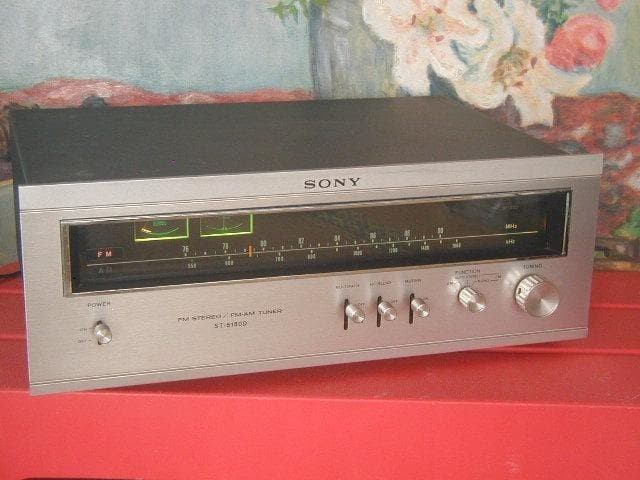
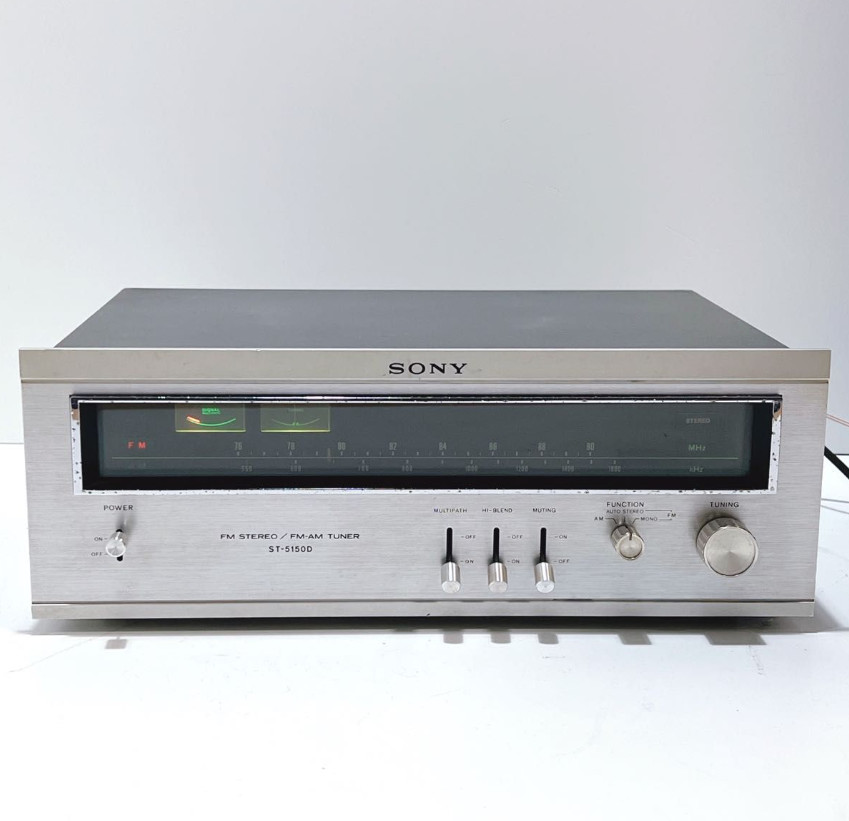
Where the ST-5150D stands out is in its thoughtful feature set. It includes a high blend circuit, useful for smoothing stereo separation at weak signal points, and a low-pass filter that prevents carrier leak and beat during recording—practical touches for users taping broadcasts. The large dial with regular interval markings makes tuning precise and legible, a small but meaningful quality-of-life upgrade over cheaper tuners of the era. And in a nod to future-proofing, it includes an FM discriminator output terminal, positioned as preparation for FM4-channel broadcasting, a format that never truly took off but reflected Sony’s forward-looking approach.
The signal-to-noise ratio of 70dB on FM and 50dB on AM are solid for the time, and stereo separation of 40dB or more at 400Hz ensures a convincing stereo image. Distortion is kept low: 0.3% in mono, 0.5% in stereo under standard modulation conditions. These numbers aren’t class-leading by 1975 flagship standards, but they’re consistent and reliable across the band.
It’s not all flawless. The AM section, while competent, shows its limits: a 45dB image rejection at 1,000kHz is modest, and sensitivity drops noticeably when relying solely on the internal ferrite bar antenna. External antenna support helps, but the AM performance doesn’t match the FM side’s poise. And while the build feels substantial at 7.0kg,
Still, the ST-5150D’s connectivity is impressively thorough. It offers both 300Ω balanced and 75Ω unbalanced FM antenna inputs, including a dedicated coaxial connector— Outputs include fixed (750mV/10kΩ) and variable (0–2V/1.8kΩ) audio, plus a unique multipath output with vertical and horizontal variants (150mV each, different impedances), allowing users to monitor multipath distortion directly. A front-panel multipath switch repurposes the signal meter for this task,
Specifications
| Manufacturer | Sony |
| Type | FM/AM Tuner |
| FM Antenna terminal | 300 Ω Balanced Type, 75 Ω unbalanced type (coaxial cable connector) |
| FM Practical sensitivity | 2.0 μ V (IHF standard) |
| FM Sensitivity | 1.6 μ V (SN ratio = 30 dB) |
| FM Signal-to-noise ratio | 70dB |
| FM Capture ratio | 1.0dB |
| FM Selectivity | 70dB(IHF) |
| FM Image interference ratio | 75dB |
| FM IF interference ratio | 90dB |
| FM Spurious interference ratio | 90dB |
| FM AM suppression ratio | 56dB(IHF) |
| FM Frequency characteristic | 20 Hz to 15 kHz ± 1 dB |
| FM Distortion factor Mono | 0.3% at 400 Hz, 100% modulation |
| FM Distortion factor Stereo | 0.5% at 400 Hz with Main 45% Sub 45% Pilot 10% modulation |
| FM stereo separation | 40 dB or More (400 Hz) |
| 19 khz and 38 khz suppression ratio | 50dB |
| FM Fixed Output | 750mV/10k Ω |
| FM Variable Output | 0 ~ 2V/1.8k Ω |
| FM Multipath output Vertical | 150mV/10k Ω |
| FM Multipath output Horizontal | 150mV/100k Ω |
| FM Discri out | 200mV/3k Ω |
| AM Antenna | Ferrite bar antenna; With External Antenna Terminal |
| AM Sensitivity | 50dB/m (when bar antenna is used); 30 μ V (when external antenna is used) |
| AM Signal-to-noise ratio | 50dB |
| AM Image interference ratio | 45dB(1,000kHz) |
| AM Distortion factor | 0.6% |
| Power | 100 VAC, 50Hz/60Hz |
| Power consumption | 15W |
| External dimensions | Width 400x Height 149x Depth 344 mm |
| Weight | 7.0kg |
Key Features
Junction FET and 4-Row Varicon Tuning System
The ST-5150D’s front end relies on a newly developed junction FET paired with a four-link varicon, a design choice aimed at reducing noise and improving tracking accuracy across the FM band. This combination was a step above basic transistor-based tuners, offering better linearity and stability—especially important for stereo decoding, where phase errors can collapse the soundstage.
2-Element Solid-State IF Filter with IC Support
In the intermediate frequency stage, a 2-element solid-state filter replaces traditional LC coils, reducing drift and improving consistency. Accuracy is enhanced through IC integration, a hallmark of mid-70s Japanese engineering that allowed tighter tolerances without manual alignment. This setup contributes directly to the tuner’s 70dB selectivity (IHF) and strong 90dB IF and spurious interference rejection.
High-Integration MPX Circuit with Custom Coil Unit
The stereo demodulator—MPX circuit—uses a high-integration IC and a newly developed coil unit designed specifically for IC compatibility. This integration reduces component count and improves reliability, while the custom coil helps maintain precise 19kHz pilot detection, critical for stable stereo separation. The 50dB suppression of 19kHz and 38kHz signals ensures minimal interference in the audio band.
Triple-Tuned AM IFT with IC Solid-State Filter
The AM section doesn’t get short shrift: it uses a triple-tuned IFT (intermediate frequency transformer) system with a solid-state filter and high-integration IC. This design improves selectivity and reduces adjacent-channel interference, though the 45dB image rejection at 1,000kHz suggests it’s not quite on par with the FM side. Still, for a tuner in this class, it’s a robust implementation.
Large Dial with Regular Interval Scale
Tuning is done via a large, clearly marked dial with evenly spaced frequency indicators. This regular interval scale makes it easier to remember station positions and reduces hunting, especially when using the precise mechanical tuning knob. It’s a small ergonomic win, but one that enhances daily usability.
Low-Pass Filter for Clean Recording
A built-in low-pass filter prevents carrier leak and beat during tape recording, a practical feature for users archiving broadcasts. Without it, high-frequency FM artifacts could interfere with tape heads or cause audible whistles. Sony included this as standard, signaling the ST-5150D’s role as a serious component in a recording-capable system.
Multipath Output and Switchable Signal Meter
One of the most distinctive features is the multipath output—vertical and horizontal at 150mV each—with dedicated terminals. A front-panel switch repurposes the signal strength meter to display multipath distortion, allowing users to adjust antenna position for minimum reflection.
FM Discriminator Output for FM4-Channel Readiness
The inclusion of an FM discriminator output (200mV/3kΩ) hints at Sony’s anticipation of FM4-channel broadcasting, a quadraphonic radio standard that never gained traction. Still, the terminal allows external decoding or signal analysis, making the ST-5150D useful beyond conventional stereo listening.
Dedicated 75Ω Coaxial Antenna Connector
This simplifies integration with rooftop or outdoor antennas, reducing signal loss and mismatch—especially valuable in fringe reception areas.
High Blend Circuit for Smoother Stereo Transitions
This preserves a sense of spaciousness while improving intelligibility, a subtle but effective compromise between fidelity and usability.Collectibility & Value
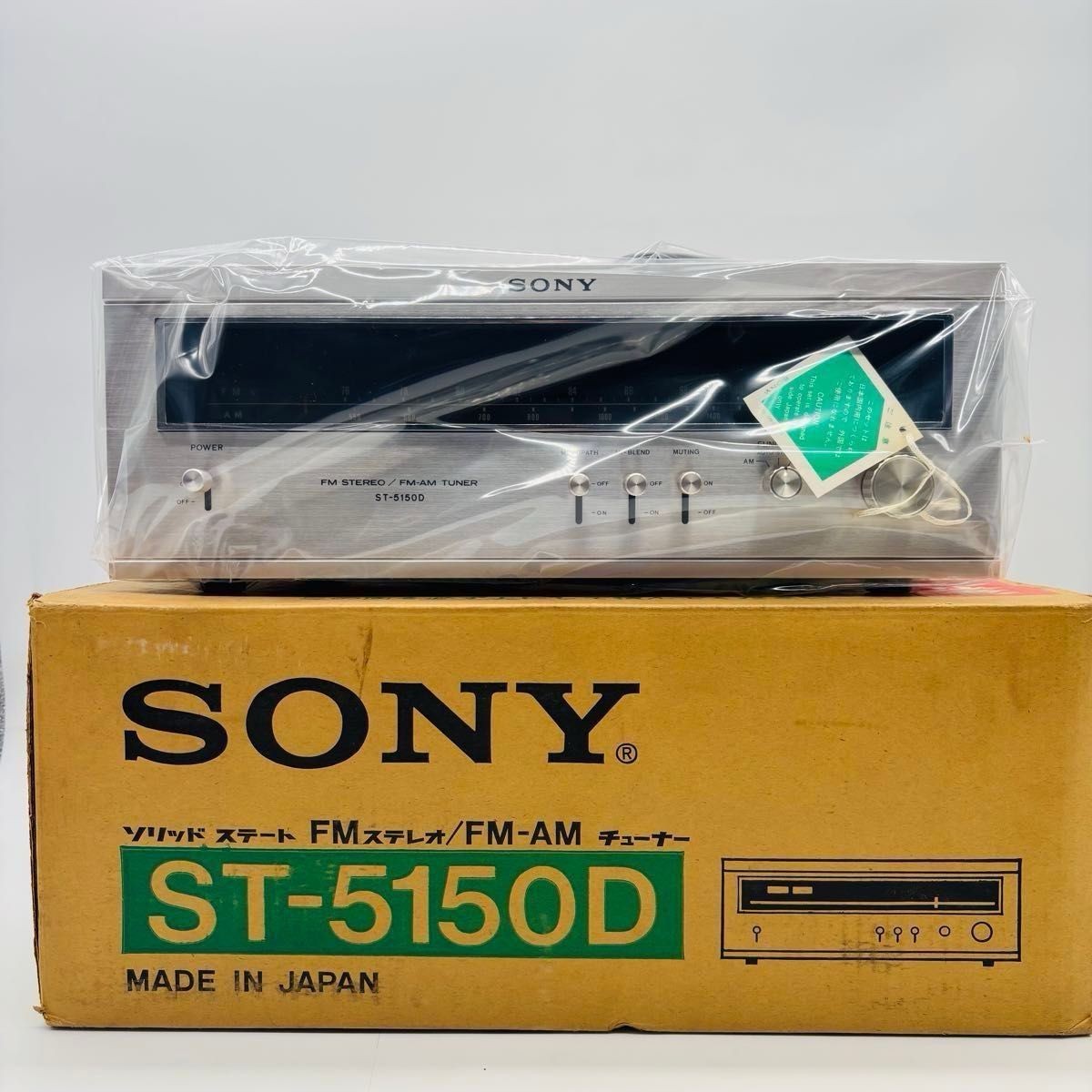
Original pricing at ¥49,800 in 1975 Current listings describe it as "Vintage Rare," though actual scarcity is unclear. Units appear intermittently on eBay, with conditions varying widely: some are NOS (New Old Stock) with original boxes, manuals, and accessories, while others are sold "for parts or repair" due to internal issues. A Facebook user comment dubs it "(MCiNTOSH KiLLER)," though this appears to be enthusiast hyperbole rather than a documented performance claim. No data exists on common failures or maintenance challenges.
eBay Listings

As an eBay Partner, we earn from qualifying purchases. This helps support our independent vintage technology research.
Related Models
- Sony ps-5550 (1978-1980)
- Sony ps-lx5r (1983-1985)
- Sony ss-7220a (1970s)
- Sony ss-97 (Late 1970s (approximately 1977-1979))
- Sony ss-999 (Late 1970s (approximately 1977-1979))
- Sony st-j88 (1986-1988)
- Kenwood kl-888s (Late 1970s (approximately 1978-1980))
- Sansui sax-200 (Late 1970s)
- Sansui sax-600 (Late 1970s)
- Sansui sr-222 (1973-1975)