Sony ST-5070 (1974)
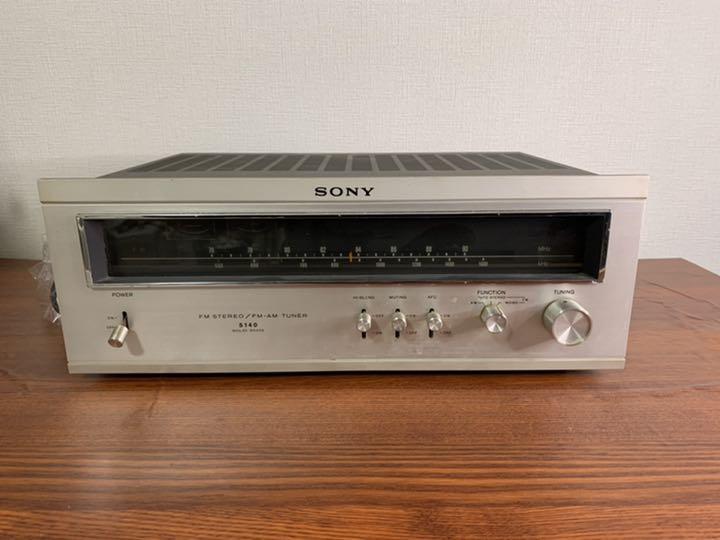
That green-lit dial glow? Pure 1970s audio alchemy—tuning in feels like watching a slow-motion light show with your ears.
Overview
The Sony ST-5070 isn’t flashy, but it’s got presence—the kind that makes you glance twice on a shelf of vintage tuners. It’s a full-function FM/AM tuner from 1974, built when Sony was deep in the groove of analog refinement, stacking specs like they were going out of style. And for its time, they almost were. This thing bristles with engineering intent: 54 transistors, a pair of ICs, a FET up front, and a dial that glows green under a soft orange pointer like some kind of mood ring for radio waves. It replaced the ST-5055A and sat just below the ST-5150D in Sony’s lineup, but don’t mistake its position for compromise—this was a serious listen, not a budget stopgap.
What stands out isn’t just the wooden side panels (a nice touch, sure) or the dual output terminals (fixed and variable, so you can feed a preamp or record deck directly), but how it handles the airwaves. The FM section uses a 3-gang front end, a pair of CF filters, and a ratio detector—old-school but effective. It’s not a PLL tuner, despite what some databases suggest; that likely refers only to the CX0431 MPX decoder IC. The real magic? That green-illuminated tuning window. Owners report it floats like a hologram, soft and inviting, turning station hunting into something meditative. And once you’re dialed in, the muting switch kicks in cleanly at 5µV, silencing noise before the signal collapses. It’s not perfect—frequency drift creeps in at around +0.2MHz, which means you might nudge the knob mid-song—but that’s part of its charm. This isn’t digital precision; it’s analog warmth with a pulse.
It’s also surprisingly self-contained. The AM section uses a ferrite bar antenna built into the chassis, so you don’t need to stretch a wire across the room to catch a broadcast. In Nagoya-area tests, users pulled in stations cleanly without any external help. Sensitivity is rated at 46dB/m via the bar antenna, or 100μV with an external hookup, and the AM IF section uses a triple-tuned IFT for better selectivity. That matters when you’re digging through crowded bands. The front panel’s got an output level control, a high-blend switch (whose effect some owners admit they never fully grasped), and a satisfyingly chunky tuning knob that makes micro-adjustments feel tactile, not fussy.
Weighing in at 4.9kg and stretching 416mm wide, it’s no lightweight, but it doesn’t feel overbuilt—just solid. The 300Ω balanced and 75Ω unbalanced antenna terminals mean it plays well with both old-school twin-lead and modern coax, and the fixed output (750mV/10kΩ) is hot enough to drive most vintage preamps without strain. It was priced at ¥39,800 around 1975, which put it in the upper-middle tier of Sony’s tuner range. Not the flagship, but no entry-level toy either.
Specifications
| Manufacturer | Sony |
| Type | FM/AM tuner |
| Tuning Range | FM 87.5 to 108 MHz |
| Intermediate Frequency | 10.7 MHz |
| Antenna terminals | 300Ω balanced, 75Ω unbalanced |
| Usable sensitivity | 2.2μV (IHF) |
| Sensitivity | 1.7μV (S/N=30dB) |
| S/N ratio | 68dB |
| Capture ratio | 1.0dB |
| Selectivity | 70dB (IHF) |
| Image rejection ratio | 45dB |
| IF rejection ratio | 95dB |
| Spurious response rejection ratio | 75dB |
| AM suppression ratio | 45dB (IHF) |
| Frequency response | 30Hz~15kHz +1 -3dB |
| Distortion | mono:0.4% (400Hz, 100% modulation); stereo:0.6% (400Hz, main 45% sub 45% pilot 10% modulation) |
| FM stereo separation | 35dB or more (400Hz) |
| Output voltage/impedance | Fixed output: 750mV/10kΩ; Variable output: 0~1.5V/1.8kΩ |
| Muting Threshold | 5 µV |
| AM Antenna | Ferrite bar antenna, with external antenna terminal |
| AM Sensitivity | 46dB/m (using bar antenna); 100μV (using external antenna) |
| AM S/N ratio | 50dB |
| AM Image rejection ratio | 70dB (1,000kHz) |
| AM Distortion | 0.5% |
| Power supply | AC100V, 50Hz/60Hz |
| Power consumption | 17W |
| Dimensions (WxHxD) | 416 x 120 x 284 mm |
| Weight | 4.9kg |
| Semiconductors | 2 x IC, 1 x FET, 54 x transistors, 36 x diodes |
Key Features
Engineered for stability, not spectacle
Sony didn’t cut corners on the front end. The RF amplifier uses newly developed junction FETs—low-noise, high-input impedance devices that helped squeeze every microvolt from weak signals. Paired with a stable local oscillator and FET mixer circuit, it’s a setup designed to reject interference before it becomes noise. The IF section leans on a newly developed 2-element solid-state filter in a single package, backed by Hi-Fi ICs and a symmetrical diode limiter to keep distortion in check. It’s not a modular design; it’s a tightly integrated signal path where each stage is tuned to the next. The FM discriminator is solid-state and non-adjustable, which means less drift over time but also less room for tweaking. Same goes for the MPX decoder—built around the CX0431 IC with a dedicated non-adjustable coil unit. This is a “set it and forget it” approach, not a tuner for tinkerers who want to recalibrate their stereo image every Sunday.
Two outputs, one smart switch
Having both fixed and variable outputs is a subtle but meaningful choice. The fixed output runs at a steady 750mV, perfect for feeding a preamp or recorder without level swings. The variable output, controlled by the front panel knob, lets you adjust volume directly from the tuner—handy if you’re using it as a standalone FM source. Then there’s the high-blend switch. Its purpose isn’t universally understood; one owner admitted they never quite figured out what it did, though it likely adjusts the high-frequency blending in stereo decoding to reduce noise during weak reception. It’s not a tone control, but more of a stealthy clarity tweak.
That dial. That glow.
The large tuning dial with a lamp-lit orange pointer and green-illuminated frequency window is the ST-5070’s soul. It’s not just functional—it’s atmospheric. The pointer floats over the scale like a needle on a compass, and the green backlight gives it a sci-fi warmth that feels more 1978 than 1974. It’s the kind of detail that makes you want to dim the lights and just tune slowly through the band, watching the S-meter swing and waiting for the stereo lamp to light. And when it does, you know you’ve hit gold.
Historical Context
The ST-5070 replaced the ST-5055A and shared the lineup with the ST-5150D, positioning it as a mid-to-upper-tier tuner in Sony’s 1974 catalog. Oddly, the ST-5090, despite its higher number, was actually the lower-tier sibling—what Japanese documentation calls the “弟機” (younger brother model). It wasn’t a radical departure, but an evolution: same core circuitry as the export model ST-5055L, refined for the domestic market. No grand announcement, no marketing blitz—just another solid step in Sony’s steady march toward analog fidelity.
Collectibility & Value
Today, the ST-5070 trades in the ¥5,500 to ¥8,800 range for working units, with one recent listing asking ¥8,800 for a 1975 model. Non-working or “junk” units go for as little as ¥1,300, with one listed at ¥1,887 described as having AM reception but no FM function. The average winning bid over a 30-day period was ¥4,125, based on limited auction data. Condition matters—the front panel and knobs can yellow or dull, but well-preserved examples still shine. No common failure points are documented, but given its age, capacitor drift and tuner contact oxidation are likely candidates for FM issues. It’s not a rare piece, but it’s not common either. If you’re after that green-lit dial and a tuner that feels like it was built to last, it’s worth the hunt.
eBay Listings
As an eBay Partner, we earn from qualifying purchases. This helps support our independent vintage technology research.
Related Models
- Sony ps-5550 (1978-1980)
- Sony ps-lx5r (1983-1985)
- Sony ss-7220a (1970s)
- Sony ss-97 (Late 1970s (approximately 1977-1979))
- Sony ss-999 (Late 1970s (approximately 1977-1979))
- Sony st-j88 (1986-1988)
- Kenwood kl-888s (Late 1970s (approximately 1978-1980))
- Sansui sax-200 (Late 1970s)
- Sansui sax-600 (Late 1970s)
- Sansui sr-222 (1973-1975)