Sony SS-WM20 (1982)
They snap shut like a cassette case and sing like a tiny hi-fi — if you can find one that still works.
Overview
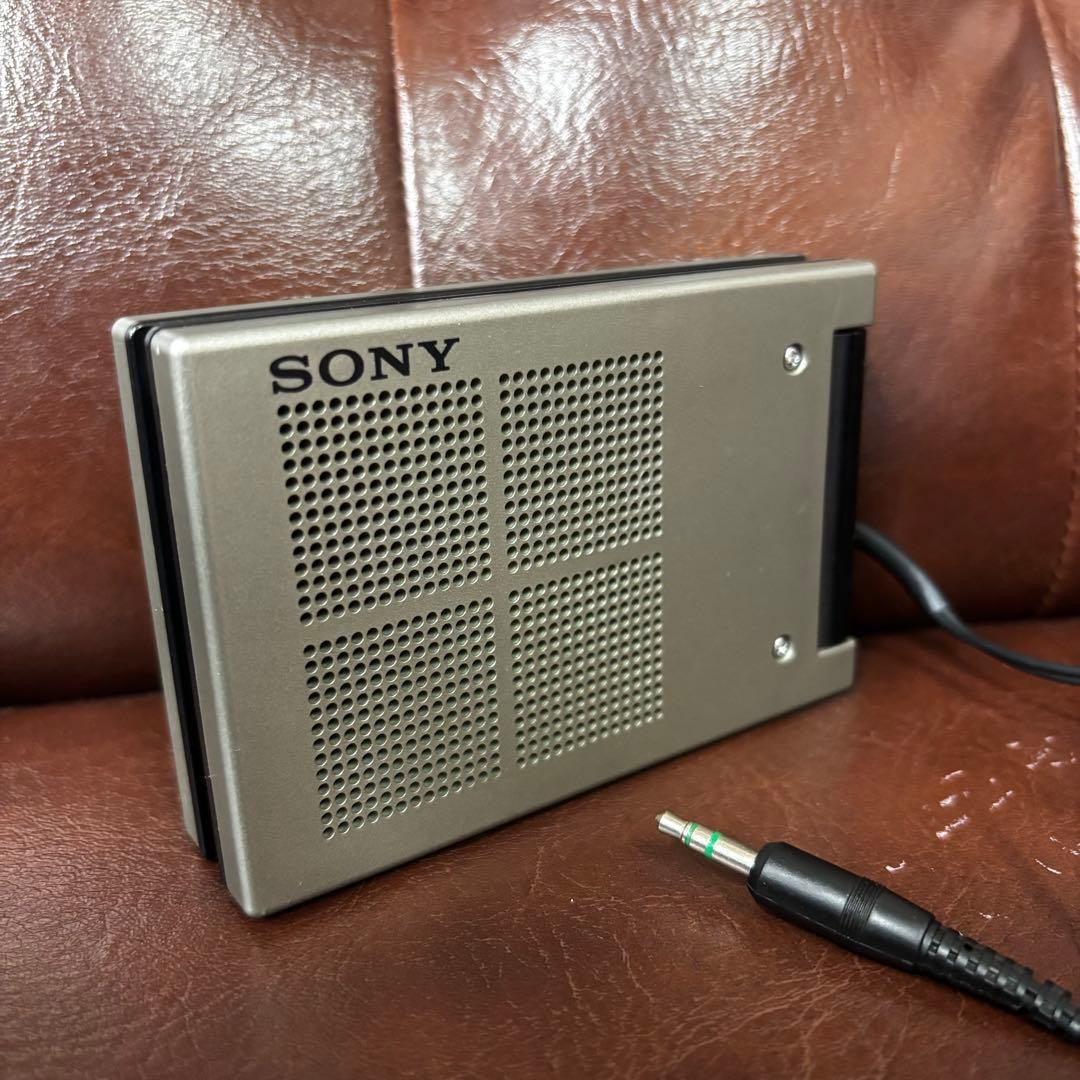
You know that moment when you’re digging through a box of forgotten Walkman accessories and something silver glints back at you, folded neatly like a secret? That’s the Sony SS-WM20 — a little-known, oddly brilliant passive speaker system from 1982 that was built to turn your portable cassette player into a pocket-sized stereo party. Don’t let the plastic shell fool you: this thing was engineered with some real ambition. It’s not amplified, doesn’t need batteries, and plugs straight into the headphone jack of any Walkman or portable device with a 3.5 mm output. At a time when most portable speakers were tinny, single-unit blobs, the SS-WM20 offered true stereo separation in a body no bigger than a cassette tape when folded. It retailed for ¥7,000 in Japan — not cheap for the early '80s — and was clearly meant for the audiophile who refused to compromise sound just because they were on the move.
It’s a 2.0 channel wired system, meaning left and right drivers in one foldable unit, connected by a short cable to a single 3.5 mm plug. The whole thing weighs just 110 grams — cord included — and measures a svelte 110 x 70 x 25 mm. That’s smaller than most smartphones today, and it was designed to fit snugly in the same pouch as your Walkman and tapes. Sony called it a “carrying type” speaker, and the German catalogs weren’t wrong when they dubbed it a *Klapplautsprecher* — literally, “folding loudspeaker.” When collapsed, it mimics the footprint of a standard cassette, making it one of the most compact stereo speaker solutions of its era. It’s made entirely of plastic, finished in a clean silver, and while it lacks any kind of bass reflex port or enclosure tuning data, it was built around a novel idea: a tension film diaphragm paired with a samarium-cobalt magnetic circuit, technology Sony was experimenting with to get cleaner response from small drivers.
And yes — it’s passive. No internal amp, no power switch, no volume knob. It’s often described as “like the SRS-20, but without an amplifier,” which tells you exactly where it sits in Sony’s ecosystem. The SRS-20 and SRS-30 were active, powered speakers; the SS-WM20 is their minimalist cousin, relying entirely on the output strength of whatever device you plug it into. That means your Walkman has to work harder, and volume is limited by headphone output levels — but for the time, it was a clever way to deliver stereo fidelity without adding bulk or batteries.
Specifications
| Manufacturer | Sony |
| External dimensions | Width 110 x Height 70 x Depth 25 mm |
| Weight | 110g (including cord) |
| Audio Inputs | 3.5 mm Jack |
| Compatible Brand | Universal, For Sony |
| Connectivity | Wired |
| RMS Power | 20 W |
| System Configuration | 2.0 Channel |
| Shape | Rectangular |
| Features | Folding/carrying type |
| Material | Plastic |
| Color | Silver |
| Compatible Model | Universal |
| Driver | Tension film diaphragm |
| Enclosure type | Folding/cassette case size |
Key Features
Passive, Plug-and-Play Simplicity
There’s no power supply, no internal circuitry beyond the drivers — just a 3.5 mm plug that feeds left and right channels directly to the speakers. This makes the SS-WM20 entirely dependent on the headphone amplifier of your source device, which in 1982 meant most Walkmans could drive it, but not at concert levels. Still, the design choice kept weight down and eliminated the need for batteries, a smart trade-off for a travel accessory. It’s the kind of thing you’d toss in your bag for a picnic, unfold on a park bench, and impress someone with actual stereo imaging from a cassette player.
Tension Film Diaphragm & Samarium-Cobalt Magnets
Sony didn’t just slap two paper cones in a plastic box. The SS-WM20 uses a “newly developed tension film diaphragm” — a lightweight, taut membrane likely designed for faster response and reduced distortion compared to traditional drivers. Paired with a strong samarium-cobalt magnetic circuit, this setup suggests Sony was aiming for clarity over raw output. These materials were still relatively exotic in consumer audio in 1982, usually reserved for high-end headphones or studio gear. Their use here hints that this wasn’t just a gimmick — it was a serious attempt at portable fidelity.
Foldable Cassette-Size Design
The real magic is in the form factor. The speakers hinge shut, folding down to the exact size of a standard cassette — 110 x 70 mm — so it could ride in the same case as your tapes. It’s a detail that feels almost obsessive, but entirely in line with Sony’s design philosophy at the time: everything should fit, everything should be portable, everything should feel intentional. The rectangular plastic shells protect the drivers when closed, and the whole thing feels sturdy despite its featherweight construction.
Universal Compatibility
Despite being marketed alongside Sony Walkmans, the SS-WM20 isn’t locked to the brand. It’s labeled as compatible with both Sony and universal devices, as long as they have a 3.5 mm stereo output. That made it a flexible accessory in an era when portable audio was becoming standardized around the mini-jack. Whether you had a Panasonic, Aiwa, or even a boombox with a headphone out, the SS-WM20 could plug in and play.
Collectibility & Value
Finding a working SS-WM20 today is a minor victory. Listings describe it as “rare” and “few in existence,” and the market reflects that. Prices range from around $54 to as high as $350 on eBay, with European buyers paying €90–€170 and Japanese auctions hovering near ¥7,500. A listing on Mercari Japan showed one selling for ¥7,499 in late 2025, and a U.S. eBay shop offered a pre-owned unit for $69.95 — all for a speaker system that weighs less than a deck of cards. Condition is critical: one listing emphasizes “可動品” (operational item), and given the age, that’s not a guarantee. The most commonly reported issue is channel failure — “left side working only” — which suggests the internal wiring or hinge connections may degrade over time. There’s no documented repair path or common fixes, so buyers are essentially gambling on longevity. But if you land one that works? You’ve got a charming, functional piece of Sony’s portable audio legacy — a tiny stereo that turns your vintage Walkman into something that feels, just for a moment, like home hi-fi.
eBay Listings


As an eBay Partner, we earn from qualifying purchases. This helps support our independent vintage technology research.
Related Models
- Sony ps-5550 (1978-1980)
- Sony ps-lx5r (1983-1985)
- Sony ss-7220a (1970s)
- Sony ss-97 (Late 1970s (approximately 1977-1979))
- Sony ss-999 (Late 1970s (approximately 1977-1979))
- Sony st-j88 (1986-1988)
- Kenwood kl-888s (Late 1970s (approximately 1978-1980))
- Sansui sax-200 (Late 1970s)
- Sansui sax-600 (Late 1970s)
- Sansui sr-222 (1973-1975)