Sony SS-S30 (1981)
They don’t make bookshelf speakers this tall — or this honest — anymore.
Overview
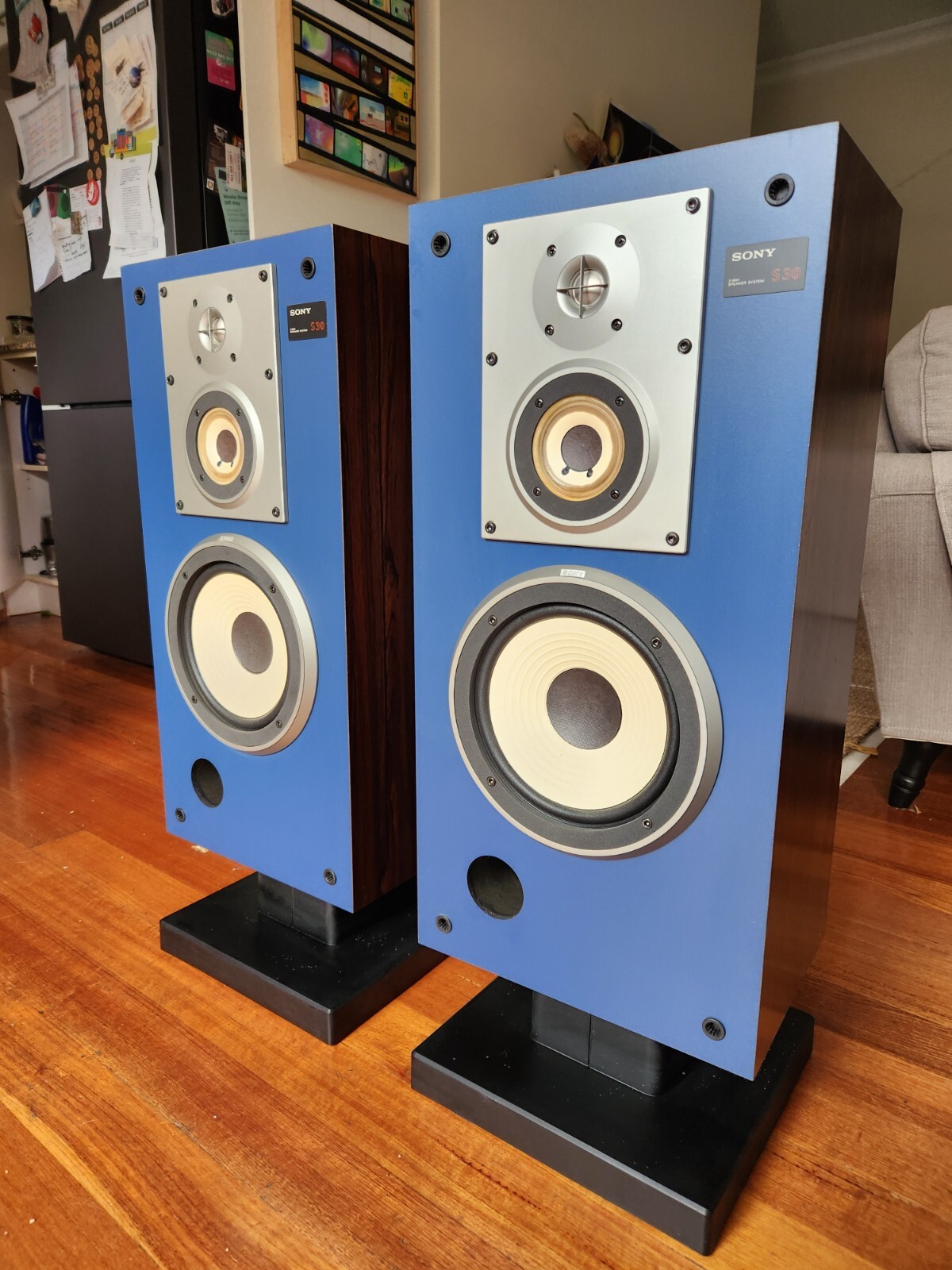
The Sony SS-S30 isn’t just a speaker from 1981 — it’s a statement in wood veneer and titanium. At over 64 centimeters tall, it straddles the line between bookshelf and floorstander, a design quirk that gives it presence without demanding center stage. Sony labeled it a "bookshelf type," but good luck finding a shelf that fits these 11-kilogram beasts. Still, that size serves a purpose: housing a full 3-way, 3-speaker bass reflex system built to deliver the sonic character of the larger SS-S50 in a slightly more approachable form. The idea wasn’t to reinvent the wheel, but to bring high-end clarity and depth into a living room-friendly footprint — or at least, as friendly as a 645mm-tall cabinet can be.
This is vintage Sony at a moment when the company was refining its acoustic identity — not chasing flash, but engineering for balance. The SS-S30 uses a trio of cone drivers: a 20 cm woofer handling the lows, a 7 cm midrange for the heart of the music, and a 2 cm titanium dome tweeter slicing through the top end with precision. That tweeter is key — titanium domes from this era can be aggressive in lesser designs, but here, paired with a crossover hitting at 2 kHz and 8 kHz, the goal seems to have been coherence. The mid and high frequencies are mounted together on a single unit board, a design choice meant to align the sound sources and stiffen the baffle. It’s a subtle but thoughtful touch — not just about sound quality, but structural integrity. You don’t see this kind of integration in budget models.
And while the specs suggest a speaker built for accuracy, the real story is in its lineage. The SS-S30 was explicitly designed to make the sound of the SS-S50 "more familiar" — a phrase that hints at accessibility, warmth, domestic comfort. It wasn’t a downsized compromise; it was a recalibration. Owners report the cabinet feels solid, the drivers test cleanly, and the overall presentation carries an "impressive sound image" — though we’re relying on modern observations, since no contemporary reviews surfaced in the research. Still, the fact that people are still talking about these on Reverb and Reddit, calling them "beautiful" and "rare," says something about their staying power.
Specifications
| Manufacturer | Sony |
| System type | 3-way, 3-speaker, bass reflex, bookshelf type |
| Woofer | 20 cm cone type |
| Midrange | 7 cm cone type |
| Tweeter | 2 cm titanium dome type |
| Frequency response | 38 Hz to 25000 Hz |
| Output sound pressure level | 92dB/W/m |
| Impedance | 6 Ω |
| Rated maximum input | 55W |
| Instantaneous maximum input | 110W |
| Crossover frequency | 2 kHz, 8 kHz |
| Dimensions (WxHxD) | Width 315 x Height 645 x Depth 280 mm |
| Weight | 11.0kg |
| Included accessories | Speaker cord (2.5m) |
Key Features
Coherent driver array via unified mid-tweeter board
Sony didn’t just stack drivers and call it a day. The midrange and tweeter are mounted together on a single unit board, a design that does two things: it acoustically aligns the sound sources, reducing time-smear between frequencies, and it reinforces the front baffle. A stiffer baffle means less cabinet resonance, which means cleaner output — especially in the critical vocal and upper-midrange region. This isn’t just engineering for specs; it’s a deliberate move toward sonic integrity. You see this kind of integration in higher-end designs, so finding it in a 1981 bookshelf model speaks to Sony’s priorities at the time.
Full-range 3-way system with titanium dome tweeter
Few bookshelf speakers from this era dared to go this low or reach this high. With a 20 cm woofer and a claimed frequency response down to 38 Hz, the SS-S30 delivers bass that borders on floorstanding territory — especially with the help of the bass reflex port. The 2 cm titanium dome tweeter extends cleanly to 25,000 Hz, offering air and detail without (in theory) the brittleness sometimes associated with early metal domes. Paired with the 7 cm cone midrange, the system aims for a seamless handoff across the spectrum. The crossover points — 2 kHz between woofer and mid, 8 kHz between mid and tweeter — suggest careful tuning to avoid overlap and phase issues. It’s a system built for transparency, not hype.
High sensitivity and robust power handling
At 92dB/W/m, the SS-S30 is efficient — it doesn’t demand a powerhouse amp to come alive. That made it a natural match for popular receivers and integrated amps of the early '80s, many of which put out 40–60 watts. With a rated maximum input of 55W and an instantaneous peak handling of 110W, it can handle dynamic swings without flinching. One Reddit user noted running them with a NAD 3020e (an 8Ω-rated amp) and wondering if they were underpowered — but that concern may say more about expectations than actual performance. These speakers are sensitive enough to sing even with modest gear, though their 6Ω impedance means you’ll want an amp that can handle a slight load dip.
Historical Context
The SS-S30 was built with a clear mission: to bring the sound of the SS-S50 closer to the user. It wasn’t a cost-reduced version, but a reimagined one — a way to deliver a similar sonic signature in a slightly more compact, living-room-friendly form. Described as a speaker that makes the SS-S50’s sound “more familiar,” the SS-S30 suggests Sony was thinking about accessibility, not just fidelity. This wasn’t about competing on raw power or size, but about refinement and presence — about making high-end audio feel at home. Introduced in 1981, it arrived during a period when Japanese manufacturers were perfecting the balance between technical precision and musicality, and the SS-S30 fits neatly into that moment.
eBay Listings



As an eBay Partner, we earn from qualifying purchases. This helps support our independent vintage technology research.
Related Models
- Sony ps-5550 (1978-1980)
- Sony ps-lx5r (1983-1985)
- Sony ss-7220a (1970s)
- Sony ss-97 (Late 1970s (approximately 1977-1979))
- Sony ss-999 (Late 1970s (approximately 1977-1979))
- Sony st-j88 (1986-1988)
- Kenwood kl-888s (Late 1970s (approximately 1978-1980))
- Sansui sax-200 (Late 1970s)
- Sansui sax-600 (Late 1970s)
- Sansui sr-222 (1973-1975)