Sony ss-7070 (Late 1970s (approximately 1977-1979))
Warm, detailed, and deceptively punchy — these bookshelf speakers from Sony’s 1970s golden era still surprise listeners who expect polite vintage sound.
Overview
The Sony SS-7070 isn’t flashy, but it’s the kind of speaker that makes you forget you’re listening to vintage gear. Introduced around 1974, this 2-way, sealed bookshelf system was built during a time when Japanese audio engineering was hitting its stride — not just copying Western designs, but refining them with obsessive materials science and magnetic innovation. Priced at ¥32,000 for a pair back then, the SS-7070 sat in the upper-mid tier of Sony’s lineup, offering serious performance without stepping into flagship territory. It wasn’t trying to be the loudest or deepest — it was aiming for balance, and by all accounts, it hit the mark.
Owners report a sound that’s warm but not soft, with a midrange clarity that made voices and acoustic instruments feel present and natural. The low end, while rolling off at 50Hz, carries surprising weight for a sealed cabinet of its size — no port to exaggerate bass, just honest cone motion driven by a 20cm woofer with some clever engineering under the hood. Paired with modestly powered receivers of the era — think 30 to 50 watts from a Kenwood, Pioneer, or Sony’s own amplifiers — these speakers don’t strain, don’t color, and don’t fatigue. They just play music.
And that’s part of their quiet charm: they weren’t marketed as high-end audiophile gear, but they were built like it. From the metal woofer bobbin to the specially treated rubber cloth on the surround, the SS-7070 reflects a philosophy where reliability and long-term performance mattered as much as specs on a page. The tweeter’s continuously variable level control is a nice touch — a rare feature at this price point — letting users fine-tune brightness to match room acoustics or personal taste. It’s a small thing, but it shows Sony was thinking about real-world listening, not just lab measurements.
Specifications
| Type | 2-way, 2-speaker, sealed enclosure, bookshelf type |
| Woofer | 20cm cone type |
| Tweeter | 6.5cm cone type |
| Frequency response | 50Hz – 20kHz |
| Output sound pressure level (new JIS) | 87dB/W/m |
| Impedance | 6Ω |
| Maximum allowable input | 40W (Weighted pink noise) |
| Crossover frequency | 4.5kHz |
| External dimensions (W x H x D) | 290mm x 508mm x 272mm |
| Weight | 9.4kg |
Key Features
Low-Distortion Magnetic Circuit
Sony didn’t just spec a magnet and call it a day — they engineered it. The SS-7070’s woofer uses a magnetic circuit designed to minimize nonlinear distortion, a common issue in mid-tier drivers of the era. A notch in the center pole, capped with thick copper plating or a copper cap, helps smooth out magnetic flux irregularities that can cause voice coil distortion. It’s a trick borrowed from high-end designs, and it pays off in cleaner bass and midbass, especially at higher volumes.
Proprietary Cone Material
The diaphragm uses Scandinavian or Nordic pulp, processed with Sony’s proprietary papermaking technology to increase rigidity while maintaining piston-like motion across a wider range. That means less breakup, less coloration, and more accurate reproduction — particularly in the upper bass and lower midrange, where cone flex can muddy the sound. It’s not exotic material by today’s standards, but in the mid-70s, this kind of controlled fiber sourcing and treatment was a sign of serious R&D investment.
Airtight Edge Treatment
The woofer’s surround uses a thin special rubber cloth applied for airtight sealing — a design choice aimed at eliminating a common resonance dip around 400Hz. That frequency range is critical for vocal presence and instrument body, and a “valley” there can make music sound thin or distant. By addressing it at the mechanical level, Sony avoided having to overcompensate in the crossover, preserving phase coherence and dynamic accuracy.
Metal Bobbin and High-Purity Wiring
Heat kills speakers, and the SS-7070 fights back with a metal bobbin (winding frame) in the woofer, which dissipates heat better than paper or aluminum alternatives. That contributes directly to its 40W pink noise rating — no small feat for a bookshelf speaker of this size. The voice coil leads use high-purity imported copper foil treated with special resin to resist breakage, a known failure point in older drivers. It’s one of those “set it and forget it” details that matter after 40 years.
Resonance-Controlled Cabinet
The enclosure is made from hard particle board, carefully selected for density and thickness, with internal reinforcement to reduce panel resonance and boxy coloration. While not exotic wood or laminated construction, it’s overbuilt for the price — no flimsy MDF here. The sealed (airtight) design avoids port turbulence and time-smearing, trading deep bass extension for tighter, more controlled low-end response. It’s a deliberate choice, and one that pairs well with the speaker’s overall philosophy of accuracy over exaggeration.
Advanced Crossover Components
The network section uses a large air-core coil with low DC resistance, reducing power loss and distortion in the critical mid-to-treble transition. While the exact topology isn’t documented, the use of standard electrolytic capacitors (now likely in need of replacement) suggests a conventional but well-executed passive design. The tweeter’s continuously variable level control is unusual for a speaker at this price — most competitors used fixed taps or nothing at all — and it gives owners real flexibility in tuning the speaker to their room.
Beat Orange Urethane Grille
It’s not just functional — it’s a time capsule. The Beat Orange colored urethane grill net is unmistakably 1970s, a bold aesthetic choice that’s either loved or hated. It’s not fabric, not foam — it’s a durable, slightly textured urethane that resists sagging and discoloration better than many vintage grilles. And yes, it’s removable, though few would argue the speakers look better without it.
Collectibility & Value
The SS-7070 typically sells for $150–$300 per pair in good condition today, making it an accessible entry into vintage Japanese high-fidelity. The original price of ¥32,000 (circa 1974) reflects its position as a premium but not exotic offering — think “serious enthusiast” rather than “audiophile elite.” The most common failure point is the foam surround on the woofer, which tends to dry out, crack, and disintegrate over time. Re-foaming kits are widely available and relatively easy to install, often restoring both performance and resale value. The crossover’s electrolytic capacitors are another aging component; while not always failed, replacing them can bring the speaker closer to its original tonal balance, especially in the treble. Overall, these are robust speakers — the cabinet rarely warps, the drivers are overbuilt, and the wiring is durable — but like any 50-year-old electronics, they benefit from a little TLC.
eBay Listings

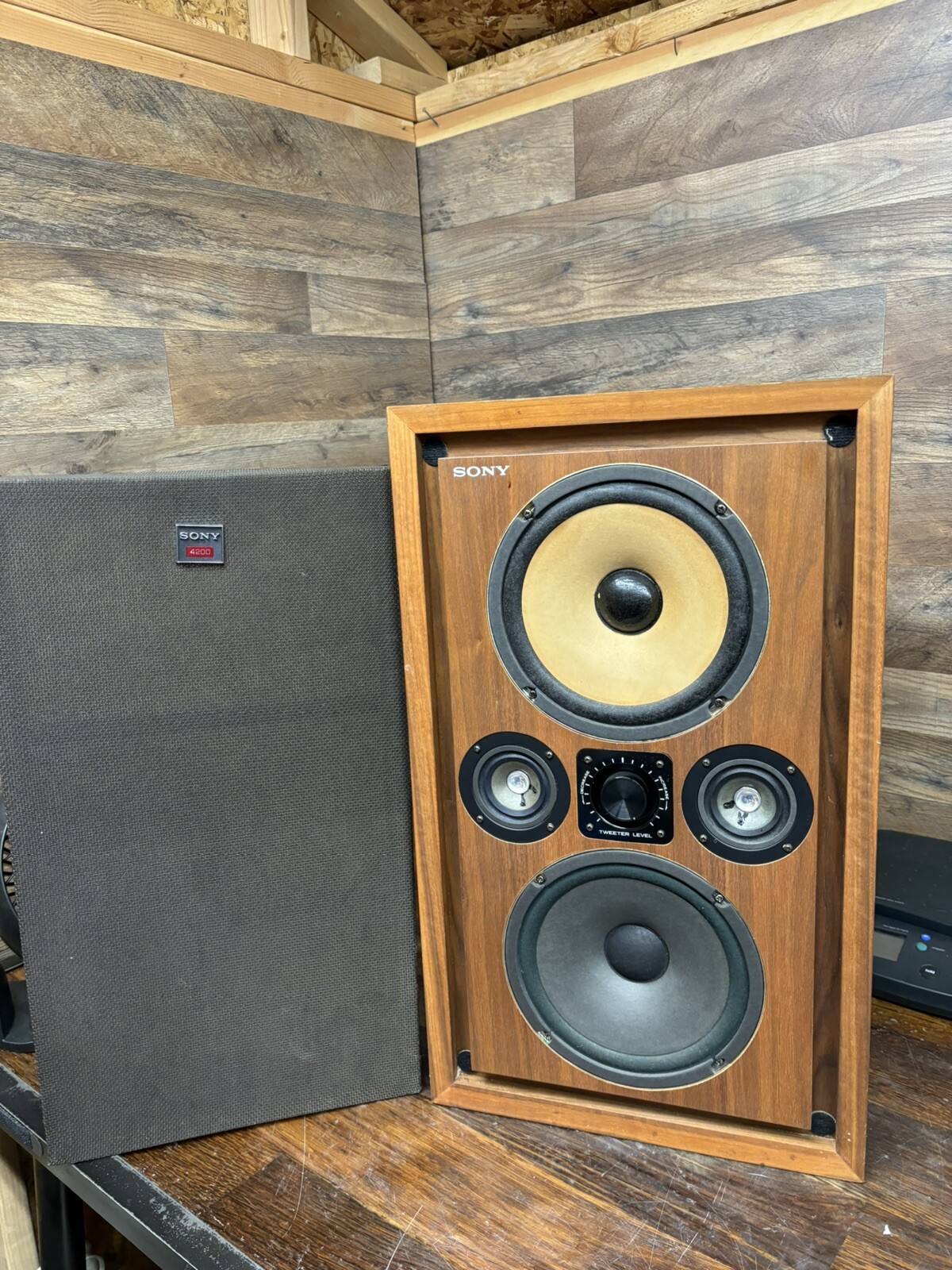

As an eBay Partner, we earn from qualifying purchases. This helps support our independent vintage technology research.
Related Models
- Sony ps-5550 (1978-1980)
- Sony ps-lx5r (1983-1985)
- Sony ss-7220a (1970s)
- Sony ss-97 (Late 1970s (approximately 1977-1979))
- Sony ss-999 (Late 1970s (approximately 1977-1979))
- Sony st-j88 (1986-1988)
- Kenwood kl-888s (Late 1970s (approximately 1978-1980))
- Sansui sax-200 (Late 1970s)
- Sansui sax-600 (Late 1970s)
- Sansui sr-222 (1973-1975)