Sony PS-5550 (1976)
It doesn’t scream “high-end,” but this export-only belt-drive turns quietly competent into something you might actually miss.
Overview
You won’t find the PS-5550 in any Japanese catalog from the mid-70s — because it wasn’t meant for Japan. Sony built the PS-5550 as an export-only model, slipping it into international markets as a mid-fi workhorse that didn’t pretend to be more than it was. No flashy marketing, no bold claims of sonic transcendence — just a solid, belt-driven turntable with enough precision to handle a decent record collection without breaking stride. It’s not a masterpiece, as one observer put it, but it’s far from disposable. For what it is — a no-frills, mechanically sound deck built during Sony’s disciplined analog era — it holds up with a quiet dignity that today’s plasticky audiophile gear often lacks.
At its core, the PS-5550 is defined by consistency. The 300mm die-cast aluminum platter spins with a 1.5kg heft that, while not massive by modern standards, contributes to stable rotation. Paired with a Sony D-009F DC-servo controlled motor and belt drive system, it achieves a wow & flutter rating of just 0.025% WRMS — a number that still raises eyebrows for a turntable in this class. Signal-to-noise comes in at 78 dB (DIN-B), which means background noise stays where it belongs: out of the way. The tonearm, an S-shaped static-balanced design with an effective mass of 11g, is well-damped and tracks reliably, especially with cartridges in the 4–14 gram range. It’s not the ultra-low-mass arm of a high-end deck, but it’s predictable, repeatable, and when set up right, it stays out of the music’s way.
This isn’t Sony showing off with exotic materials or radical engineering. It’s Sony doing what they did well in the 70s: refining proven designs into reliable, serviceable hardware. The plinth uses a non-resonant construction, and the diecast aluminum base is decoupled from the wooden outer case — a simple but effective form of isolation. It’s not audiophile-grade suspension, but it’s smarter than bolting everything to a slab. The hinged, smoked plastic dust cover gives it a clean look, and the illuminated stroboscope makes speed checks a breeze. It’s a complete package, built for people who wanted good sound without fuss.
Specifications
| Manufacturer | Sony |
| Product type | belt-driven turntable |
| Production years | 1976 |
| Drive system | Belt drive |
| Motor | Sony D-009F DC-servo controlled motor |
| Speeds | 33 1/3 & 45 rpm |
| Speed adjustment range | ±3% |
| Wow & flutter | 0.025% WRMS |
| S/N ratio | 78 dB (DIN-B) |
| Platter | 300mm aluminum die-cast |
| Platter weight | 1.5kg |
| Tonearm type | static-balanced S-shaped tonearm |
| Tonearm overall length | 220mm (13 1/8") |
| Tonearm effective mass | 11g |
| Pivot to stylus | 9 5/8" |
| Overhang | 1 9/32" |
| Stylus force range | 0...3 grams |
| Anti-skating range | 0...3 grams |
| Shell weight | 10.5 grams |
| Cartridge weight range | 4...14 grams |
| Power consumption | 6W |
| Dimensions (W x H x D) | 453 x 150 x 365mm (18 1/2" x 5 3/8" x 15 1/8") |
| Weight | 10.5kg (20 lbs.) |
Key Features
DC-Servo Motor & Speed Control
The Sony D-009F motor isn’t just a standard DC motor — it’s servo-controlled, meaning it constantly monitors and corrects rotational speed. This is what allows the PS-5550 to hit that remarkably low 0.025% wow & flutter. Speed selection and pitch adjustments are electronically controlled, a small luxury in an era when many still relied on manual belts or pulleys. The ±3% speed adjustment range gives users fine control, and the illuminated stroboscope built into the plinth edge makes calibration straightforward. It’s not quartz-locked like some of Sony’s later direct-drive models, but for a belt-drive, it’s impressively stable.
Auto-Return & Shutoff
One of the more refined touches is the auto-return and shutoff system. Unlike many turntables that use mechanical linkages or trip levers, the PS-5550 uses opto-sensing to detect the end of the record. The tonearm has its own small motor dedicated solely to returning it to the rest after playback — a clever way to eliminate mechanical wear and ensure smooth, repeatable operation. It’s not silent, but it’s reliable when the system is functioning. Owners report that when these mechanisms work, they work well — but when they fail, they can be a headache to diagnose.
Tonearm & Tracking
The static-balanced S-shaped tonearm isn’t exotic, but it’s thoughtfully executed. With a 220mm overall length and 11g effective mass, it’s optimized for medium-compliance moving magnet cartridges — the kind that were standard in the 1970s. The calibrated counterweight includes a built-in scale for stylus force (0–3 grams), and anti-skating is similarly adjustable across the same range. Viscous damped cueing ensures the arm lowers gently, protecting both record and stylus. One owner summed it up: “tracks beautifully.” That’s high praise for a stock arm, especially on a mid-tier deck.
Build & Isolation
The construction is described as “quite well built,” and that holds up. The diecast aluminum base is rigid and decoupled from the wooden outer casing, reducing the transmission of external vibrations. It’s not a full suspension system, but it’s more thoughtful than the one-piece plinths found on lower-end models. The non-resonant plinth design further dampens unwanted coloration. The whole unit weighs in at 10.5kg — substantial enough to resist microphony, but not so heavy it needs its own foundation. It’s a balanced, pragmatic approach to isolation that reflects Sony’s engineering priorities at the time: effective, not extravagant.
Historical Context
The PS-5550 existed in the shadow of Sony’s more famous turntables. It wasn’t part of their high-end domestic lineup, nor was it intended to compete with the flagship PS-X75 Biotracer. Instead, it sat quietly below models like the PS-6750 and PS-X7, serving as a capable export alternative. It was a “fairly rare mid-fi” offering — not rare because it was coveted, but because it was never widely distributed. Sony positioned it as “everyday gear,” and that’s exactly what it was: a dependable, no-nonsense turntable for listeners who valued consistency over showmanship. It didn’t push boundaries, but it didn’t need to. In an era when many brands were chasing direct-drive hype, Sony quietly proved that a well-executed belt-drive could still deliver excellent performance.
Collectibility & Value
The PS-5550 isn’t a trophy turntable, but it has its niche. A listing in March 2025 on a Japanese auction site asked ¥85,000 — a price that reflects its condition and completeness more than any inherent desirability. The original Sony cartridge is often missing or in need of a new stylus, which can be a hurdle for new owners. More critically, the speed control ICs — specifically the µPC 1032H — are known to fail and are now difficult to source. That’s the kind of failure that can sideline a deck permanently unless a technician can cross-reference or retrofit a replacement.
On the upside, service manuals and repair schematics are available, which helps keep these units alive. Some enterprising sellers even offer 3D-printed replacement gears, addressing another common wear point. One owner noted their unit “hadn’t been used in decades” and was “frozen stiff” — but after restoration, it was “back to life and holding its own.” That’s the story of many PS-5550s: neglected, then revived, and found to be surprisingly capable. It’s not a collector magnet, but for someone who values understated competence, it’s a rewarding find.
eBay Listings


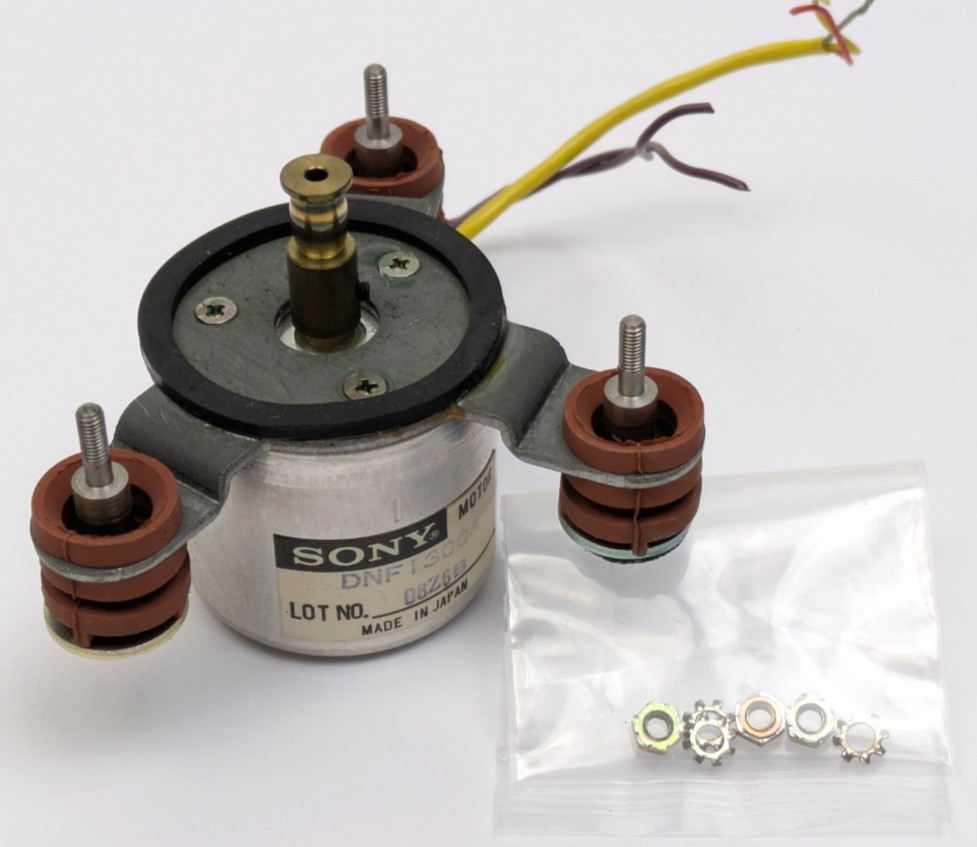
As an eBay Partner, we earn from qualifying purchases. This helps support our independent vintage technology research.
Related Models
- Sony ps-lx5r (1983-1985)
- Sony ss-7220a (1970s)
- Sony ss-97 (Late 1970s (approximately 1977-1979))
- Sony ss-999 (Late 1970s (approximately 1977-1979))
- Sony st-j88 (1986-1988)
- Kenwood kl-888s (Late 1970s (approximately 1978-1980))
- Sansui sax-200 (Late 1970s)
- Sansui sax-600 (Late 1970s)
- Sansui sr-222 (1973-1975)
- Sony apm-8 (1982-1984)