Sony ps-5170 (1974)
It powers up with a soft hum and settles into near-silence—this is the quiet confidence of a 1970s Sony that never needed to shout.
Overview
The Sony PS-5170 isn’t flashy, but it’s no slouch. Released around 1974, it was Sony’s answer to the growing demand for reliable, mid-tier turntables that could deliver solid performance without the fuss of manual-only operation. Priced at ¥33,800 at launch, it sat comfortably in the sweet spot between budget decks and high-end statement pieces. This is a belt-drive record player system built for daily use, wrapped in the clean, functional design language Sony favored in the mid-70s. It doesn’t pretend to be exotic—just capable, consistent, and thoughtfully engineered.
Under the hood, it leans on a 4-pole hysteresis synchronous motor, a type developed specifically for turntable use, which helps keep speed stable and noise low. Paired with a double-side polished urethane belt, the drive system delivers smooth rotation with minimal vibration transfer. The 30 cm aluminum die-cast platter weighs in at 1.0 kg—nothing outrageous, but enough mass to resist wobble and maintain inertia. It spins at 33 1/3 and 45 rpm, with a pitch control of ±3%, giving users a small window to tweak tempo or correct slightly off-speed pressings.
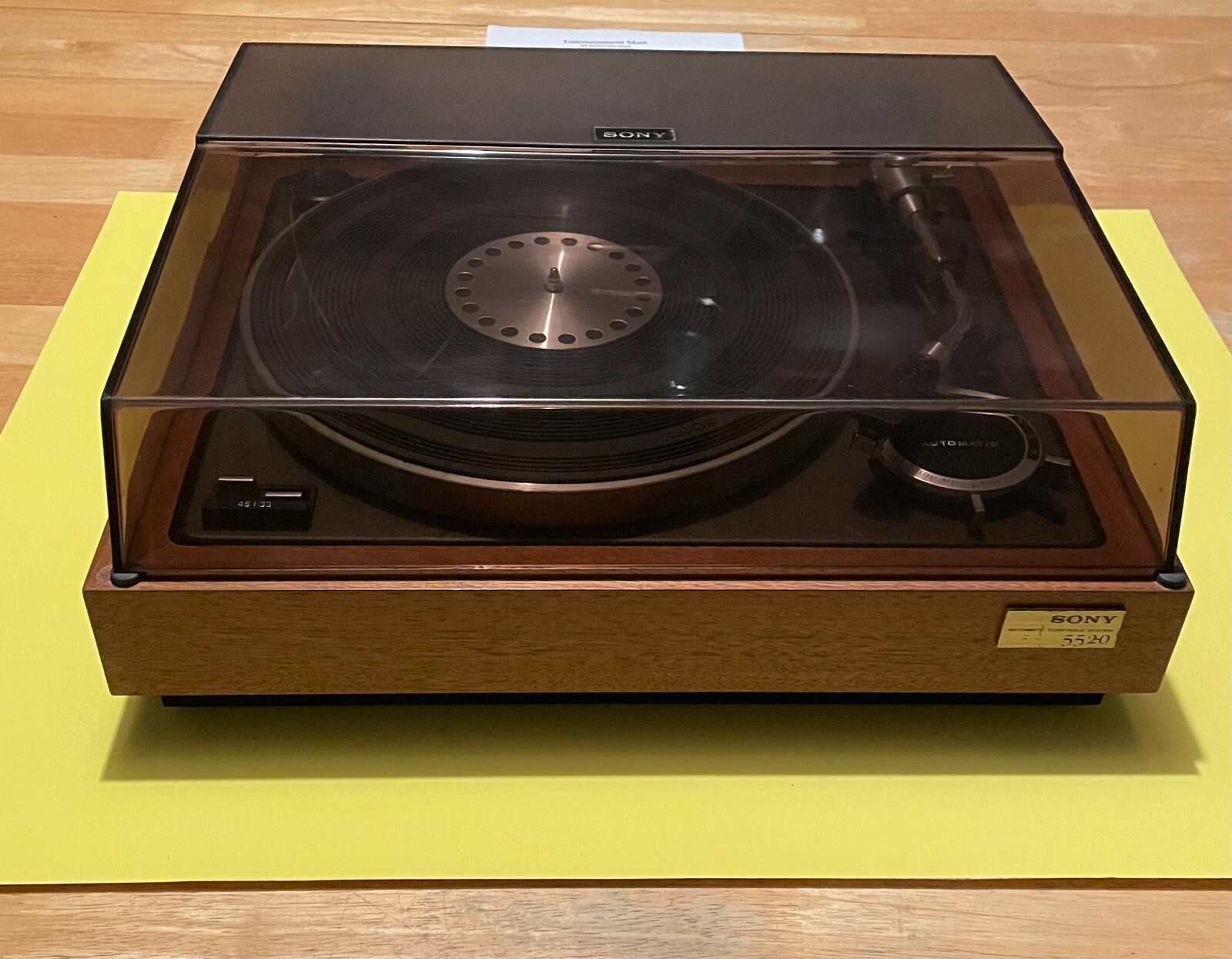
The PS-5170 is semi-automatic, meaning it handles the basics: auto return and auto cut. You cue the record, drop the tonearm, and when the track ends, it lifts the arm and returns it to the rest. It’s not full auto (no auto-start), but it’s convenient enough for casual listening without sacrificing too much in terms of mechanical simplicity. The removable acrylic dust cover keeps things tidy when not in use, and the whole unit measures 450 x 175 x 395 mm, weighing 8kg—solid enough to feel substantial on a shelf, but not a burden to move.
It came equipped with an IM-type cartridge, a moving magnet design by Sony, featuring a 0.5 mil diamond needle and an output voltage of 4mV. The cartridge is mounted on a standard headshell (SH-150), which means owners aren’t locked into Sony’s ecosystem—aftermarket replacements within the 4g to 12g weight range are fair game. The tonearm itself is a static balanced universal type, 216.5mm in effective length, with an overhang of 16.5mm and an offset angle of 23° 30’. Tracking error is kept within +3° 05’ to -1°, which is respectable for a mid-tier deck of this era. Needle pressure is adjustable from 0 to 3g, with the sweet spot recommended between 1.5g and 2.5g (Sony suggests 2g).
One subtle but meaningful detail: the output cable is a low-capacity type designed to reduce high-frequency loss. It’s a small thing, but it shows Sony was paying attention to signal integrity, even at this price point. The tonearm also includes an inside force canceler and an arm lifter—practical touches that make operation smoother and reduce wear.
Specifications
| Manufacturer | Sony |
| Turntable | 30 cm aluminum die-cast, 1.0 kg |
| Motor | 4-pole hysteresis synchronous motor |
| Drive system | Belt drive |
| Number of revolutions | 33 1/3, 45 rpm |
| Pitch control | ±3% |
| Start-up characteristic | Within 1/2 Rotation (33 1/3rpm) |
| Wow flutter | 0.08% WRMS or less |
| Signal-to-noise ratio | 45 dB or more |
| Tone arm | Static balanced universal tone arm |
| Effective length | 216.5mm |
| Total Length | 295mm |
| Overhang | 16.5mm |
| Tracking error angle | + 3 ゜ 05', -1 ゜ |
| Offset Angle | 23 ° 30' |
| Needle pressure adjustment range | 0 ~ 3g (0.5g scale) |
| Inside force cancel range | 0 ~ 3g |
| Shell Weight | 10.5g |
| Usable cartridge weight | 4g ~ 12g |
| Cartridge | IM Type |
| Frequency characteristic | 15 Hz to 22 kHz |
| Separation | 25dB(1kHz) 23dB(10kHz) |
| Output voltage | 4mV |
| Optimum load impedance | 50k Ω |
| Compliance | 10x10 -6 Cm / dyne (vertical, horizontal) |
| Vertical tracking angle | 15 ° |
| Needle pressure (optimum needle pressure) | 1.5g ~ 2.5g (2g) |
| Needle | 0.5 mil diamond needle |
| Cartridge Weight | 6.8g |
| Exchange needle | ND-132GA |
| Power supply voltage | 100 VAC, 50Hz/60Hz |
| Power consumption | 8W |
| External dimensions | Width 450x Height 175x Depth 395 mm |
| Weight | 8kg |
| Attachment | 45 Rotation Adapter, Tracking error confirmation gauge (Sold Separately), Sony Oil OL-2KA, Head Shell SH-150 |
Key Features
Semi-Automatic Convenience
The PS-5170 strikes a balance between automation and simplicity. It’s equipped with a semi-auto mechanism that handles auto return and auto cut—once the record finishes, the tonearm lifts and returns to its rest. You still have to lower it manually, which keeps the mechanism less complex and potentially more reliable over time. For listeners who didn’t want the ritual of full manual operation but weren’t ready to pay for full-auto decks, this was a smart compromise.
Thoughtful Tonearm Design
The static balanced universal tonearm is a workhorse. With an effective length of 216.5mm and a precisely defined offset angle, it’s engineered to minimize tracking error across the record surface. The inclusion of an inside force canceler helps counteract the inward pull that can distort inner grooves, especially on longer albums. The arm lifter adds convenience and protects the stylus during setup. Since the headshell is standard, users can upgrade or swap cartridges without needing proprietary parts—just keep the total weight between 4g and 12g.
IM-Type Cartridge with Replaceable Stylus
Sony’s IM-type cartridge delivers a frequency response from 15 Hz to 22 kHz, with 25dB of channel separation at 1kHz. It’s not class-leading by modern standards, but for 1974, it was competitive. The 0.5 mil elliptical diamond stylus (model ND-132GA) is replaceable, which is a big plus for longevity. Today, replacement styli are still available—mrstylus.com offers a "quality replica from Switzerland from current production" for 23.95 €, while sonimage.fr lists one for 48.90 €. That kind of ongoing support makes the PS-5170 more viable as a working turntable than many of its peers.
Low-Capacity Output Cable
It’s easy to overlook the cable, but Sony specified a low-capacity type to reduce high-frequency loss. In an era when some manufacturers cut corners here, this choice suggests they took signal fidelity seriously, even on a mid-range model. It’s a small detail that adds up when you’re trying to preserve the clarity of the cartridge’s 4mV output.
Collectibility & Value
There is no verified data on current market prices for complete Sony PS-5170 units. However, replacement styli for the original cartridge are available from European vendors: mrstylus.com lists one for 23.95 € (20.13 € excl. VAT), describing it as a modern quality replica, while sonimage.fr offers a replacement for 48.90 €. These prices suggest that while the PS-5170 isn’t a high-demand collector’s item, it’s not entirely forgotten. The availability of parts means it can still be a functional turntable for someone who values 1970s Sony engineering over rarity or prestige.
eBay Listings

As an eBay Partner, we earn from qualifying purchases. This helps support our independent vintage technology research.
Related Models
- Sony ps-5550 (1978-1980)
- Sony ps-lx5r (1983-1985)
- Sony ss-7220a (1970s)
- Sony ss-97 (Late 1970s (approximately 1977-1979))
- Sony ss-999 (Late 1970s (approximately 1977-1979))
- Sony st-j88 (1986-1988)
- Kenwood kl-888s (Late 1970s (approximately 1978-1980))
- Sansui sax-200 (Late 1970s)
- Sansui sax-600 (Late 1970s)
- Sansui sr-222 (1973-1975)