Sony PS-2510 (1973–1974)
It powers up with a soft neon glow and a faint hum that settles into silence—then spins vinyl with the quiet confidence of a machine built to last.
Overview
The Sony PS-2510 isn’t flashy, but it carries itself like something important. Released in Japan in 1973, it arrived during the country’s golden era of high-fidelity audio, when engineers were pouring obsessive detail into every screw, circuit, and casting. This was the moment component stereos began overtaking all-in-ones, and direct-drive turntables were still something of a revelation. Sony didn’t invent the idea—Panasonic likely did—but they entered the game with serious intent, building on the foundation of the TTS-2500 and PS-2500. The PS-2510 followed as a refined expression of that early direct-drive philosophy: no belts, no gears, just a solid die-cast platter spinning with precision thanks to an AC servo motor and electronic speed control.
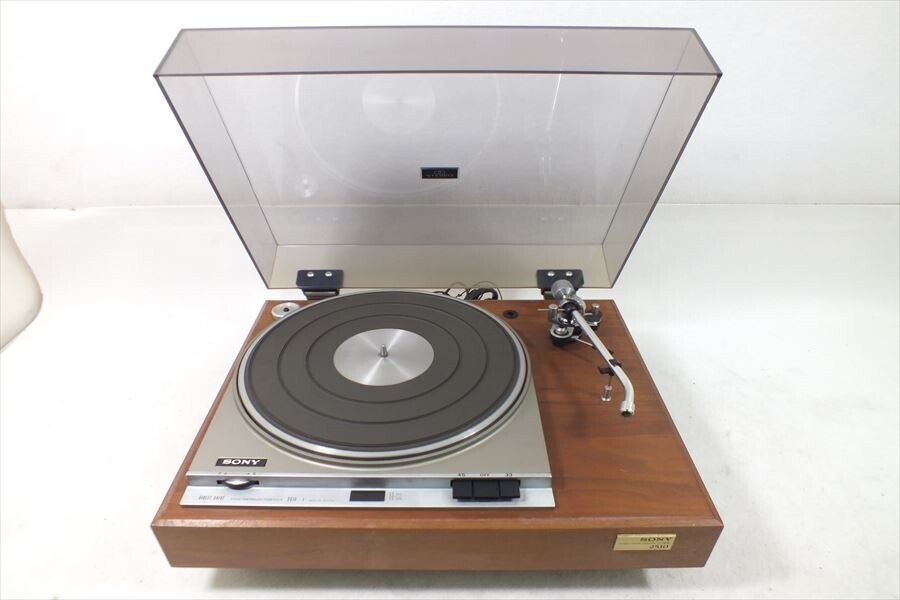
It’s not a flashy showpiece. It’s brown, heavy (13.1 kg), and built like a lab instrument. But open the acrylic dust cover—designed as a fleece-top and removable—and you see the care: concentric dotted rings on the platter meant to catch the flicker of a neon strobe, a tonearm packed with adjustments most users would never fully exploit, and a chassis that uses rubber dampers and theoretical insulators to fight vibration. It was designed to resist howling, skipping, and signal degradation from floor tremors. Owners report it’s “sturdy and doesn’t break,” “never broken down,” and “a good machine with no quirks.” One called it “a product that makes you feel the conscience and motivation of Sony engineers.” That’s not marketing talk—that’s the voice of someone who’s lived with it.
And yes, it’s got one well-known flaw: the tonearm’s cartridge connector terminals use rhodium (or possibly silver) plating instead of gold, which makes them prone to contact issues over time. It’s the kind of trade-off you accept when you’re holding a device into which, as one owner put it, “a massive amount of labor and materials were poured.”
Specifications
| Manufacturer | Sony |
| Drive type | Direct-drive |
| Motor | AC servo motor |
| Speeds | 33 and 45 rpm |
| Speed adjustment range | +/- 4 per cent |
| Pitch Range | +/- 33 % |
| Wow flutter | 0.03% WRMS or less |
| Signal-to-noise ratio | 60 dB or more |
| Start-up characteristic | Within 1/2 Rotation (33 1/3rpm) |
| Tone arm | Static balanced universal tone arm |
| Effective length | 245mm |
| Overhang | 14mm |
| Tracking error angle | + 2° 16', -1° 12' |
| Needle pressure adjustment range | 0 ~ 3g (0.2g scale) |
| Arm Height Adjustment Range | 7mm |
| Usable cartridge weight | 4g ~ 17g (without auxiliary weight); 8g ~ 21.5g (Auxiliary Weight) |
| Power supply voltage | 100 VAC, 50Hz/60Hz |
| Power consumption | 14W |
| External dimensions | Width 486x Height 192x Depth 391 mm |
| Weight | 13.1kg |
| Platter | 31 cm aluminum die cast, 1.0 kg, Removable |
| Color | Brown |
| Connectivity | Stereo L/R RCA outputs |
| Original stylus model | Sony ND-124P needle stylus |
| Stylus tip shape | conical diamond |
| Attachments | 45 Rotation Adapter, Tracking error confirmation gauge, Auxiliary weight, Silicon cloth |
Key Features
The Heart: AC Servo Direct Drive
At the core of the PS-2510 is an AC servo motor—no belts, no gears, no reduction mechanisms. This wasn’t just about convenience; it was about eliminating sources of speed variation and mechanical noise. The motor spins the 31 cm die-cast aluminum platter directly, and speed is regulated electronically using a servo circuit built around a dedicated IC (possibly the CX-0032) and supported by eight transistors and ten diodes. The result? A start-up time of less than half a rotation at 33⅓ rpm and wow & flutter held to an impressive 0.03% WRMS or less. That’s studio-grade stability for a consumer turntable in the early 1970s.
Speed Control & Strobe Synchronization
Speed switching and adjustment are fully electronic, with a front-panel VR (variable resistor) allowing fine-tuning across both 33⅓ and 45 rpm. The turntable uses a built-in stroboscope system—not crystal lock—for speed verification. A neon lamp flashes intermittently, synchronized to the AC line frequency (50/60 Hz), and the concentric dotted circles on the platter reflect this light via a mirror. Users can visually confirm rotation accuracy by watching the pattern stabilize. The outer edge of the platter is magnetized for pulse detection, and a pulse detection head monitors rotation, feeding data back to the servo system. It’s analog precision wrapped in analog feedback.
The Tonearm: A Swiss Army Knife of Adjustability
The static-balanced universal tonearm is a marvel of mechanical engineering. It supports cartridges weighing between 4g and 17g (up to 21.5g with the auxiliary weight), with tracking force adjustable from 0 to 3g in 0.2g increments. It includes a lateral balancer for anti-skate, a fine zero-balance adjustment, arm height adjustment (±7mm), and even cartridge tilt adjustment (±13°). The offset angle is fixed at 20° 40’, and overhang is set to 14mm. The arm’s connector uses rhodium (or silver) plating instead of gold—a known weak point for oxidation and contact issues over decades—but the rest of the system screams precision. It even came with a tracking error confirmation gauge to help users set it up correctly.
Isolation & Vibration Control
Sony didn’t just focus on the motor and arm—they attacked vibration at every point. The chassis and platter are die-cast for mass and rigidity. The cabinet includes theoretically optimized insulators to prevent feedback and needle skipping. Rubber dampers are used at support points to isolate the turntable from board-borne vibrations, improving signal-to-noise ratio. Even the 45 rpm adapter and silicon cloth are included to preserve record and stylus life. This is a system designed for quiet operation, low rumble, and long-term stability.
Design & Usability
The PS-2510’s brown finish and minimalist front panel hide a wealth of engineering. The acrylic dust cover lifts off completely—useful for cleaning or servicing. The platter itself is removable, simplifying maintenance. RCA outputs deliver stereo signal, and the entire unit consumes just 14 watts. It was sold without a cartridge (cartridges like the XL35 or XL-45 were sold separately), but it shipped with the ND-124P stylus—a conical diamond tip known for durability and clear midrange reproduction, especially in vocals and acoustic instruments.
Historical Context
The PS-2510 launched in Japan in 1973, a time of rapid innovation in audio technology. The oil shock had passed, and a new generation of young audiophiles was driving demand for high-fidelity components. The era marked a shift from all-in-one stereos to modular systems, and direct-drive turntables were emerging as a serious alternative to belt-driven designs. Panasonic may have been first, but Sony responded quickly with the TTS-2500 and PS-2500, followed by the PS-2510. The TTS-2500 LP drive, weighing 15 kg, replaced the older belt-driven TTS-3000 in 1971 and formed the mechanical heart of these new models. With new products hitting the market every six months, Sony had to innovate fast—and the PS-2510 shows the results of that pressure: a densely engineered, no-compromise machine built for longevity and precision.
Collectibility & Value
Originally priced around ¥59,800 in 1973 and rising to ¥61,800 by 1974, the PS-2510 was a premium product. Today, it trades in a narrow but dedicated market. A listing on eBay has been seen at $399.00, while a used unit appeared on HifiShark for €770 on July 21, 2022—indicating wide variability based on condition and region. Replacement parts are available but not abundant: the Sony ND-124P stylus (conical diamond) can be found through LP Gear for $27.95, and a tonearm counterweight for the PS-2410/PS-2510 was listed at $39 in 2025. The most common issue remains poor contact at the tonearm’s cartridge terminals due to non-gold plating—a fixable problem with careful cleaning or re-plating. Owners of the related PS-2500 have also reported deteriorating rubber feet, suggesting a similar check is wise. Despite these quirks, owners consistently praise its durability: “It has never broken down,” one noted, “which is also wonderful.”
eBay Listings



As an eBay Partner, we earn from qualifying purchases. This helps support our independent vintage technology research.
Related Models
- Sony ps-5550 (1978-1980)
- Sony ps-lx5r (1983-1985)
- Sony ss-7220a (1970s)
- Sony ss-97 (Late 1970s (approximately 1977-1979))
- Sony ss-999 (Late 1970s (approximately 1977-1979))
- Sony st-j88 (1986-1988)
- Kenwood kl-888s (Late 1970s (approximately 1978-1980))
- Sansui sax-200 (Late 1970s)
- Sansui sax-600 (Late 1970s)
- Sansui sr-222 (1973-1975)