Sony PS-2350 (1975–1976)
It hums to life with a whisper, the platter spinning up in half a rotation—this is belt-drive precision from Sony’s golden analog era.
Overview
The Sony PS-2350 isn’t flashy, but it’s the kind of turntable that makes you forget you’re listening to machinery. It just works—smoothly, quietly, and with a consistency that still impresses decades later. Released in 1975 as part of Sony’s mid-range lineup, it was designed as a step-up from the PS-2250 and PS-2251, offering better speed stability, lower noise, and a more refined mechanical layout without jumping into the high-end tier. Priced at ¥33,800 (around 1975), it hit that sweet spot between affordability and performance that made it a favorite among Japanese audiophiles who wanted something better than entry-level but didn’t need flagship specs.
What sets the PS-2350 apart isn’t just its specs—it’s the engineering philosophy. Sony didn’t cut corners here. The entire chassis floats on springs, isolating the platter and tonearm from external vibrations. That “floating chassis” design wasn’t just marketing fluff; owners report it genuinely reduces feedback, especially on less-than-ideal surfaces. Paired with a 4-pole synchronous motor developed exclusively for this turntable, the PS-2350 delivers near-inaudible wow and flutter at 0.06% WRMS and a claimed speed accuracy of ±0.002%. For a belt-drive model from the mid-70s, that’s exceptional.
It spins up fast—within half a rotation at 33 1/3 rpm—and stops with auto-return and auto-cut, so you don’t have to get up when the record ends. The S-shaped tonearm, model VL-32G, uses a gimbal suspension system and is statically balanced, with a lateral balancer to keep tracking errors in check. The tracking error angle is +3′ to -1′, which is tight for a pivoted arm of this era, and the overhang is set at 16.5mm. It came from the factory with the SH-135 headshell and the XL-15 MM cartridge, a high-compliance unit with a 0.5 mil diamond needle, recommended at 2.0g tracking force (adjustable between 1.5g and 2.5g). The tonearm’s effective length is 216.5mm, and it can handle cartridges weighing between 4g and 12.5g—plenty of room for upgrades, though many original units now run with replacements since the stock cartridge is often missing or worn out.
At 7.7kg and measuring 450x160x380mm, it’s no lightweight, but not massive by high-end standards. The 300mm aluminum die-cast platter feels substantial, damped by a 286mm rubber mat that’s 3mm thick and weighs 205g—Sony clearly paid attention to mass and damping. The removable acrylic dust cover keeps things tidy, and the height-adjustable insulator feet let you level it on uneven surfaces. It’s a complete package, right down to the included 45 rpm adapter and mounting hardware, though the tracking error confirmation gauge was sold separately—a curious omission for a model touting precision.
Specifications
| Manufacturer | Sony |
| Drive system | Belt drive |
| Motor | 4-pole synchronous motor |
| Number of revolutions/Speed | 33 1/3, 45 rpm |
| Pitch Control | ±6% |
| Start-up characteristic | Within 1/2 Rotation (33 1/3rpm) |
| Speed accuracy | ±0.002% |
| Wow flutter | 0.06%WRMS |
| Rumble | -78dB (DIN B) |
| Signal-to-noise ratio | 63dB(DIN-B) |
| Turntable/Platter | 30 cm / 300mm Aluminum Die Cast |
| Turntable platter rubber mat diameter | 286mm |
| Turntable platter rubber mat thickness | 3mm |
| Turntable platter rubber mat weight | 205g |
| Platter mat | rubber |
| Tone arm | Static balance S-shaped tone arm |
| Tonearm model | VL-32G |
| Effective length | 216.5mm |
| Total Length | 300mm |
| Overhang | 16.5mm |
| Tracking error/Tracking error angle | + 3 ゜', -1 ゜ |
| Needle pressure adjustment range/Stylus pressure range | 0 ~ 3g |
| Anti-skating range | 0~3g |
| Shell/Headshell | SH-135 |
| Shell/Headshell Weight | 7.5g |
| Usable/Applicable cartridge weight | 4g ~ 12.5g (when using the attached shell) |
| Cartridge | MM Type |
| Recommended tracking force for the original cartridge | 2.0±0.5g |
| Frequency characteristic | 10 Hz to 30 kHz |
| Separation | 25 dB or More (1 kHz) |
| Output voltage | 3 mv (1 khz, 5cm/s) |
| Optimum load impedance | 47k Ω ~ 100k Ω |
| Compliance | 10x10 -6 cm/dyne |
| Needle pressure (optimum needle pressure) | 1.5g ~ 2.5g (2.0g) |
| Needle | 0.5 mil diamond needle |
| Dead weight | 5.5g |
| Exchange needle | ND-134G |
| Power supply voltage | 100 VAC, 50Hz/60Hz |
| Power consumption | 8W |
| External dimensions | Width 450x Height 160x Depth 380 mm |
| Weight | 7.7kg |
| Attachment | 45 Rotation Adapter, Cartridge spacer, 1 set of cartridge mounting screws |
| Sold Separately | Tracking error confirmation gauge |
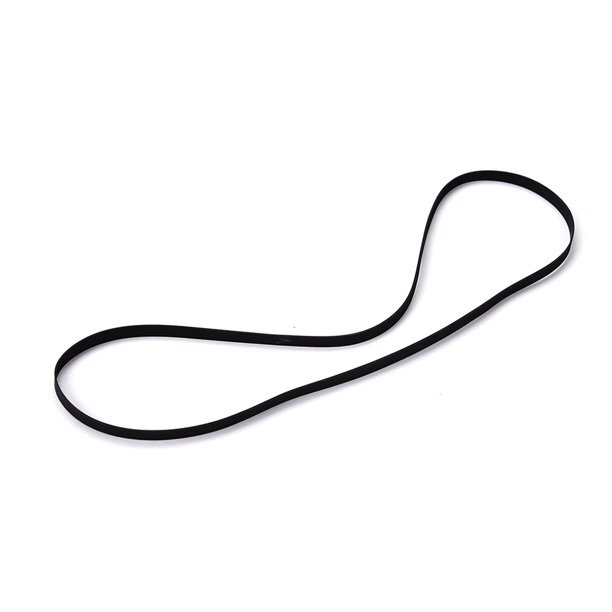
| Replacement belt reference | FR1950A |
Key Features
Floating Chassis & Vibration Isolation
The PS-2350’s most distinctive engineering choice is its floating chassis. The main assembly is suspended on springs, decoupling it from the base and external vibrations. This wasn’t common in mid-tier turntables of the era, and it shows Sony’s commitment to performance across their lineup. The support section is further damped with a rubber-like material, and the precision pivot bearing is isolated to increase sensitivity. Combined with the height-adjustable insulator feet, this design makes the PS-2350 surprisingly resilient to floor-borne noise—something owners still praise today.
Motor & Drive System
Despite being belt-driven, the PS-2350 doesn’t sacrifice speed stability. The 4-pole synchronous motor was developed specifically for this turntable and features FG (frequency generator) servo control, which helps maintain consistent rotation. It’s paired with a high-precision urethane belt, polished on both sides to reduce slippage and wear. The belt reference is FR1950A, still available today for around $8.78, which is good news for longevity. The motor runs quietly, and with rumble measured at -78dB (DIN B), it stays out of the way of the music.
Tonearm & Cartridge System
The VL-32G tonearm is a static-balance, S-shaped design with a gimbal suspension system—smooth and stable, if not quite as refined as the best linear-tracking arms of the time. It includes both a lateral balancer and an inside four-scan seller (likely a typo or mistranslation; possibly referring to internal counterweight or anti-skate mechanism). The effective length is 216.5mm, with an overhang of 16.5mm, and it uses the SH-135 headshell (7.5g). The original XL-15 MM cartridge has a compliance of 10x10⁻⁶ cm/dyne and a frequency response of 10 Hz to 30 kHz—respectable for its time. However, as one owner noted, the tracking force can affect tonality; running too light (within the 1.5g–2.5g range) may introduce edginess in vocals, especially on bright pressings.
Auto Functions & User Experience
The PS-2350 includes auto-return and auto-cut, convenient features that were becoming standard in mid-to-high-end turntables by the mid-70s. The pitch control offers ±6% adjustment, useful for DJs or those matching tempos, and the output cable is a low-capacity type to minimize high-frequency loss—another small but thoughtful detail. The power draw is modest at 8W, and it runs on 100VAC, making it suited for Japanese mains without modification.
Historical Context
The PS-2350 was positioned as a step-up model from the popular PS-2250 and PS-2251, placing it in Sony’s mid-range turntable lineup during the late 1970s. It arrived at a time when belt-drive designs were gaining favor for their isolation advantages over direct-drive, even as Sony itself was pioneering the latter with its later PS-F series. This model reflects a transitional moment—Sony applying high-end engineering to a more accessible product, emphasizing precision, low noise, and reliability over flash. There’s no record of direct competitors named in the sources, but it competed in spirit with offerings from Technics, Pioneer, and Yamaha in the same performance bracket.
Collectibility & Value
The PS-2350 trades at a wide range of prices depending on condition and completeness. A new-in-box unit with warranty sold for €59 on March 19, 2026, while another fetched €130 on Kleinanzeigen just weeks earlier. A fully serviced example sold on eBay in March 2023 for $450—a premium price, but reflective of what a well-maintained, fully restored unit can command. More commonly, working units appear in the €50–€150 range, with higher prices likely for those with original cartridges and intact suspension.
The original Sony cartridge is often missing or in need of a new stylus. Replacement styli like the 662-DS ($28.30) or DCA-10143 ($38.06) are available, but owners should verify compatibility. The most common maintenance task is belt replacement—the FR1950A belt is still in production and inexpensive. Technicians note that the suspension springs can sag over time, requiring adjustment, and the pitch control slider pots often need cleaning with DeoxIT to restore smooth operation. “Electrification NG” (poor grounding or static issues) has been reported on used units, so checking the grounding path is wise.
While not a rare unicorn, the PS-2350 is a sleeper hit among Sony collectors—overengineered, reliable, and sonically competent. It’s the kind of turntable that, if treated well, can still deliver a satisfying analog experience nearly 50 years later.
eBay Listings


As an eBay Partner, we earn from qualifying purchases. This helps support our independent vintage technology research.
Related Models
- Sony ps-5550 (1978-1980)
- Sony ps-lx5r (1983-1985)
- Sony ss-7220a (1970s)
- Sony ss-97 (Late 1970s (approximately 1977-1979))
- Sony ss-999 (Late 1970s (approximately 1977-1979))
- Sony st-j88 (1986-1988)
- Kenwood kl-888s (Late 1970s (approximately 1978-1980))
- Sansui sax-200 (Late 1970s)
- Sansui sax-600 (Late 1970s)
- Sansui sr-222 (1973-1975)