Sony ps-2300 (1972-1974)
It spins up in half a rotation and stays dead quiet—this is Sony’s forgotten high-end belt-drive statement from the early '70s.
Overview
The Sony PS-2300 isn’t the turntable you’d expect from a company better known for compact electronics and flashier direct-drive systems. But in 1971, Sony made a quiet play for audiophile credibility with this belt-drive, walnut-clad heavyweight—positioned as a high-end, no-compromise turntable aimed squarely at the best from Technics, Denon, and Micro Seiki. It’s a machine built with obsessive attention to rotational stability and mechanical isolation, using a 4-pole hysteresis synchronous motor developed specifically for this deck, driving a 31 cm aluminum die-cast platter through a precision polyurethane belt. Owners report it delivers a dead-quiet background, rock-solid speed, and a level of engineering integrity that feels more Swiss than Japanese. At 7.2 kg and housed in a massive, non-resonant chassis, it doesn’t rattle or ring—it just rotates. And it does so within 0.07% WRMS wow and flutter, a number that still raises eyebrows today. This was Sony’s Professional Series flagship before the Biotracer line took over, and it shows: every spec is tightened, every tolerance minimized.
But here’s the catch: you’re not going to stumble on a working PS-2300 at a garage sale for $50. Most units showing up in the wild are parts donors, untested, or missing the original IM-type cartridge—which, when present, is often damaged or worn. The shell is international standard (SH-120), so it’s replaceable, but the original cartridge’s 5mV output, 10×10⁻⁶ cm/dyne compliance, and 0.5 mil diamond stylus were tuned to this arm’s geometry. The straight, low-mass, dynamically balanced tonearm—245mm effective length, 14mm overhang, 20°40' offset—was newly developed for this model and includes a lifter, a small luxury that speaks to its intended use. It’s statically balanced, with needle pressure adjustable from 0 to 3g in 0.1g increments, and designed to handle cartridges between 4g and 13g (with the CW-50 auxiliary weight needed for heavier loads). Everything about it says “engineered,” not “marketed.”
Specifications
| Manufacturer | Sony |
| Turntable/Platter | 31 cm aluminum die cast, 1.5 kg |
| Motor | 4-pole hysteresis synchronous motor |
| Drive system | Belt drive |
| Number of revolutions/Speeds | 33 1/3, 45 rpm |
| Start-up characteristic | Within 1/2 Rotation (33 1/3rpm) |
| Wow flutter | Within 0.07% WRMS |
| Signal-to-noise ratio/Rumble | 48 dB or more |
| Tone arm | Static balanced universal tone arm |
| Tone arm type | straight |
| Effective length | 245mm |
| Total Length | 336mm |
| Overhang | 14mm |
| Tracking error angle | + 2 ゜ 16', -1 ゜ 12' |
| Offset Angle | 20 ° 40' |
| Needle pressure adjustment range | 0 ~ 3g (0.1g scale) |
| Shell Weight | 10.5g |
| Usable cartridge weight | 4g ~ 13g (CW-50 is used for 13g or more) |
| Cartridge | IM Type |
| Frequency characteristic | 15 Hz to 22 kHz |
| Separation | 25dB(1kHz) 23dB(10kHz) |
| Output voltage | 5mV |
| Load impedance | 50k Ω |
| Compliance | 10x10 -6 cm/dyne |
| Vertical tracking angle | 15 ° |
| Needle pressure (optimum needle pressure) | 1.5g ~ 3g (2g) |
| Needle | 0.5 mil diamond needle |
| Dead weight | 6.5g |
| Power supply voltage | 100 VAC, 50Hz/60Hz |
| Power consumption | 9W |
| External dimensions | Width 490x Height 180x Depth 395 mm |
| Weight | 7.2kg |
Key Features
The Platter and Drive System
At the heart of the PS-2300 is its 31 cm aluminum die-cast platter, weighing in at 1.5 kg—substantial for a belt-drive deck of its era. It’s not a peripheral weight design or a sandwich construction, but a single, dense casting meant to smooth out speed variations through pure inertia. The 4-pole hysteresis synchronous motor, developed specifically for this turntable, delivers rock-steady rotation locked to the 50/60 Hz line frequency. It’s not quartz-locked—there’s no evidence of that in the specs—and it’s definitely not direct-drive, despite some eBay listings claiming otherwise. The drive is via a highly accurate polyurethane belt, which Sony engineered to minimize stretch and slippage. The result? The platter reaches full speed in just half a rotation at 33 1/3 rpm, a feat that speaks to both motor torque and belt grip.
The Tonearm: Precision Geometry
Sony didn’t just slap on an off-the-shelf arm. The PS-2300 uses a newly developed static-balanced universal tonearm with a straight tube design, emphasizing low mass and rigidity. At 245mm effective length and 336mm total length, it’s a medium-arm by modern standards, but its geometry is tightly controlled: overhang at 14mm, offset angle at 20°40', and tracking error kept to +2°16' at the outer groove and -1°12' at the inner. The arm includes a lifter—a small but meaningful convenience for repeated use—and the headshell is international standard, so swapping cartridges isn’t a chore. The needle pressure adjusts from 0 to 3g in precise 0.1g increments, and the arm can handle cartridges from 4g to 13g. For anything heavier, Sony offered the CW-50 auxiliary weight (¥600 at the time). The tonearm’s bearings, while robust, are now 50+ years old—owners report they often need cleaning and re-lubrication to restore smooth tracking.
Cartridge and Sound
The PS-2300 shipped with an IM-type cartridge, a moving magnet design featuring a 0.5 mil diamond stylus, 5mV output, and 50kΩ load impedance. Its frequency response spans 15 Hz to 22 kHz, with channel separation of 25dB at 1kHz and 23dB at 10kHz—respectable for the time. The compliance is 10×10⁻⁶ cm/dyne, placing it in the medium range, well-matched to the arm’s effective mass. The optimum tracking force sits between 1.5g and 3g, with 2g recommended. The cartridge’s dead weight is 6.5g, and the shell weighs 10.5g. If the stylus wears out, the ND-126G replacement costs ¥2,000 (original price). But here’s the reality: the original cartridge is often missing. When it’s there, it’s usually worn. And because it’s an IM-type with no documented modern equivalent, sourcing a direct replacement is tricky. Many owners opt for modern MM cartridges in the same compliance and weight range, tuning the setup carefully.
Chassis and Aesthetics
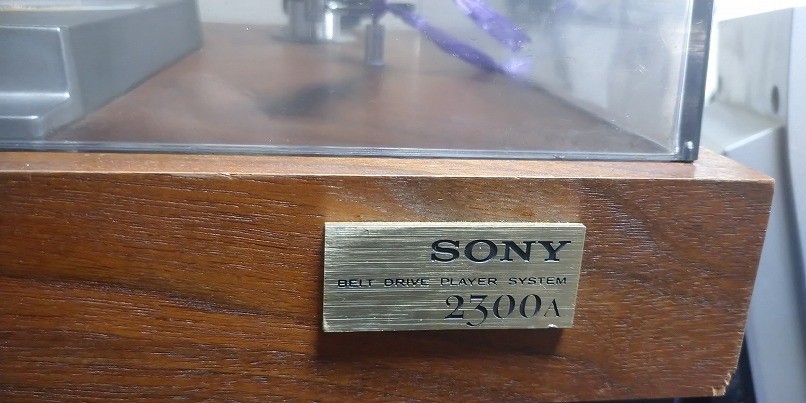
The PS-2300 doesn’t shout. It’s finished in walnut, a warm, understated veneer that grounds it in the high-fidelity tradition of the early '70s. The chassis is described as “massive, non-resonant”—a claim backed by its 7.2kg weight and rigid construction. The semi-transparent acrylic dust cover is a standout: it uses a fleece-lined top that allows it to stop at any position when opened, eliminating the clatter of hard stops. The 45 rpm adapter was sold separately, a common cost-saving move at the time. Everything about the build says “serious tool,” not lifestyle accessory. This was a turntable for people who cared about specs, not showroom sparkle.
Historical Context
The PS-2300 was introduced in 1971 as part of Sony’s Professional Series turntables, serving as the flagship model before the Biotracer series emerged. It was designed during a period when belt-drive decks were still the gold standard for audiophiles, even as direct-drive technology began to rise. Sony positioned it as a no-compromise machine, built to compete with elite offerings from Technics, Denon, and Micro Seiki—brands synonymous with precision and performance. Unlike Sony’s later direct-drive turntables, which prioritized convenience and speed accuracy for DJs and broadcasters, the PS-2300 was a purist’s machine: belt-driven, mechanically isolated, and acoustically inert. It reflected a moment when Sony was still proving itself in the high-end audio space, not just the consumer electronics market.
Collectibility & Value
Finding a fully functional Sony PS-2300 today is rare. Most units on the market are untested, missing parts, or sold as “junk” for parts recovery. The original cartridge is frequently damaged or absent, and the tonearm bearings often need servicing after decades of dormancy. However, replacement parts do exist: the drive belt (FR1920A) is available for $8.78 USD from specialty vendors like DaCapo Audio, and the SH-120 replacement shell and ND-126G stylus are documented (though sourcing them may require hunting). Individual components—like the 35g tonearm weight base (¥1,800 in 2024) or a dust cover hinge (¥2,800)—can fetch surprising prices from restorers. In good, working condition, the full unit typically sells for $800–$1,200, though many auction listings are for incomplete or unverified units, some going for as little as ¥1,100. It’s not a turntable you buy on impulse—it’s one you restore with purpose.
eBay Listings


As an eBay Partner, we earn from qualifying purchases. This helps support our independent vintage technology research.
Related Models
- Sony ps-5550 (1978-1980)
- Sony ps-lx5r (1983-1985)
- Sony ss-7220a (1970s)
- Sony ss-97 (Late 1970s (approximately 1977-1979))
- Sony ss-999 (Late 1970s (approximately 1977-1979))
- Sony st-j88 (1986-1988)
- Kenwood kl-888s (Late 1970s (approximately 1978-1980))
- Sansui sax-200 (Late 1970s)
- Sansui sax-600 (Late 1970s)
- Sansui sr-222 (1973-1975)