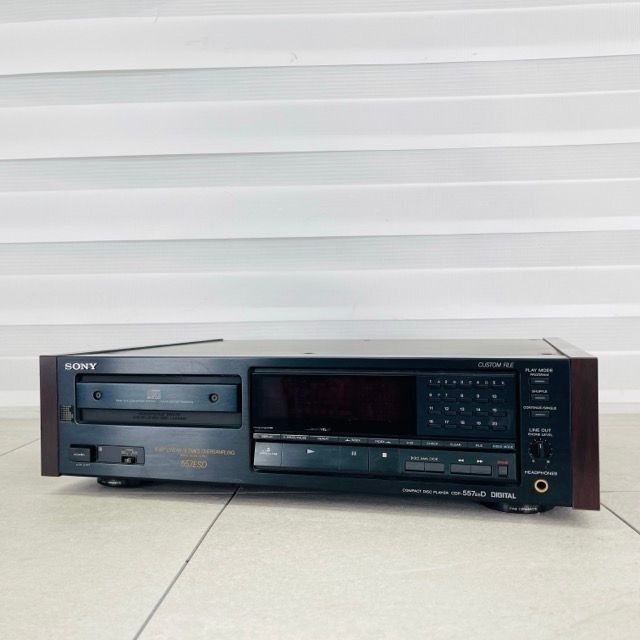
Sony CDP-557ESD (1987–1988)
The CDP-557ESD was Sony's flagship CD player of 1987. It was the original "7" series player, sold in the US as the CDP-707ESD, and it is one of the most lavishly built machines of its era. Hi-Fi News (1987) reported that Sony shocked the market with this new flagship, said to offer 18-bit/8x oversampling at a time when such specifications were unheard of. It listed at ¥180,000 in Japan ($1,800 in the US by 1988), and production ran from June 1987 to November 1988.
The build is where the 557ESD gets interesting. At center stage sits the first version of the BU-1 aluminum die-cast base. It is a transport assembly known to be of the "almost everlasting" kind, with owners reporting the laser, servos, and motor easily exceeding twenty years of life. The BU-1 holds the main motor, the laser's linear motor with its two magnetic rails, and the legendary KSS-190A pickup. The whole assembly rests on a Gibraltar sub-base, a material made of calcium carbonate (same composition as marble), glass fiber, and resin. That sub-base is bonded to double-layered, copper-plated steel plates. Two separate power transformers feed fourteen independent power supplies, with premium Elna Duorex and Elna For Audio capacitors throughout. The digital-to-analog conversion uses two Burr-Brown PCM64P chips (18-bit resolution) teamed with Sony's CXD1144A, the industry's very first 8fs digital filter.
The feature set was ambitious for 1987. The player offered both coaxial (75 ohm) and TOSLINK optical digital outputs. It was the only player in that year's Sony range to provide both, since the lesser models had just optical. Hi-Fi News noted this distinction specifically. There were fixed and variable analog outputs (2 V RMS fixed, 0-2 V RMS variable), a motor-driven volume control operable from the included wireless remote, and a "Custom File" system that could store up to 226 titles of disc information. That included ten-character disc memos, up to six custom index points per disc, and twenty program banks, all retained by memory backup when power was off. The front panel carried an alphanumeric display, and the loading tray was "acoustically sealed" with a rubber band sandwiched between the drawer's front and the sub front-plate.
The 557ESD also introduced what Sony called S Servo II. It was an improved version of their predictive error-correction servo, which could anticipate read errors caused by scratches or dirt and correct them before they happened. Prediction time accuracy improved from 1/8,000 to 1/10,000 of a second. Error Prediction Logic II and a Servo Stabilizer II were part of the package, along with GIC low-pass filters (one per channel) and FET-charged analog outputs. The chassis was divided into two parts, mechanical/power and circuit, separated by a copper-plated internal chassis, with openings sealed in special resin. Ceramic-powder feet and ceramic-damped D/A chips handled resonance control.
Unlike all later X7-series players, the 557ESD has no balanced outputs. Those arrived with the next generation, the CDP-X7ESD. The 557ESD instead became the development basis for Sony's reference CDP-R1 and DAS-R1 combo, launched a few months later. It weighed 18 kg (nearly 40 lbs). It was all metal, with double steel plates, an extruded 4mm front plate, and copper plating everywhere, including the screws.
Measured performance was outstanding for the era. Frequency response was 2 Hz - 20 kHz (±0.3 dB per The Vintage Knob, though the service manual cites ±0.5 dB). S/N ratio was 115 dB (EIAJ), dynamic range 100 dB, stereo separation 110 dB, THD 0.0015%, and wow and flutter 0.001% (weighted, peak). Power consumption was 18 W. Dimensions were 47 × 12.5 × 37.5 cm. The European model required 220 V AC (or 240 V adjustable by Sony personnel), 50/60 Hz.
As one enthusiast site put it, a CDP-557ESD built today would cost five or six times what it cost in 1987 — nobody can afford to build like that anymore. The BU-1 transport was reused in the next four models of the X7 series, and the chassis set the main layout for all of them. It remains a benchmark of Japanese high-end audio at its most lavish, before the stock-market crashes of the late 1980s changed what manufacturers could justify building.
eBay Listings



As an eBay Partner, we earn from qualifying purchases. This helps support our independent vintage technology research.