Accuphase DP-70V (1990)
Front-loading CD player with discrete 20-bit D/A conversion and fully separated digital/analog circuitry, released in November 1990.
Overview
The Accuphase DP-70V is a high-end front-loading compact disc player from Accuphase Laboratory, Inc. It came out in November 1990 as the successor to the DP-70. It was positioned as a state-of-the-art player, with advanced digital-to-analog conversion and isolation between the digital and analog sections. It also works as a digital control center, with multiple digital inputs and outputs, and its design uses technology from the separate transport/processor combination DP-80L/DC-81L. It was made in two versions, likely differing in laser pickup - either the Sony KSS-190A or the KSS-281A with integrated RF amplifier.
Specifications
| Product type | Front-loading Compact Disc Player |
| Disc format | CD |
| Number of channels | 2 |
| Rotation speed | 500 ~ 200 rpm (CLV) |
| Performance speed | constant 1.2 ~ 1.4m/s |
| Reading system | Non-contact optical reading (using semiconductor laser) |
| Laser | GaAlAs (double hetero diode) |
| Transport mechanism | Sony KSS-190A with BU-1C/D laser head combo |
| Digital Outputs | coaxial (0.5Vp-p/75 Ω), optical (660 nm, -21 to -15dBm) |
| Digital Inputs | coaxial (0.5Vp-p/75 Ω), optical (received power -15dBm to -27dBm) |
| Quantization | 16-bit linear |
| Sampling frequencies | 32.0 kHz ± 0.1%, 44.1 kHz ± 0.1%, 48.0 kHz ± 0.1% |
| Frequency response | 4.0 Hz to 20 kHz ± 0.3 dB |
| D/A converter | Discrete 20-bit, 8x oversampling |
| Digital filter | Independent 20-bit 8x oversampling per channel; attenuation -110 dB (24.1 kHz to 328.7 kHz) |
| Total harmonic distortion + noise | 0.0016% (1kHz), 0.002% (20 Hz to 20 kHz) |
| Signal-to-Noise Ratio | 119 dB |
| Dynamic range | 98 dB |
| Channel separation | 109 dB |
| Line output (unbalanced) | 2.5V / 50 ohm (RCA) |
| Line output (balanced) | 2.5V / 50 Ω (XLR) |
| Output level control | 0 to -40 dB, 1 dB step (digital) |
| Semiconductors | IC: 74, Transistor: 32, Diode: 66 |
| Power supply | 100V/117V/220V/240V, 50Hz/60Hz |
| Power consumption | 23 W |
| External dimensions (W x H x D) | 475 x 135 x 389 mm |
| Weight | 24.3 kg |
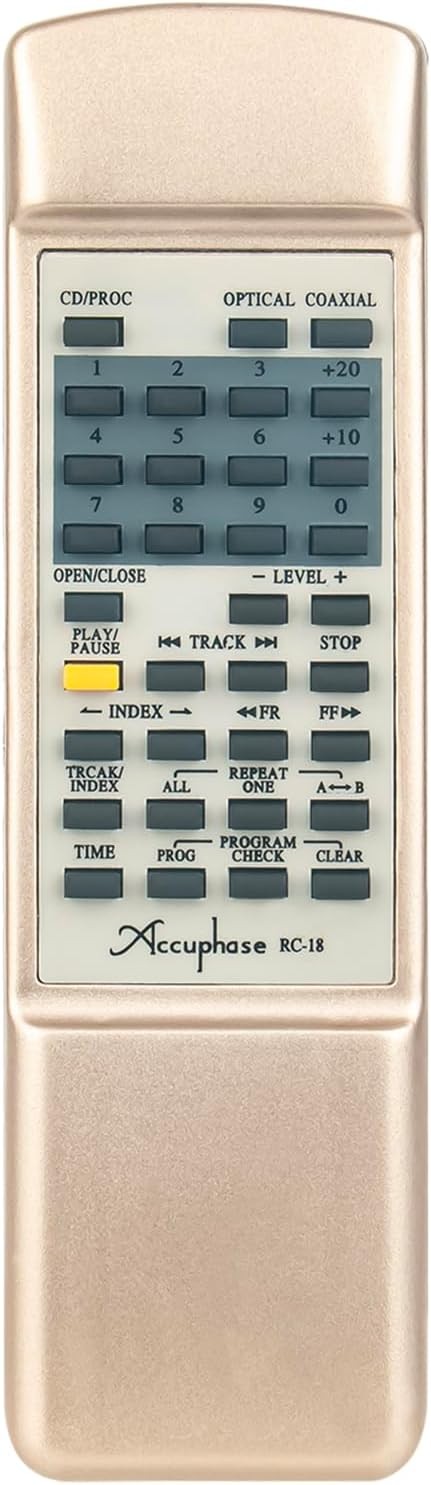
| Remote control | RC-7 (infrared, DC 3V, 2x R6 batteries), dimensions 64 x 176 x 18 mm, weight 180g (with batteries) |
Design
The DP-70V uses a discrete, current-addition type 20-bit D/A converter for high linearity. Each channel gets its own 20-bit 8x oversampling digital filter. Digital and analog circuits are isolated with ultra-high speed opto-couplers (40Mbit/sec, 4 per channel). The digital and analog sections have separate power transformers, and the analog transformer has independent windings per channel. The audio low-pass filter is a 3rd order GIC Butterworth active filter. The transport sits on an aluminum die-cast frame that floats from the chassis, and the disk table floats too. A linear motor tracking system is run by an 8-bit microprocessor. The front panel shows only a few controls - Play, Track Search, Pause - and the rest are behind a flip-down panel. The chassis uses a sturdy frame with brass legs for resonance control, a gold-colored metal front, and wood side panels. The display uses blue LEDs. The servo board has no potentiometers, but three 2.2kΩ trimmers on the pickup may drift over time.
Context
The DP-70V sits chronologically between the Accuphase DP-70 (1987) and the DP-75V (1999). It was marketed as a state-of-the-art player in its era and is often compared favorably to contemporaries like the Sony CDP-X7ESD and Marantz CD-7. Accuphase Laboratory, Inc. was founded in 1972 by former Kenwood engineer Jiro Kasuga.
Market
The original retail price was ¥480,000 (approximately USD 10,000 at period exchange rates). As of 2017, mint-condition units were valued between €1500 and €2000. Common problems are aging or failure of the laser pickup and drift in the trimmer potentiometers on the pickup. Maintenance typically means cleaning the lens, greasing the guides, and possibly replacing the pickup trimmers. Original spare parts are getting scarce, and the service manual is not widely available.
eBay Listings



As an eBay Partner, we earn from qualifying purchases. This helps support our independent vintage technology research.
Service Manuals, Schematics & Catalogs
- Catalog (1991) — archive.org
- Catalog (1992) — archive.org
- Catalog (1990) — archive.org