Sony APM-33W (1982)
They don’t sound like anything else from the early '80s — rigid, flat, and freakishly precise, like sound etched in metal.
Overview
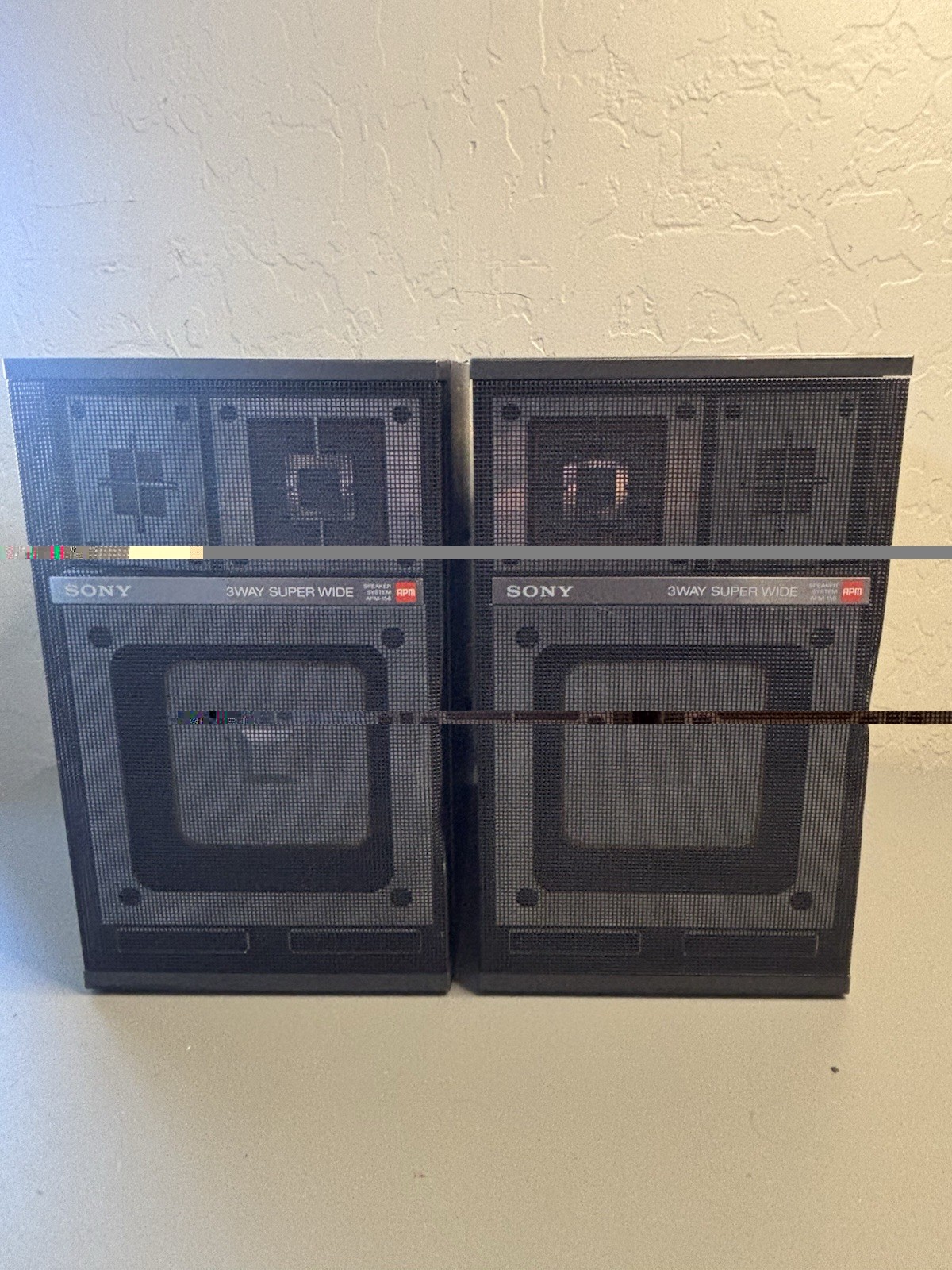
Let’s clear the air right up front: there’s no such thing as a “Sony APM-3.” That’s a myth born from typo-riddled search results and forum shorthand. The real deal is the Sony APM-33W Loudspeaker System, a bookshelf-sized anomaly from 1982 that looks like it was designed by aerospace engineers who moonlighted in audio. This isn’t your warm, forgiving vintage speaker — it’s a clinical, high-precision instrument built to keep up with the digital revolution Sony was leading at the time. And yes, it weighs 14.4kg for a reason.
Priced at ¥55,000 per unit when new, the APM-33W wasn’t cheap, but it wasn’t the flagship either. It sat within Sony’s ES (Elevated Standard) series, a family of gear meant to showcase their most advanced engineering. These speakers were built to match the ultra-clean output of Sony’s own PCM digital recorders, early Compact Disc players, and Beta HiFi VCRs — formats that demanded transparency, not coloration. The idea was simple: if your source is capturing or playing back every micro-detail, your speakers better not smear it. And the APM-33W, with its flat diaphragms and honeycomb construction, was engineered to do just that.
Owners report a sound that’s “clean, uncolored, and highly musical” — but don’t mistake that for soft or romantic. This is a speaker that tells you exactly what’s on the tape, warts and all. It’s not trying to flatter poorly recorded tracks; it’s built for the ones that were engineered with care. And while it’s technically a bookshelf speaker, it’s a heavy, dense one — more like a piece of lab equipment than something you casually place on a shelf. The build screams intent: this was never about aesthetics. It was about accuracy.
Specifications
| Manufacturer | Sony |
| Model | APM-33W |
| Product type | 3-Way Loudspeaker System |
| Production years | 1982 |
| Dimensions | 315 x 540 x 320mm (W x H x D) |
| Weight | 14.4kg |
| Playback frequency band | 39 Hz to 20000 Hz |
| Output sound pressure level | 91dB/W/m |
| Impedance | 6 Ω |
| Instantaneous maximum input | 160W |
| Rated maximum input | 80W |
| Crossover frequency | 2.2kHz |
| Level control | + 0 to -50dB continuously variable |
| Low band unit | 324 cm^2 Plane type |
| High band unit | 16 cm^2 Plane type |
| Enclosure Type | Bass Reflex |
Key Features
The Flat Diaphragm Revolution
Sony didn’t just tweak the cone — they threw it out. The APM-33W uses a flat diaphragm for both the woofer and tweeter, a radical departure from the domes and cones everyone else was using. Why? Because traditional cones create a “cavity effect” — trapped air resonance that muddies the sound. Sony’s solution was a square, flat diaphragm made from a honeycomb sandwich structure: an aluminum honeycomb core with aluminum foil skins, the same kind of material used in aircraft and Shinkansen trains. The result? Bending rigidity that’s 500 to 1000 times greater than a conventional cone, with deformation reduced to just 1/20 to 1/30 in real-world use.
The square shape isn’t just for looks — it simplifies the vibration pattern compared to a circle, making it easier to control. And to keep that flat surface moving as a single piston, Sony drove the woofer at four points — “milestones” where low-order vibrations naturally cancel out. Four armatures connect directly to the voice coil, eliminating split vibration across the diaphragm. The tweeter uses the same honeycomb structure, driven at a single point chosen to cancel unwanted resonance. This is what “Accurate Pistonic Motion” actually means: not just forward movement, but coherent, undistorted motion across the entire surface.
Crossover and Cabinet Engineering
The network inside isn’t an afterthought. Sony used oxygen-free copper for the internal wiring — a premium choice even today — and paired multiple high-quality capacitors in parallel to preserve signal integrity. Air-core coils ensure minimal magnetic distortion. This isn’t just a crossover; it’s a filter built with the same care as the drivers.
The cabinet itself is over-engineered in the best way. The back plate features fine grooves on both the inner surface and outer edges to dampen vibrations that could color the sound. Inside, three different types of sound-absorbing materials are placed strategically to control internal reflections without killing dynamics. It’s a bass reflex design, so there’s a port, but the focus is on tight, controlled low end — not boom. And yes, there’s a continuously variable level control ranging from +0 to -50dB, letting you fine-tune the tweeter output to your room or preference.
Optional Stand and System Integration
Sony sold a matching stand, the WS-300, for ¥6,000 per pair. At 295 x 140 x 290mm and weighing about 3kg, it’s compact but sturdy, designed to get the speakers to ear level without wobbling. These stands are rare now, but when found, they complete the look — a rare case where the factory stand actually matches the speaker’s industrial aesthetic.
The APM-33W was meant to be part of a larger ES ecosystem. It wasn’t a standalone curiosity; it was a component in a high-end system built around digital sources. That context matters — these speakers weren’t trying to compensate for analog tape hiss or vinyl warble. They were built for the future, and that future was digital.
Historical Context
The APM-33W arrived in 1982, right as Sony was pushing the boundaries of digital audio. The Compact Disc had just launched, PCM recorders were being used in professional studios, and Beta HiFi was bringing high-fidelity sound to home video. The APM series, including the APM-33W, was Sony’s answer to the need for speakers that could handle the wide dynamic range and extended frequency response of these new formats.
It drew directly from the know-how of the APM-6Monitor, a larger studio-grade speaker that first introduced the flat diaphragm concept. The APM-33W wasn’t a downsized version, but it carried the same DNA: rigid materials, multi-point drive, and a no-compromise approach to piston-like motion. It was part of a broader APM (Accurate Pistonic Motion) loudspeaker series that represented Sony’s most ambitious speaker engineering of the early '80s.
There’s a conflicting claim that Japanese and export versions of the APM-33W used different crossover filters — one optimized for HiFi, the other for “flattering” electronic music. But no definitive evidence confirms this, and the official specs don’t differentiate. Until more data emerges, it’s best to treat the APM-33W as a single, consistent design built for accuracy first.
Collectibility & Value
The APM-33W is a cult favorite among Sony ES collectors and analog-digital crossover enthusiasts. As of mid-2023, a pair in working condition trades for about $350–$400 in the U.S., with one mint set including stands listed for $350 CAD. In 2018, a used pair sold for €350 on Audio Kontakt — prices have held steady, not skyrocketed.
The biggest threat to longevity? The surrounds. Owners warn they must be “perfect, no evidence of falling apart.” If they degrade, there’s no commercial refoam kit — only DIY solutions or specialists like Sound Oddity, who’ve reverse-engineered custom fabric surrounds for APM series drivers, including the APM-33W. One Reddit user reported needing to brace the cabinet’s back panel to stop rattling, suggesting that while the drivers are advanced, the enclosure, while well-damped, can still flex under load.
These aren’t easy speakers to service, but for those who value their unique engineering and clinical clarity, they’re worth the effort. Just don’t expect warm, forgiving sound — or light lifting.
eBay Listings



As an eBay Partner, we earn from qualifying purchases. This helps support our independent vintage technology research.
Related Models
- Sony ps-5550 (1978-1980)
- Sony ps-lx5r (1983-1985)
- Sony ss-7220a (1970s)
- Sony ss-97 (Late 1970s (approximately 1977-1979))
- Sony ss-999 (Late 1970s (approximately 1977-1979))
- Sony st-j88 (1986-1988)
- Kenwood kl-888s (Late 1970s (approximately 1978-1980))
- Sansui sax-200 (Late 1970s)
- Sansui sax-600 (Late 1970s)
- Sansui sr-222 (1973-1975)